Election 2026.
REC determined the final number of voters in the elections
The Republic Election Commission (REC) made a decision today on determining the final number of voters in Serbia
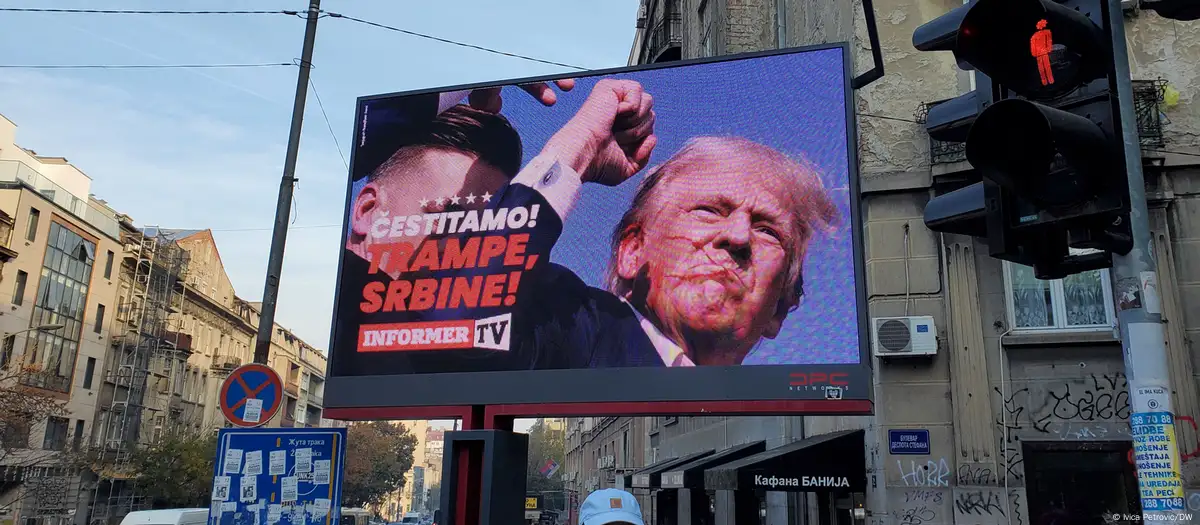 Photo: Ivica Petrovic/DW
Serbs, like few European nations, are delighted that Donald Trump will be back in the White House in a few days. Aleksandar Vučić is also looking forward to it, who hopes that he will now get all those annoying advocates of liberal democracy off their backs.
"A new era of relations between Serbia and the USA!" The Serbian press greeted the news of Fr election of Donald Trump for president of the United States last year, writes Deutsche Welle (DW).
The President of Serbia, Aleksandar Vučić, said via Instagram that in a telephone conversation with President-elect Trump, he emphasized that Serbia was the country where Trump's support was the highest in all of Europe.
"I am sure that we will make America great, and that we will be able to make Serbia a decent country and a country that will be able to cooperate very well with the USA," said Vučić.
Only ten days before the inauguration, US Deputy Secretary of State Richard Verma will arrive in Serbia this weekend with the aim of starting a strategic dialogue between Serbia and the US and thus raising the relationship to a higher level.
"When America establishes a strategic dialogue with a country, it means that it sees it as a reliable partner and ally," Vuk Velebit from the organization Pupin Initiative, which works to strengthen relations between Serbia and the USA, assessed for DW.
"Until now, Serbia has had strategic agreements with China, Russia and, of course, a special relationship with the European Union. And the fourth pillar of foreign policy is America, and by signing this strategic dialogue, Serbia will also achieve this with Washington. This means that relations with China and Russia, but their influence will be balanced by a special relationship with America," explains Velebit.
Cooperation or sanctions?
According to the announcements, strategic cooperation would first be focused on the areas of economy, energy and security.
However, it comes at a time when President Vučić announced that he received information that the US will impose sanctions on the Oil Industry of Serbia (NIS), whose majority ownership is in the hands of a Russian state company.
"It puts us in a very difficult position because after some time, not only for the supply of oil, we have problems with the refinery, petrochemicals, essentially the survival of the economy we have today," said Vučić.
In his last statement on this matter, he said that Belgrade has until February 25 for the Russians to completely exit the ownership of NIS. Sanctions were finally confirmed by the US Ministry of Finance.

That's how speculation ended, whether the announcement of sanctions might just be Vučić's smokescreen. It's not. To DW's interlocutors, it looks like a good opportunity for the authorities in Belgrade to push for a change in the ownership of NIS.
"I think that on the Serbian side there is a desire to correct the harmful sale of NIS, which was sold below the market price, which made us completely dependent on Russia in the energy sector," says Velebit.
"It is not good to be dependent on any partner, and it is extremely important for Serbia to regain control, but also to diversify the energy sector." The USA and American companies could be a reliable partner there," says Velebit.
Such a scenario fully corresponds to the aspirations of the American administration, whose focus was precisely the energy diversification of the region and moving away from Russia.
"Let's not forget that the Washington Agreement that Trump signed with Vučić in 2020 also had provisions on this," reminds Vuksanović.
High expectations from the new administration
The euphoria regarding the return of Trump to the head of the USA can be seen mostly in the pro-government tabloids, which on the front pages announce the great dismantling of globalism.
President Aleksandar Vučić also agrees with them, saying that he believes in Donald Trump and calling him the leader of the era.
"Donald Trump is preparing 200 acts, which he will adopt on the first or second day after coming to power." When he brings it, the whole system of the fake liberal world that existed, in which there were their servants who are worthy and good, and all these others are evil and bad, will collapse," said Vučić.
But, apart from the "fight against the globalists" that makes Serbian officials happy, with the return of the Republicans, the hope that the USA could be more favorable to Serbia in the dialogue process with Kosovo is growing.

"The Serbian government certainly does not believe that the Trump administration will change its attitude towards Kosovo, but it believes that on issues such as the economic position of the Serbs in the north of Kosovo and the protection of monuments and religious buildings in Kosovo, they could get a better deal with the Trump administration." explains Vuksanović.
"But now the key problem is whether that capital will actually be spent on something else - on trying to secure the Trump administration's support for the regime at a time when it is facing the most serious problem, which is the student demonstrations," adds the DW interlocutor.
Are the hopes well founded?
Are the high expectations of Serbia justified? Analysts agree that they are partly, because relations between the USA and Serbia have been on an upward trajectory for years - from the Trump administration to the Biden administration.
"The authorities in Belgrade made three investments in partnership with the future Trump administration, namely: the relationship with Richard Grenell, the building of the General Staff and the delivery of ammunition to Israel in order to regain access to the Israeli lobby and gain access to the White House," recalls Vuksanovic.
Richard Grenell was a special envoy for negotiations between Serbia and Kosovo and a frequent guest of Belgrade. In 2023, President Vučić presented him with the Order of the Serbian Flag of the First Order for distinguished services in developing and strengthening peaceful cooperation and friendly relations between the Republic of Serbia and the USA.
In addition, Belgrade was visited by Donald Trump Jr. in September, who discussed potential investments with a group of businessmen from Serbia, and Trump's son-in-law Jared Kushner also has business ventures in Belgrade.
Serbia signed a contract with Kushner's company on the revitalization of the General Staff complex, parts of which were destroyed in the NATO bombing in 1999.
The construction of two high-rise buildings with apartments and hotels is planned on the site of the ruins, although the protection of cultural property has not been removed from that building.
The contract has not yet been published, and New York Times wrote that the investment is worth 500 million dollars and that, according to that proposal, Serbia should receive 22 percent of the profit. Serbia allegedly leased the complex's land for 99 years.
On the other hand, the signing of strategic cooperation could be a green light for American investors and an indication that Serbia is a country that is safe for investments, notes Velebit. He also points out that America is Serbia's largest trade partner in the field of IT services and believes that the new administration will be even more receptive to business cooperation.
He is convinced that the Trump administration will focus more on Eastern rather than Western Europe. "For them, curbing Russian influence will be important, but also curbing Turkish influence." And that's why America's relationship with Poland, Slovakia, Hungary and Serbia will be very important," Velebit assesses.
Does this mean that Serbia could also change its course towards the west?
"The West has always had the majority package, had more shares in Serbia and the Balkans than Russia and China. But I believe that of all Western partners for Belgrade, the United States will be the most important, as long as Trump is there. And the main tension in the relationship with Trump and the administration will come neither because of Kosovo, nor because of Russia, but because of the relationship with China," concludes Vuksanović.
The Republic Election Commission (REC) made a decision today on determining the final number of voters in Serbia

A citizen of Belgrade whose polling station in Banja Luka was changed in the voter list without his knowledge claims that the Ministry did not correct his data and that the deadlines have expired. The elections are on October 25 and he still doesn't know where he will vote.

The pardon procedure implies the appropriate role of the Minister of Justice, who should initiate the procedure or submit an opinion on the pardon, says prosecutor Radovan Lazić.
Phone numbers 064 876 85 05 and 011 2068 100 will be available 24/7 for reports and addresses to citizens, and the possibility of direct addresses at the premises of the Protector of Citizens is also provided.

NUNS demands an urgent investigation due to the threats sent to two Radar journalists who wrote about the Sky correspondence in which Aleksandar Vučić is mentioned. The association states that the threats also mention violence against children of journalists and warns of impunity

There is, literally, no difference between the one who claims it is day in the middle of the night, or the one who claims to be a giraffe, from the claims we read on billboards: that Vučić is working to unify Serbs and that Serbia is doing better and better day by day.

The pre-election arrests due to the alleged "overthrow of the state" testify to the regime's panic. The bad news for them is - they can't arrest the whole people who decided to defend themselves from progressive beatings and election theft

The ring that tightens around Ćaciland Student list is getting narrower. Because there are more and more spoiled people who see the false prophet for what he is: a street obscener who is fighting Serbia

The archive of the weekly Vreme includes all our digital editions, since the very beginning of our work. All issues can be downloaded in PDF format, by purchasing the digital edition, or you can read all available texts from the selected issue.
See all