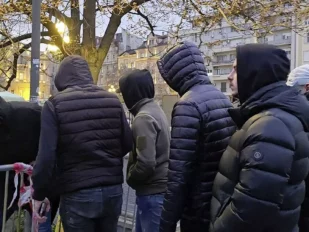
Commenting on the growing civil rebellion, the President of Serbia Aleksandar Vučić he dramatically declared that "anger is growing rapidly on the larger side of the political spectrum," and was soon joined by his party colleague Vladimir Djukanovic that with the statement that the supporters of the Serbian Progressive Party are "disgusted, they will take sticks, they will go and break them like a straw", they mean by "straw" the citizens who are protesting.
Finally, so that no one would have doubts about what these messages should mean, TV Pink host Predrag Sarapa clarified that while chatting with the guests on the way, as if they were talking about market topics, he stated that three people " who "patriots" asked where they could get weapons "to defend themselves".
Such statements are a kind of threats, creating fear, but also creating the perception that the people who are "on the larger side of the political spectrum" are angry and becoming unpredictable, which can create a justification for further repression, according to the interlocutors of "Vremen".
Encouraging progressives
Speaking about Vučić's statement, the professor of the Faculty of Political Sciences in Belgrade, Dušan Spasojević, assessed that on the one hand it was a kind of threat to the people who are in the protest, but also to those who were thinking of joining them, especially to employees in the public sector.
"It is also a kind of encouragement and a response to pressure from within, because there is certainly a part of the voters of the Serbian Progressive Party who are very dissatisfied with what is happening. Because of this, they are scared and worried, therefore they are aggressive, and they advocate some other solutions. Through that statement, Vučić tried to give them their rights somehow. We are not talking about organized attacks on students, but about people who love Vučić, vote for him and honestly think that some kind of colored revolution is happening to us," Spasojević told Vreme.
He states that there are elements of incitement to violence in Vučić's statement, and adds that everything Vučić has said from the beginning has these elements.
"When he asks why a person who drives a car and hits someone standing in front of the car should be prosecuted - it is a kind of incitement or at least giving the right to react that way," says Spasojević.
According to his opinion, in this case too, there is a constant problem when it comes to Vučić's statements.
"His first three sentences are conciliatory, and the next three are bellicose, and so on in a circle." This is his constant tactic towards all protests in recent years. There are elements of a little threat, a little incitement, a little justification and relativization of violence," says Spasojević.

Photo: Printskrin / N1Dusan Spasojevic
Đukanović is sometimes a clown, sometimes a scarecrow
When it comes to Đukanović, Spasojević points out that this SNS deputy is in charge of some kind of radicalization and amplification of what Vučić says, so that it can most often be seen in the context of provoking the opposition public.
"Djukanović always thirds, he doesn't do it independently, and in that thirding he sometimes goes too far, which is why Vučić warned him. "Simply, his role is to sometimes be a clown, and sometimes to scare the government, and he does that in his own way," says Spasojević.
Speaking about Sarapa's statement, Spasojević notes that it is a front in which "official politics say something, the tabloids say something, and Pink says something."
He adds that these actors "don't have creative freedom", but they send relatively unison messages that have their own layers.
"Not once did Đukanović post something on Ix, then they talked about it on Pink, and then Vučić made a statement about it for the mainstream media. With such a mechanism, they shape the message. Not all parts of the message are addressed to everyone, but everyone hears what they need," concludes Spaspjević.
Causing fear, insecurity and potentially violence
Psychologist and founder of the Center for Psychological Support, Psychotherapy and Education "Psiho ludens" Tamara Đorđević tells "Vreme" that the analysis of the statements of Vučić, Đukanović and Sarapa points to different psychological techniques and strategies used to shape the perception and behavior of the public.
He adds that each statement has a specific goal, but they all share a common characteristic – inciting fear, insecurity and potentially violence.
He states that in Vučić's statement we can see a tendency to create a perception in the listeners that the people who are on the larger side of the political spectrum are "angry" and are becoming unpredictable, which can create justification for further repression.
"In a psychological sense, such a statement can be an attempt to arouse a sense of fear among the general public while strengthening the legitimacy to adopt more drastic measures - from repression to violent responses." Through this statement, it is implied that if many people are angry, then it is justified, and a mass of angry people can be seen as a legitimate reaction. In essence, this is to say that this is a 'general opinion' and that others could also join, because such collective anger must be taken seriously," says Đorđević.
A warning that calls to action
She indicates that Vučić, as a representative of the authorities, uses his position of authority to contribute to the creation of feelings of fear and insecurity regarding the protests.
"He presents himself as someone who understands the 'deeper' social and political processes and makes a recommendation, or even a warning, about what might follow if the anger continues to spread." In this context, his statement acts as a warning that calls for action, but not necessarily through dialogue," says Đorđević.
She points out that Đukanović's statement clearly shows the use of language that uses images of violence, such as sticks and breaking straws, and that the statement reflects how Đukanović experiences the potential escalation of anger into physical violence.
A direct manifestation of the power of politicians
He adds that Đukanović's statement may indicate an awareness of growing discontent and that Đukanović may be trying to encourage the public perception that people are already on the edge of patience, ready to reach extreme solutions.
"In psychological terms, this is an alarming picture of collective anger." This statement is a clear threat and is a direct manifestation of the power of a politician who is trying to intimidate the people. He talks about violence as a response to protests, suggesting that the government, that is, the powerful, will be ready to 'crush' any form of resistance or opposition. "Using the image of a 'straw' as something that is easy to break has a deep psychological meaning: the goal is to reduce the severity of the protests and show that they are "weak" and easily breakable," says Đorđević.
She points out that in this context, the statement about sticks and violence shows an obvious threat, calling for violent responses from the authorities against those who oppose the regime.
Photo: Private archiveTamara Djordjevic
Tabloid communication
Đorđević points out that Sarapa's statement uses very simple language and tone, which is characteristic of tabloid, everyday communication that is not abstract and intellectual, but direct and concrete.
"Using such language is intended to create an image of concrete, serious threats and actions." "The statement is made in such a way as to immediately cause anxiety or panic - people looking for weapons for 'defense' suggests that violence is imminent, which contributes to the spread of fear among the audience," says Đorđević.
She states that in all three cases the rhetoric of fear and threat is used, which in the current context could be seen as encouraging feelings of helplessness among Protestants and confirming the dominance of the authorities.
"All three statements use different levels of language sophistication, where President Aleksandar Vučić's statement is most likely addressed to a more educated audience, while Vladimir Đukanović's statement is most likely addressed to an audience eager for action." "The statement of TV presenter Predrag Sarapa most likely targets the widest population, where such a style of speech is the most effective in attracting viewers who do not analyze the information too deeply," says Đorđević.
Displays that play on emotions and fear
She warns that the three examples show the different ways in which information can be shaped to influence an audience – from subtle and serious analytical displays, through direct calls to action, to sensational displays that play on emotion and fear.
"Psychologically speaking, the message sent through these three statements can have a dual effect on people protesting - on the one hand, it can cause feelings of fear and insecurity that could demotivate people, while on the other hand it can fuel even more anger and escalation of protests , if people feel that the only way to fight for their rights is through extreme measures. "These statements recognize strategies that use basic psychological mechanisms to shape the behavior and reactions of the people and society, with the aim of preserving control and power in the hands of those in power," Đorđević concludes.