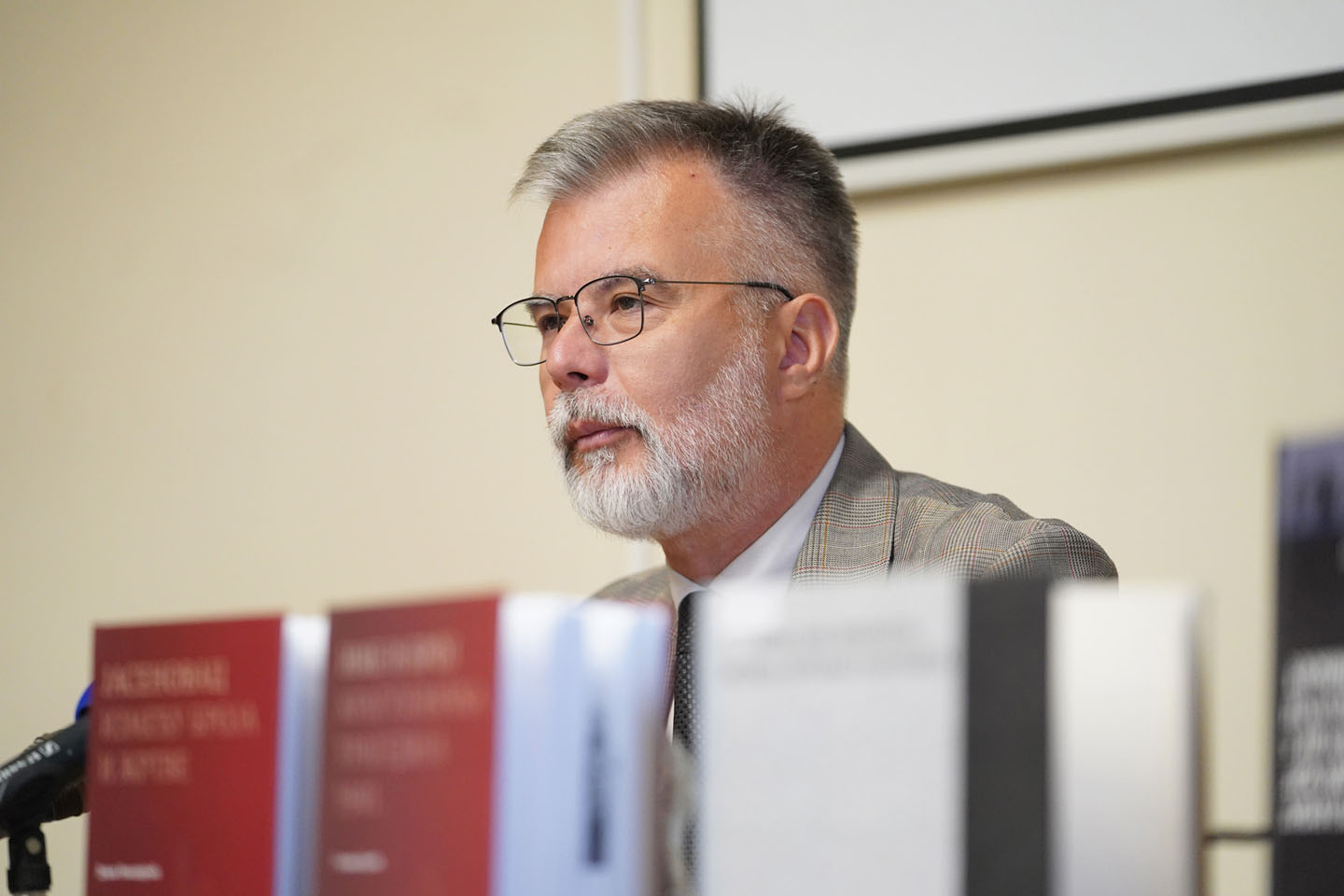
The Museum of Genocide Victims in Belgrade celebrates 30 years of existence today (Friday). It is a unique institution in Southeast Europe, a benchmark in the international scientific community. It was founded, reminds director Dejan Ristić, "for the sake of permanent remembrance of the victims of the genocide committed against Serbs on the entire territory of the NDH, the collection, processing and use of data about them and the fulfillment of obligations from the International Convention on the Prevention and Punishment of the Crime of Genocide."
Because of the war in Ukraine, the word "genocide" has become common in public discourse, and the historical experience of people from this area has also been actualized. In this context, Dejan Ristic defines genocide "as the most brutal and dramatic form of war crime that is systematically perpetrated against members of a nation" as it was "perpetrated between 1941 and 1945 against Serbs on the entire territory of the Independent State of Croatia, whose terrifying multi-decade we feel the consequences even in our time."
Ristić reminds that "during the past few decades, but also in our time, we have witnessed several attempts to abuse the term genocide which carries with it long-term very dangerous and potentially tragic consequences" and insists that it should be discussed "with a heightened awareness of the responsibility for what is said and done, to very carefully weigh the context in which the term is used genocide can use. Everything else is an (un)conscious misuse that cannot bring anyone good."
Jasenovac, the epicenter of the genocide committed against the Serbs
Ristić defines Jasenovac, for which the Museum of Victims was founded, as "the system of concentration and death camps of the NDH, the epicenter of the genocide committed against Serbs on the entire territory of that country."
"Jasenovac, as a warning to everyone and for all time, was, without any doubt, the most brutal and monstrous wasteland in all of Europe during the entire duration of the Second World War. It was a space where a true hell filled with hatred, violence and absolute destruction was embodied in the overall history of the human race, directed, first of all, towards the members of the Serbian people."
In the era of socialist Yugoslavia, says Ristić, Jasenovac "was not a taboo topic, but in relation to him, as well as to the historical phenomenon of genocide committed against Serbs on the entire territory of the NDH, there was a completely ideological taboo approach. The Serbian victims of the genocide were depersonalized through the use of names victims fascism, while their Croatian, and partly Muslim, executioners were renamed in the Yugoslav version of socialism fascists although they were not in any way. Namely, Ustasha is an autochthonous Croatian anti-civilizational, destructive, ultra-conservative and clero-nationalist movement that was joined by a part of the originally Muslim population."
Disinterested, without knowledge or compassion
If we agree that during Yugoslavia, historiography was under ideological control, says Ristić, "It remains for the Museum of Genocide Victims to analyze together with the scientific community the topics, historiographic works and scope of research in the previous thirty years."
In this context, "the knowledge that at universities in the Republic of Serbia, starting from 1945 until today, not a single doctorate on the subject of Jasenovac has been defended could be devastating for Serbian historical science and science policy makers." At the same time, I don't believe that the state prevented or hindered those researches, at least in the previous three decades."
And as far as memory is concerned: "Let's look around us for the hour and think about our relationship to the killing fields and loss sites from the period of the Second World War. In that review, like a reflection in a mirror, we will see ourselves - disinterested, devoid of basic historical knowledge and the need for compassion in relation to the innocent victims of our, as well as other nations."
The Museum of Genocide Victims is celebrating its 30th anniversary today (Friday). Genocide, a term that is used lightly today, is "the most brutal and dramatic form of war crime that is systematically perpetrated against members of a nation", which "undoubtedly was committed against Serbs during the NDH".
Read daily news, analysis, commentary and interviews at www.vreme.com