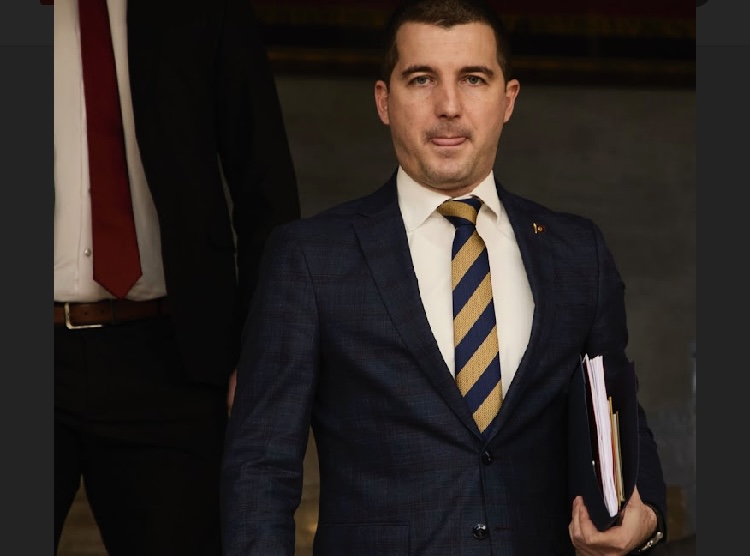
The Ministry of Foreign and European Affairs of Croatia has declared Andrija Mandić, Aleksa Bečić and Milan Knežević persons undesirable in Croatia due to "systemic actions to undermine good neighborly relations" and more
Ministry of Foreign and European Affairs Croatia sent a note to the Embassy of Montenegro in Zagreb announcing that they are the President of the Assembly Montenegro Andrija Mandić, Deputy Prime Minister of Montenegro Aleksa Bečić and member of the Montenegrin Parliament Milan Knežević declared undesirable in Croatia, writes Radio Free Europe (RSE).
Mandić and Knežević are from the parties of the disbanded pro-Russian Democratic Front, on whose initiative the Parliament of Montenegro voted on June 28 the Resolution on the genocide in Jasenovac, which is unacceptable for Croatia.
The announcement stated that the three of them were declared persona non grata due to systematic actions to disrupt good neighborly relations with Croatia and continuous abuse of Croatia for internal political purposes in Montenegro, writes Radio Free Europe.
It was emphasized that the actions of Mandić, Knežević and Bečić cannot in any way be considered benevolent and good-neighborly in relation to Croatia, nor is it in line with the declared goal of Montenegro's membership in the European Union.
Mandić: "Modern Croatia is identified with NDH"
Mandić proposed to the Government at the session of the Parliament of Montenegro not to introduce or undertake any reciprocal measures regarding Croatia's decision.
He pointed out that Montenegro remains committed to good neighborly relations.
"I also understand that Croatia wants to lead the policy it wants. I'm only sorry that I won't be vacationing on Korčula this summer. "It's inconvenient, but I'll manage on our coast," Mandic said.
He added that the whole outcry eventually came down to a reaction related to only three politicians.
"No well-intentioned person could have guessed that in 2024, modern Croatia will be identified with Independent State Croatia in such a way that the leaders of the three parties will be banned from entering Croatia," said Mandić, as reported by Radio-television of Montenegro.
Photo: Tanjug/Media BureauMember of Parliament of Montenegro Milan Knežević
Knežević: "My grandfather liberated the Croatian town of Karlovac from the Ustashas and Nazis"
On that occasion, Bečić assessed that Croatia declared him undesirable because his party voted for the Resolution on the genocide in Jasenovac and emphasized that Croatia did not have the same criteria for other leaders from the government in Montenegro whose parties voted for the same Resolution.
Knežević wrote on the X network that in 1945 his grandfather "liberated the Croatian town of Karlovac from the Ustashas and Nazis" and concluded that "it seems they won and we lost."
On the initiative of Mandić and Knežević, the majority in the Parliament of Montenegro adopted the Resolution on Genocide in Jasenovac, although a month before that, Croatia sent a note of protest to Montenegro to announce the adoption of that resolution.
Despite this, the Resolution was adopted in the Parliament of Montenegro, with the support of the MP of the Europe Now Prime Minister Milojko Spajić.
Photo: Stevo Vasiljević/PobjedaDeputy Prime Minister of Montenegro Aleksa Bečić
Resolution upon resolution
Apart from the parties of the pro-Russian coalition Mandić and Knežević, the Resolution was supported by Bečić's Democratic Montenegro Party and the Socialist People's Party.
The initiative for the Parliament of Montenegro to adopt the Resolution on the Genocide in Jasenovac was submitted by pro-Serbian and pro-Russian parties because they were dissatisfied with the fact that the Government of Milojko Spajić supported the Resolution on the Genocide in Srebrenica at the United Nations on May 23.
Those parties deny that genocide was committed in Srebrenica in 995, which is why they strongly opposed the support of Montenegro in the United Nations and claim that the resolution "declares the Serbian people genocidal."
What is happening in the country and the world, what is in the newspapers and how to pass the time?
Every Wednesday at noon In between arrives by email. It's a pretty solid newsletter, so sign up!
Nenad Stefanović filed a disciplinary complaint against Branko Stamenković, claiming that his public appearances damaged the reputation and trust in the work of the public prosecutor's office. Among the disputed statements is the one that Stamenković gave to the weekly "Vreme", talking about the "para-prosecutor system" in Belgrade.
"I have not terminated the employment contract of any employee," said the principal of the "20. Oktobar" elementary school, Gordana Radojević, in her denial regarding the article about the parents demanding her resignation. He claims that the employees left at their own request or their fixed-term contracts expired.
The BIA rejected Radar's allegations of personnel changes and documentation, calling them part of a hybrid attack on the security system. The agency points out that by law it does not inform the public about internal personnel decisions.
The findings of the experts represent new evidence in the proceedings regarding the physical confrontation between Šapić and Mićić, which took place on September 28 at the Bežanijska Kosa.
At the moment when the institutions of the Republic are destroyed, when Vučić's octopus is still alive, when people are disgusted by the injustice and the stench left behind by the Essenes regime, we have, as Machiavelli said, only civic virtue as the fuel with which we can return to the beginning
The four independent members of REM are an example of perseverance and civic responsibility. Rodoljub Šabić even, upon leaving the premises of REM, after the sentencing of the Informer, experienced that the Essenes insulted him, hit him with their hands and feet. But that too will soon be over
Vučić pardoned the batterers and Dijana Hrkalović. The election winners should abolish the sultan's power that allows one man to run afoul of the entire judicial system
The archive of the weekly Vreme includes all our digital editions, since the very beginning of our work. All issues can be downloaded in PDF format, by purchasing the digital edition, or you can read all available texts from the selected issue.