Biljana PlavsicFILE - Yugoslav President Slobodan Milosevic, right, gestures while he meets Bosnian Serb President Biljana Plavsic, on Sept. 24, 1997 in Belgrade. (AP Photo, File)
On the occasion of the death of Biljana Plavšić, "Vreme" publishes Tamara Skrozza's text "Absolute Friends" from 2009, written at the time when Plavšić, after serving her sentence, was released from a Swedish prison and returned to Belgrade
Biljana Plavšić, former president of the Republic of Srpska and one of the most prominent political figures of the Bosnian Serbs during the war in Bosnia and Herzegovina, died in Belgrade at the age of 96, the Radio-television of Republika Srpska announced. The funeral should be held in Banja Luka.
She was released in 2009, after serving part of her sentence.
We transmit Tamara Skrozza's text with her right after she was released from prison.
Photo: Wikimedia / Andrija12345678Biljana Plavšić
Denial of guilt
Over the past nine years, Biljana Plavšić not a word did she acknowledge her personal contribution to the crimes in Bosnia and Herzegovina. On the contrary. "I sacrificed myself. I did nothing wrong", she said in a recent interview for a Swedish newspaper. So "innocent and pure", she returned to Belgrade as a free woman, ending her prison career much earlier than expected...
While her war-political partners are still getting sick by running away or outsmarting The Hague, Biljana Plavšić could freely walk around the Kalenić market this weekend and finish preparing her winter clothes in time.
Successfully proving that women can be more practical and intelligent than men, the former president of Republika Srpska returned to Belgrade on October 27, 2009, after less than nine years of absence. Although her wartime "merits" are no less than the "merits" of Radovan and Ratko, even though she was convicted of the worst war crime, Plavšić ended her prison career before they even started it.
Former head of the Department of Biology at the University of Sarajevo, she started her political career in 1990, as a member of the collective Presidency of BiH and president of the Council for the Protection of the Constitutional Order of BiH. Immediately before the start of the war in Bosnia and Herzegovina, she resigned from those positions and became a member of the Presidency of the Republic of Srpska, and later vice president of the RS and a member of the Supreme Command of the RS Armed Forces. Since after the signing of the Dayton Agreement, Radovan Karadžić was forced to leave his political activities in 1996, he was replaced in the presidential chair by Biljana Plavišić.
Even then, the president shows enviable pragmatism: counting on international support, she "breaks with the past" and suddenly becomes moderate, prone to cooperation and compromises. Although, in the meantime, she was also confirmed as the president of the RS in the elections, she was expelled from Karadzic's Serbian Democratic Party in 1997 due to intra-party conflicts. That is why she founded the Serbian National Alliance, and in 1998 she ran again in the presidential elections as a representative of the reform coalition Sloga. She lost those elections to Nikola Poplašen, and in 2000 her mother party voted no-confidence in her after the defeat in the local elections. Retiring from the post of MP in the RS Assembly in 2000 will be the official end of her political career.
Since she was at the top of the RS leadership during the siege of Sarajevo, the massacre in Srebrenica and everything that marked the first half of the nineties in Bosnia and Herzegovina, Biljana Plavšić was accused of genocide, crimes against humanity, war crimes against Bosnian Muslims and Croats and serious violations of the Geneva Convention before the Hague Tribunal on April 7, 2000. She voluntarily went to The Hague on January 10, 2001 and declared that she was not guilty of any of the charges. The guarantees of the Government of Serbia allowed her to be free until October 2002, when she admitted her guilt. It was pure magic: since Plavšić pleaded guilty to crimes against humanity, the Prosecutor's Office withdrew the accusation of genocide and the other counts of the indictment, so in February 2003 she was sentenced to (according to many, a symbolic) 11-year prison sentence. After serving two-thirds of her sentence, the Hague Tribunal and the Swedish government decided to release her early.
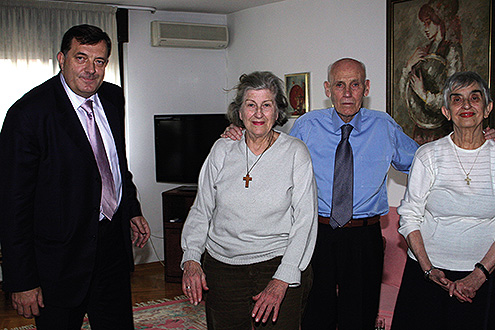
Photo: TanjugMilorad Dodik and Biljana Plavšić with their brother and sister-in-law
Testimonies
During her stay in Sweden, Biljana Plavšić wrote the book Testimony, in which she talks about war actions in Bosnia and Herzegovina, political games in Republika Srpska, but in which, above all, she tries hard to shift all the blame for massacres, crime and general tragedy to Radovan Karadžić. In this sense, she also testified against the president of the Assembly of Bosnian Serbs, Momcilo Krajišnik, who was later sentenced to 20 years in prison.
Such sprinkling of ashes and an attempt to wash away her own guilt began already during the admission of guilt, when she told the Judicial Council, among other things: "The path and example of Saint Sava was followed by great Serbian leaders, even in today's time, persistently showing nobility and dignity even in the most difficult circumstances (...) Unfortunately, our leadership, including me, abandoned this path during the last war." I believe it is clear to you that I parted ways with those leaders - albeit too late. However, that leadership shamelessly continues to demand the loyalty and support of our people. This is done by inciting fear, telling half-truths to convince our people that the world is against us. But the fruits of their work - that leadership - are clear: graves, refugees, isolation and resentment towards the whole world, which rejected us because of those leaders."
Neither in that statement, nor in subsequent interpretations and explanations, did Plavšić acknowledge her personal contribution. On the contrary. "I sacrificed myself." I didn't do anything wrong," she said in a recent interview for a Swedish newspaper. "Plavšićka didn't shoot anyone and didn't kill anyone," Milorad Dodik, her only remaining political friend, will say. In the meantime, what will we do with graves, refugees, isolation, resentment? Who is to blame for that? According to Plavšić, it is someone else's fault. Someone who personally slaughtered, raped and robbed. Someone who, unlike the "powerless" Biljana, could have known about all this, and who, again unlike her, could have prevented it. Not eating onions, not smelling onions.
All of that could still somehow be swallowed up, if Biljana Plavšić herself had not made an effort to ensure that her national-political engagement would be remembered for all time. If nothing else, the media archives remember that part of the image of the former president were also statements that any decent politician would be ashamed of, and which (if it were not for the famous admission of guilt) could be interpreted as a direct path to graves, refugees, isolation and indignation. One of the legendary ones is the one according to which "there are 12 million Serbs, and even if six million of them die on the battlefield, six million will remain who will enjoy the fruits of victory."
Accompanied by Milorad Dodik, Biljana Plavšić left the airport in the afternoon on October 27 to her apartment in Katanićeva Street in Vračar.
The former president was elegant, kind and smiling.
The public was informed in a timely manner that her relatives would prepare a vegetarian meal and uramaschi for her, and the parking service made sure that she would not be disturbed by cars parked on the road in Katanićeva.
Bosnian graves, raped women, Sarajevo ruins, people who fled and were destroyed by the war, are far from Vračar, far from Biljana Plavšić, far from everyone who welcomed her and was happy for her.
Life, therefore, goes on. As if nothing happened.
Photo: SSGT Lance Cheung, USAF/US Department of DefenseBiljana Plavšić
The cook
During her stay in the Norwegian Hinsenberg prison, Biljana Plavšić repeatedly complained about the conditions of her imprisonment. Forgetting what kind of crime she was convicted of, she stated that the most difficult thing for her was that "she is in a prison where there are women convicted of the most serious crimes, murderers and drug addicts."
A few months after she arrived in Norway, Plavsic broke her arm "after an incident with female prisoners from Islamic countries who persecuted her." When she requested a pardon and release in 2007, the former president of the RS wrote in a letter to the Swedish authorities that she was "humiliated" and that "Nazis who were convicted after World War II were treated better." At the same time, her cousin said that "Biljana has been buying groceries in the canteen and cooking by herself for two years, because one of the prisoners who was released from prison told her that they spit on her food."
Election time! And someone has to report to you independently. That's why it's in October annual subscription the digital edition of "Vremena" even 2.500 dinars cheaper. Choose now!
What is happening in the country and the world, what is in the newspapers and how to pass the time?
Every Wednesday at noon In between arrives by email. It's a pretty solid newsletter, so sign up!
The pardon procedure implies the appropriate role of the Minister of Justice, who should initiate the procedure or submit an opinion on the pardon, says prosecutor Radovan Lazić.
Phone numbers 064 876 85 05 and 011 2068 100 will be available 24/7 for reports and addresses to citizens, and the possibility of direct addresses at the premises of the Protector of Citizens is also provided.
NUNS demands an urgent investigation due to the threats sent to two Radar journalists who wrote about the Sky correspondence in which Aleksandar Vučić is mentioned. The association states that the threats also mention violence against children of journalists and warns of impunity
For the first time in almost two years, the opposition in Venezuela took to the streets across the country to demand elections by July 2027. The government organized its own march in the same square on the same day
France is preparing for Saturday's protests with a series of bans on gatherings and an increased police and military presence. The courts have already overturned one ban in Paris, and unions and students are calling for peaceful demonstrations
There is, literally, no difference between the one who claims it is day in the middle of the night, or the one who claims to be a giraffe, from the claims we read on billboards: that Vučić is working to unify Serbs and that Serbia is doing better and better day by day.
The pre-election arrests due to the alleged "overthrow of the state" testify to the regime's panic. The bad news for them is - they can't arrest the whole people who decided to defend themselves from progressive beatings and election theft
The ring that tightens around Ćaciland Student list is getting narrower. Because there are more and more spoiled people who see the false prophet for what he is: a street obscener who is fighting Serbia
The archive of the weekly Vreme includes all our digital editions, since the very beginning of our work. All issues can be downloaded in PDF format, by purchasing the digital edition, or you can read all available texts from the selected issue.