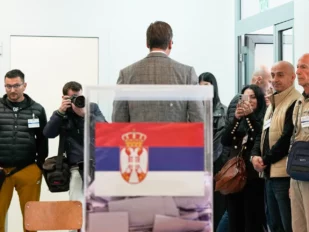
Aleksandar Vučić is still waiting for congratulations from the West after the elections, which international observers had many objections to, and the opposition openly questions them.
"The message is that they did not congratulate from the EU." This is unprecedented," Florian Biber, a professor at the University of Graz and an expert on the Balkans, told Vreme.
He particularly emphasizes the reaction of the German Ministry of Foreign Affairs which marked on Twitter that the way the elections were conducted was "unacceptable" for an EU candidate.
"Serbia voted, but the ODIHR mission reports on misuse of public funds, intimidation of voters and cases of vote-buying," the German Ministry said.
"I don't remember ever reading such a reaction after an election in the last twenty years." It is encouraging that such a message arrives from Germany for the first time," Bieber points out and adds:
"Now everything depends on the reactions of the opposition and citizens in Belgrade. If nothing happens there, it is unlikely that the EU will push the issue. But if there is a continuation of protests and pressure not to recognize the results, the EU will not be able to ignore it."
Observers are critical like never before
At the press conference of the ODIHR mission, it was said that the campaign featured harsh rhetoric and abuse of public funds.
Media monitoring bodies were ineffective during this election period and REM was "passive", this body of the Organization for Security and Cooperation in Europe stated. ODIHR noted vote buying and other irregularities.
"All observers are critical like never before, which opens the door to mediation," says Florian Bieber.
"Rarely will the EU directly say that it does not recognize the results of some elections." But they can be expected to say that the elections are not fair and that solutions should be found, that is, to mediate between the government and the opposition," Biber concludes.
NR
Read daily news, analysis, commentary and interviews at www.vreme.com