

Election 2026.
REC determined the final number of voters in the elections
The Republic Election Commission (REC) made a decision today on determining the final number of voters in Serbia

The President of Turkey is coming to Belgrade, and from there he will go to the BRICS summit. It seems that the President of Serbia will not go to that summit. Why won't they? And what will Vučić discuss with Erdogan?
Visit of the Turkish President Recep Tayyip Erdogan He comes to Belgrade at a time of great geopolitical tensions. These events are the reason why Turkey, one would say, after very lively diplomatic activity on the Balkans, during the past years had some other foreign policy priorities.
The economic crisis in Turkey itself, the war in Ukraine, the conflict in the Caucasus and the current conflicts in the Middle East, diverted Turkey's focus from, first of all, the situation around Kosovo, Bosnia and Herzegovina, but also Sandžak. However, during that time, Turkey had a solid increase in economic cooperation with Serbia, and it is expected that economic activities will be the focus of this visit as well. writes DW.
Deals with dictators
Naim Leo Beshiri, director of the Institute for European Affairs, also sees economic cooperation as the main focus of the upcoming visit:
"Besides, it seems that Erdogan doesn't have many interlocutors in the democratic world, and Serbia comes in handy there, and for his domestic political points." However, behind all of this, there are lucrative economic deals that Aleksandar Vučić makes with small and large dictators around the world, so that behind all these benefits of good cooperation are hidden good corruption projects," Beširi told DW.
Turkey is in the middle of three major conflicts, Duško Lopandić from the Forum for International Relations reminds DW, and that is why, it is believed, some of its initiatives and visits to the Balkans could not be seen during the past years:
"The Balkans were relatively peaceful in the previous period, and during that time the economic exchange between Turkey and Serbia reached some 1,5 billion dollars. There are also numerous infrastructure and investment projects, as well as tourism cooperation. "Turkey, in addition, is influential in what we can call the Muslim part of the Balkans with its policy, but we should also add Albania, which he will also visit," points out Lopandić.
Brotherly love has grown cold.
After his visit to Belgrade, the Turkish president will still be at the upcoming summit of the BRICS countries - unlike the Serbian president Vučić, who stated that he expects important visits from abroad at that time. It is stated that the reason for missing the BRICS summit is the visit of Polish Prime Minister Donald Tusk to Serbia on October 23 and 24.
In the Serbian public, this is seen as a hitherto unrecorded finger in the eye of Russian President Vladimir Putin, who in some way directly invited the Serbian president to the aforementioned summit. Even though both sides tried to iron out that diplomatic rift, a strong impression remained of the Serbian leadership's reluctance from excessive public expression of brotherly love between Serbia and Russia.
"It is clear that we had numerous events that led to a cooling of the relationship between Putin and Vučić", notes Naim Leo Beshiri, adding several harsh statements by Maria Zakharova, who criticized Vučić again a few days ago, because he also avoided Sergej in New York Lavrov.
"It is noted that the two presidents have not communicated for two and a half years, and all this shows that the personal animosity between Vučić and Putin has exceeded a certain limit. The only reason why sanctions are not being imposed on Russia is, it is said, exactly that corrupt money that the Serbian elite brought to Russia, and now they are thinking how to get it out of there. And as for not going to the BRICS summit, I don't think Vučić sees any benefit, and I think he's right," says our interlocutor from the Institute for European Affairs.
Swinging in all directions
Duško Lopandić observes that in recent months there has been more and more insistence on turning to the European Union and the West in general, and says that "we can see this first of all from the activities of the President of Serbia and the Minister of Foreign Affairs Marko Đurić - this is especially visible in relation to Russia."
"On the other hand, it is completely clear that the government will continue its non-European agenda in relation to Turkey, Arab countries, China and so on. In that context, the relationship towards BRICS should be viewed, which is not a priority for Vučić at the moment. But you never know with this policy, which is ready to waver on all four sides," says Lopandić.
The American ambassador to Serbia, Christopher Hill, also notices a kind of turn in Serbian foreign policy, who literally points out in every media appearance that Serbia is definitely turning to the West. "The problem is," adds Lopandić, "that Serbian foreign policy is so full of contradictions that I think a large number of European politicians no longer trust Aleksandar Vučić."
Naim Leo Beshiri, however, does not see any turning of Serbia towards the West, "but only the long-term deception of Western countries." I am convinced that this alleged turning to the West always comes at a time when the West is preparing some stronger criticism of the authorities in Belgrade. "You simply cannot be pro-Western and do everything against Western standards and rules domestically," notes Beshiri.
Avoided sanctions on Russia
In order to once again send a message of distancing himself from Russia, Aleksandar Vučić warned in a dramatic tone in recent days that the final introduction of sanctions against Russia is on the table and that this time it will be difficult to avoid it. How transparent this maneuver was is also shown by the triumphant writing of the regime media, which stated that Vučić, with his brilliant diplomatic skills, managed to remove the necessity of imposing sanctions on Russia from the declaration in Dubrovnik.
"I think that after such bombastic statements, Vučić immediately hires agencies for public opinion research and gets a clear picture of the mood among the citizens." If that is the mood for sanctions, he will introduce them, and vice versa. If he really wanted to, he would have already prepared the public for the introduction of sanctions. But it is obvious that he does not want to, because he has no points of contact with the West - the only goal of his balancing act is to stay in power as long as possible", concludes Naim Leo Beshiri.
The Republic Election Commission (REC) made a decision today on determining the final number of voters in Serbia

A citizen of Belgrade whose polling station in Banja Luka was changed in the voter list without his knowledge claims that the Ministry did not correct his data and that the deadlines have expired. The elections are on October 25 and he still doesn't know where he will vote.

The pardon procedure implies the appropriate role of the Minister of Justice, who should initiate the procedure or submit an opinion on the pardon, says prosecutor Radovan Lazić.
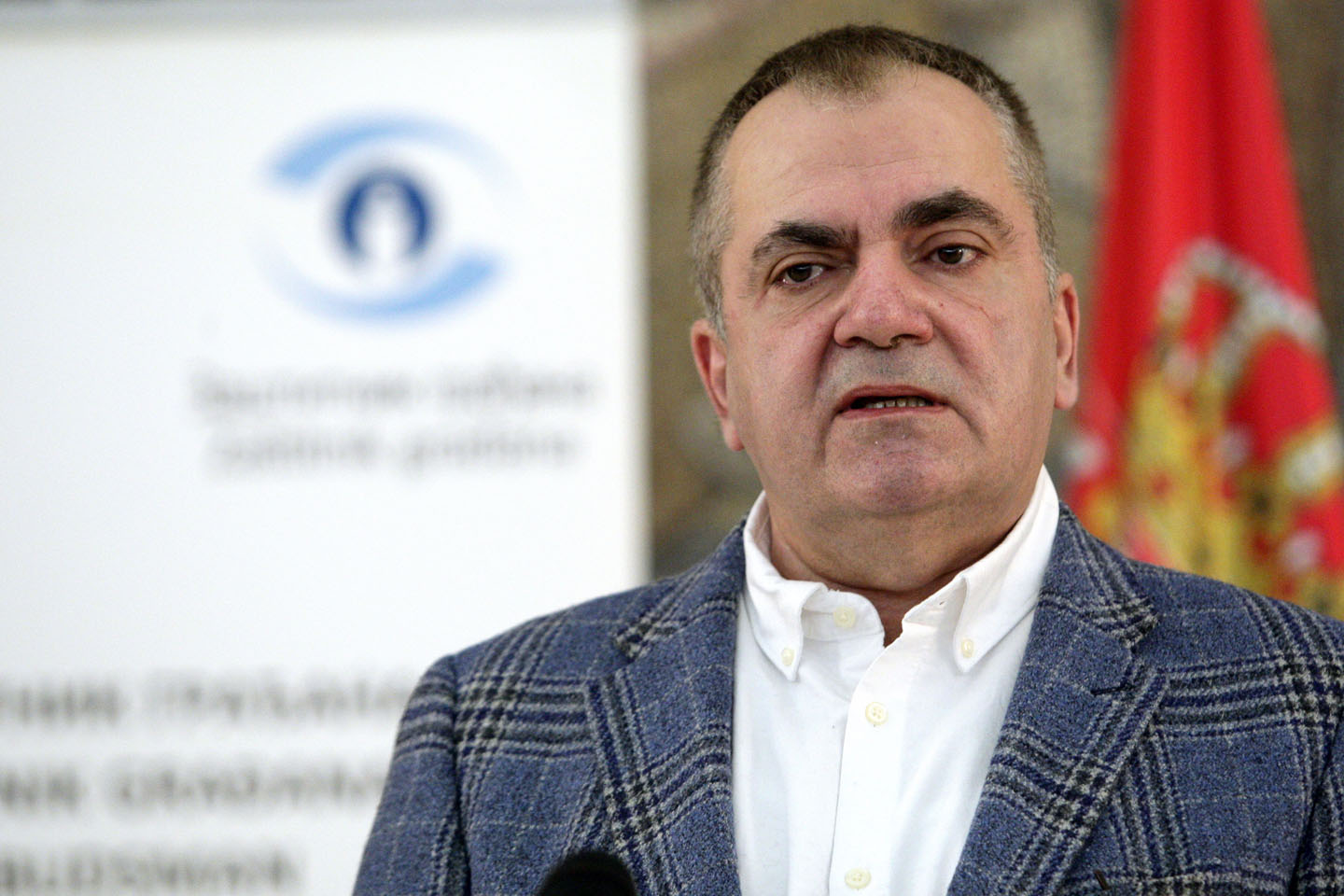
Phone numbers 064 876 85 05 and 011 2068 100 will be available 24/7 for reports and addresses to citizens, and the possibility of direct addresses at the premises of the Protector of Citizens is also provided.

NUNS demands an urgent investigation due to the threats sent to two Radar journalists who wrote about the Sky correspondence in which Aleksandar Vučić is mentioned. The association states that the threats also mention violence against children of journalists and warns of impunity

There is, literally, no difference between the one who claims it is day in the middle of the night, or the one who claims to be a giraffe, from the claims we read on billboards: that Vučić is working to unify Serbs and that Serbia is doing better and better day by day.

The pre-election arrests due to the alleged "overthrow of the state" testify to the regime's panic. The bad news for them is - they can't arrest the whole people who decided to defend themselves from progressive beatings and election theft

The ring that tightens around Ćaciland Student list is getting narrower. Because there are more and more spoiled people who see the false prophet for what he is: a street obscener who is fighting Serbia

The archive of the weekly Vreme includes all our digital editions, since the very beginning of our work. All issues can be downloaded in PDF format, by purchasing the digital edition, or you can read all available texts from the selected issue.
See all




