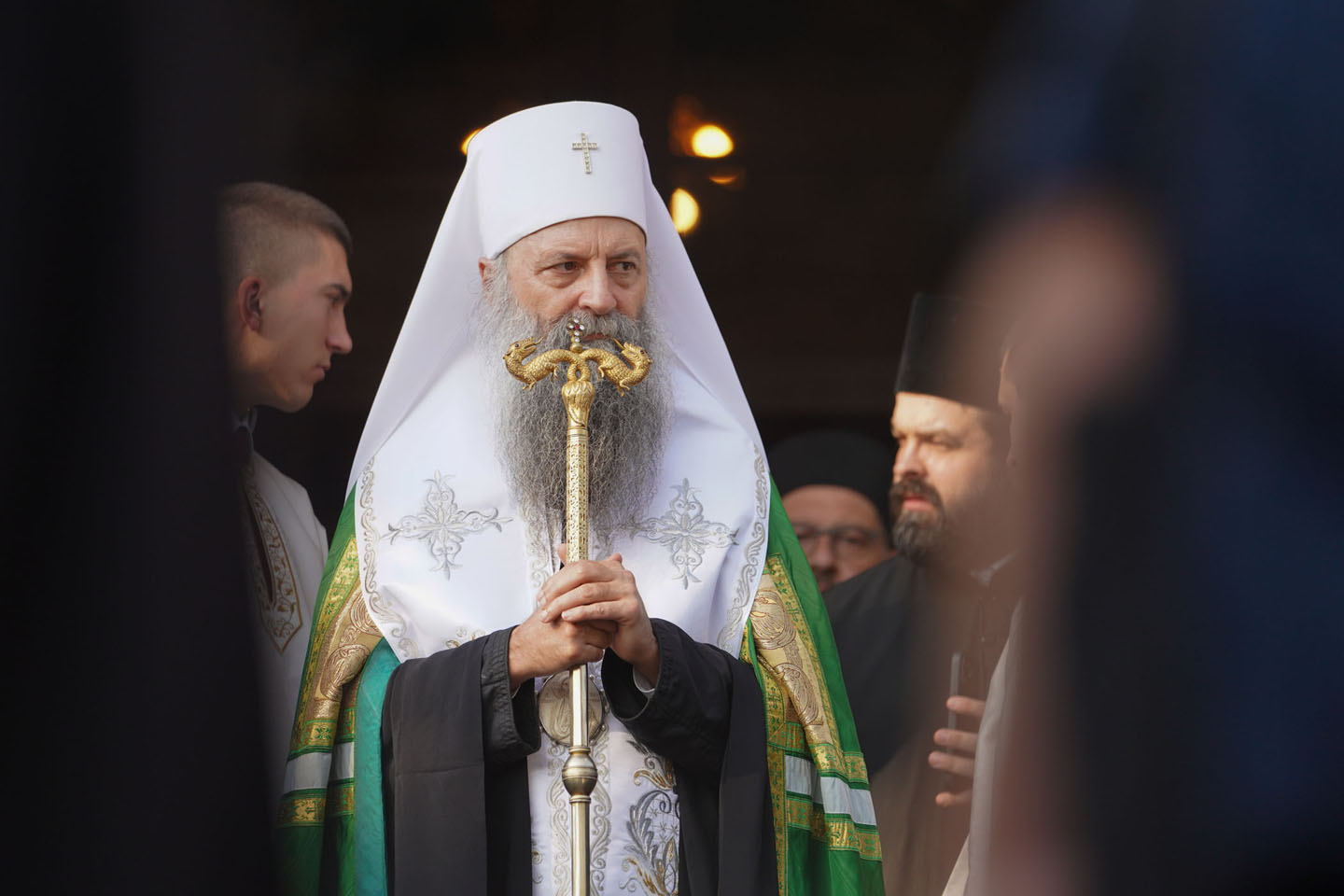
The liturgy of the Day of Resurrection will start at 19:XNUMX p.m. from the Church of the Ascension, and it will be led by Patriarch Porfirije. There will be a short stop at the corner of Kralja Milutin and Kralja Milana streets in order to hold a memorial service. After that, the liturgy will be continued to the Church of Saint Sava, where a prayer will be offered, and the patriarch will address the people at that place.
"After that, the people will be able to kiss the relics of Saint Bishop Nikolaj, which will be in the church until Sunday," said the bishop of Toplički. it says N1.
On the initiative of Patriarch Porfirio, at the head of the liturgy there will be a coffin with the relics of Saint Bishop Nicholas.
A prayer for peace among people
The Serbian Orthodox Church announced earlier that this year's litany will be based on the words of Bishop Nikolaj Žički and Ohridski: "Let us pray for blessed peace among people!"
"Patriarch Porfirije saw and listened well, knowing the hearts of his flock, his people, that the arrival of such a wonderful saint, who is one of our most beloved, would bring joy to many and bring comfort," Bishop Petar of Toplicki, assistant to the patriarch, told RTS.
Relics from Valjevo
The relics of Saint Bishop Nikolaj rest in the Lelić Monastery near Valjevo, and were transferred to the Cathedral Church in Belgrade the day before the liturgy.
Ceremonially and accompanied by the Bishop of Valjevo, Hesihi, the ark with the relics was transferred from the Saborna to the Church of the Ascension on Wednesday evening, before the holiday vigil. The relics will remain in the church on the day of the celebration, and they will be solemnly taken out at 19:XNUMX p.m. so that the litany will go to the Temple of Saint Sava.
A new way of celebrating the city's glory
With the arrival of Patriarch Porfiri at the head of the Serbian Orthodox Church, the way of celebrating the city's glory changed.
The Pasovdan Litia always started from the Church of the Ascension, but followed a different route and made a circle through the streets of Belgrade, returning to the place from where it started.
From 2021, the liturgy goes to the Church of St. Sava in Vračar, where the patriarch prays.
Three prayers are read at the liturgy - for health, for the peace and prosperity of Belgrade, and for the repose of the souls of the heroes who gave their lives for Belgrade.
The time of celebration has also been changed, and at the initiative of the patriarch, litia is held in the evening instead of in the morning.
Another innovation introduced by Patriarch Porphyry is the bringing of relics. Thus, in 2021, the relics of despot Stefan and Sveta Petka were at the head of the column.
The Jerusalem Cross, which is traditionally worn at the head of the procession, has been entrusted to professional athletes since the time of Porphyry - in 2022 the cross was worn by water polo player Stefan Mitrović, and the year before by weightlifter Rade Savić.
The history of celebrating the city's glory
The way to celebrate the glory of Belgrade was devised in 1862 by Metropolitan of Belgrade Mihailo Jovanović, on whose proposal the Church of the Ascension was built in Belgrade. In the treasury of the Ascension Church, an authentic Slavic banner of the Belgrade City Administration from 1938 is kept.
After the Second World War, the last lithia was held in 1947, and its participants were stoned. Soon, holding litia itself was forbidden.
Since 1993, Spasovdan has been celebrated again as the city glory of Belgrade, and in the same year, the Spasovdanska Litija was renewed.
The only year when the Spasovdanska litiya was skipped, since the renewal of the celebration of the city's glory, was in 2020, and that was because of the coronavirus epidemic. After the liturgy, the celebration was celebrated in a narrow group of people.
ZS/N1
Read daily news, analysis, commentary and interviews at www.vreme.com