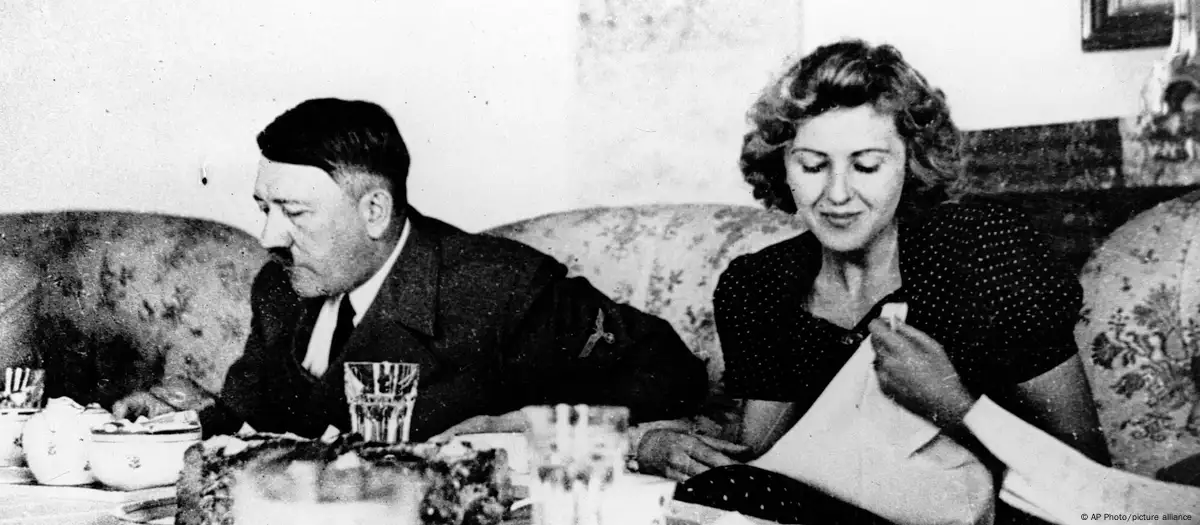
The first scene of the film "The Tasters" takes place in November 1943 in the East Prussian village of Gross-Parch (today in Poland). A young woman named Rosa Sauer (Elisa Schlott) runs away from Sedan, because her apartment was hit in the bombing and her father-in-law and mother-in-law who live there are moving in. Her husband, a German soldier, is at the front Ukraine.
Just a few kilometers from the village, hidden in a thick forest and surrounded by barbed wire, is the "Wolf's Lair", Adolf Hitler's fortified shelter on the Eastern Front, writes DW.
Soon after her arrival, Rosa finds herself in a group of women who are forcibly recruited by the SS. They drive to Hitler's secret compound every day to try the food there before it is served to Hitler.
Without ever seeing him, the women know that the Nazi "Führer" has many enemies and that his meals - and that means theirs - could be poisoned. Although many in wartime Europe were desperate for food, lavish meals were a terror for these women.
In the midst of all this, Rosa enters into a secret relationship with SS-Lieutenant Ziegler (Max Rimelt). He also befriends one of the women in the group, Elfride (Alma Hazun), quite shy and discreet. She has good reasons for that.
The German film, directed by Italian director Silvio Soldini ("Bread and Tulips", 2000), is based on Rosella Postorino's 2018 bestseller "Le assaggiatrici", which has been translated into more than 30 languages, including Serbian under the title "In the Wolf's Den".
The director worked with German actors without speaking the language himself. He has avoided directing historical films until now, but one of the reasons he was motivated to adapt the novel was that it focuses on women - which is unusual for a World War II story. Soldini told DW that he also liked that the story did not judge the two main characters, Rosa Sauer and Albert Ziegler. The two, he says, are "ordinary human beings, despite being caught in the cogs of a terrible system."
According to the testimony of Margot Welk
Rosella Postorino's novel was inspired by the testimony of a woman named Margot Welk. She did not talk about her experiences from World War II until December 2012, when she turned 95 years old. Then she started giving interviews to the media.
She recalled that for about two and a half years, starting in 1942, she was among 15 young women who had to taste the food prepared for the Wolf's Den. The film shows the recruitment of those women and their daily schedule, just as she described it, she also said that she was Mergot Welk.
Welk also said that she survived thanks to a lieutenant who put her on a train to Berlin in 1944. He knew that the Soviet army was only a few kilometers from the Wolf's Den. After the war, she met the lieutenant again, and he told her that all the other women in her group were shot by Red Army soldiers.
Her escape inspired Rosella Postorino to include a love story in her novel. Welk never mentioned such a thing.
She stated, however, in an interview for "Spiegel" in 2013, that she was raped by one of the SS officers while she was working as a taster. And after she returned to Berlin, she was also raped by Soviet soldiers, several times, as she said.
More than a year after the end of the war, she found her husband again. He too had traumas due to war experiences.
Postorino tried to contact Welk to interview her for the novel, but she died in 2014.
There is no historical evidence.
After the release of a documentary about Margot Welk that same year, German historian Sven-Felix Kellerhoff stated that the story was unlikely to be true. In an article for the "Welt" newspaper, he wrote that in the last years of his life, Hitler had problems with digestion and that he hired a cook who prepared meals just for him in a special kitchen near his bunker, inside the so-called "Safety Zones 1" (Sperrkreis 1). This means that it would not make much sense to transport food outside of that strictly restricted area to be tested by a group of women before being given to Hitler.
Author Felix Bohr in his new book "Before the Fall: Hitler's Years in the 'Wolf's Den'", writes that the first cook who prepared meals for Hitler according to this regime was Helene von Exner. She was hired in July 1943. Before her, a cook named Otto Gunther prepared large quantities of meals for Nazi leaders housed in the Wolf's Den. Outside of Hitler's inner circle, up to 2.000 people worked in the Wolf's Den.
Maybe the women had to try other foods and were told they were Hitler's meals?
In his book detailing the organization of daily life in the Wolf's Den, Bohr mentions Margot Welke's testimony only in a footnote, noting that no other historical source corroborates her claims. As he told DW, during the intensive research of the structures of the Wolf's Den, "I did not find any sources that confirm Margot Welk's story." However, as he adds, "I haven't found any documents that prove the opposite."
Director Soldini does not mind any possible historical untruths. After all, as he says, "the film is based on a novel, not a true story."
The story that was told remains relevant, he believes, because the film draws parallels with current events in the world. Like "Hitler's tasters", we all feel political violence today, even if we have the privilege of eating good meals, says the director.