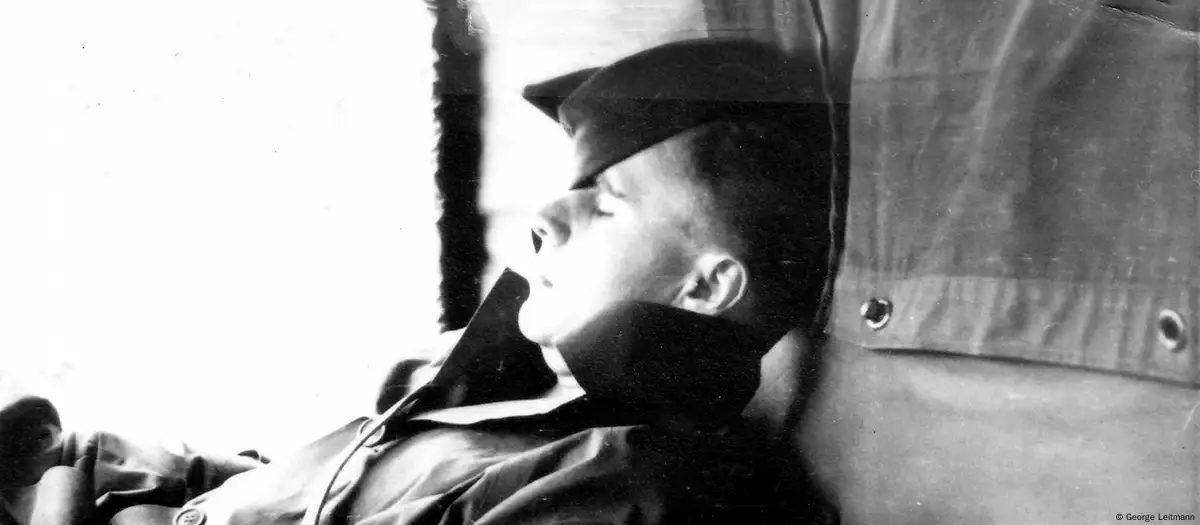
When he entered the Kaufering camp in 1945, George Lightman was looking for only one face - the face of his father. Instead, he found an inferno: corpses, ashes, and the silence of horror. That image haunts him even today, as he bears witness to his own losses and warns of the return of ideas that once brought the world to the edge of the abyss.
George Lightman (99) helped free Germany from National Socialism as an American soldier. Eighty years after the end of the war warns of the return of fascism - in Germany and the USA.
George Lightman is 99 years old today. In the spring of 1945, as a nineteen-year-old, as part of the 286th Engineer Battalion of the 6th US Army, he set foot on German soil for the first time, the war was still raging. American and British soldiers, as well as the Red Army of the Soviet Union, advanced on all fronts, he reports Deutsche says.
At that time, the situation was unclear in some southern German villages. "The front line was extremely volatile," he recalls. In the last months of the war, the Wehrmacht and the SS fought fanatically to preserve the crumbling Nazi power.
Photo: DWGeorge Lightman today
The horrors of war - that never go away
"We came to a small place," he recalls almost 80 years later. "We saw 15 to 20 children. All boys. They were ten to twelve years old." The dead. They were hanged. "I knocked on the first door and asked what happened." The residents told him: it was done by members of the infamous German Waffen SS. "They gathered the children from the village, gave each one a hand-held anti-tank rocket and ordered them to fire when they saw the first American tank."
When the tanks arrived, the children ran away. "A day later the SS came back, rounded up the children and hung them from trees. They were hanging their own children!" Historians would later document numerous crimes committed by the Wehrmacht and the SS against German civilians who no longer wanted to fight — the so-called. crimes of the final phase of the war.
The Germans killed millions of people in Germany and Europe, but also their own children. "That image has never been erased from my memory: the bodies of children hanging in the wind."
Doubt in humanity
War experiences left a deep mark on George Lightman. "The image of those children made such a deep impression on me that I began to doubt humanity. Perhaps the thing that disturbs me most of all to this day is that as a human being you cannot trust yourself. Because what motivated the SS was not rational."
He, an American soldier and liberator, questions himself in the face of the crimes of others. Perhaps this is one of the key differences between the biographies of the victims of National Socialism and the biographies of the perpetrators: decades after the end of the war, almost all German mass murderers and their accomplices denied their own responsibility for the war that claimed the lives of more than 60 million people.
And they denied their support for the fascist ideology that divided people into valuable and worthless lives, and ended with industrial mass murders of European Jews, Sinti and Roma and many others. The Germans shot, gassed, killed - a total of 1,5 million children - mostly because they were Jewish.
DW / Private archiveThe horrors of the camp
George Lightman was not just an American soldier who fought against Nazi Germany. He was also a Holocaust survivor. He was born in Vienna, the capital of Austria as Georg Leitman. When the Nazis took over, his Jewish family decided to flee in 1940. George, his mother and grandparents were granted US visas. Only his father Jozef did not. In 1940, he fled to what was then Yugoslavia. When it seemed safe, George and the rest of the family boarded a ship for the US. He never saw his father again.
After the war, he made a scientific career in the USA. For many years he was a professor of engineering sciences at the elite American University of Berkeley in California. He received numerous recognitions and awards. He still lives there with his 100-year-old wife, Nancy, in a nursing home. It is still often asked, "How was it possible in such a short time to turn such an educated people like the Germans into something so evil?"
There is no answer to that question. Like many others. But they don't stop persecuting him. "Whenever I met Germans, I wondered how much they or their parents were guilty. But to blame them for the supposed guilt of their ancestors was, scientifically speaking, inappropriate to me."
In search of a father
When he volunteered for the army in his new homeland, the USA, at just 18 years old, he followed an inner urge: uncertainty about his father's fate. His fight against the Germans was also a quest. This is how he differed from most of his comrades.
"When we reached the Kaufering concentration camp (part of the Dachau camp system) near Munich, my comrades were appalled. They abhorred German crimes. But I immediately thought of my father. When we met the liberated people, I always hoped to see him again."
Kaufering consisted of eleven different camps. The Nazis deported 23.000 people, mostly Eastern European Jews, to the Bavarian province. They were forced to work for the German war industry. In the end, they all had to be killed. It was a strategy of destruction through work, as the Nazis called it.
When George Lightman entered the liberated camp in April 1945, a world from Dante's Inferno opened up to him - that's how one survivor described the camp. Laitman remembers, "There were bodies lying everywhere. Many were still smoldering because the Germans had tried to burn them. Since the people were just bones and skin, they didn't burn." Those images still come back to him in his sleep today.
"Coldness and ruthlessness return to all of us"
The European Holocaust Memorial Foundation manages the memorial area. George Lightman is an honorary member. Recently, numerous guests gathered on the occasion of the 80th anniversary of liberation. George did not come this time, the trip from California was too difficult for the 99-year-old.
The commemoration was marked by mourning for those killed, but also by concern for the future: the rise of the far-right Alternative for Germany, the rise of Donald Trump in the USA, Russia's war of aggression in Ukraine.
The spirit of fascism is back - the power of the stronger, Viennese historian Florian Wenkinger worriedly said in his speech: "Elon Musk considers empathy to be the greatest weakness of Western civilization. This is where we must remain firm. If social solidarity, a sense of justice and compassion are targeted, then it is quite clear that coldness and recklessness can return to all of us, that they can threaten us all."
George Lightman is also deeply concerned about current politics. "The fact that someone like Donald Trump can become president is incredible. That large parts of society support fascist ideas is disturbing. To blame certain groups of people for something - that has always brought misfortune."
May 2025 George Lightman turns 100 years old. Despite everything he's been through, he says he's had a good life. He was able to travel the world, he started a family and met interesting people.
It was only many years after the end of the war that he found out how his father had died. In a camp in Yugoslavia, the Germans shot him and hundreds of other prisoners in the head. Because he was Jewish. To this day, George Lightman imagines how his father experienced the last minutes of his life. He thinks about it every day.
What is happening in the country and the world, what is in the newspapers and how to pass the time?
Every Wednesday at noon In between arrives by email. It's a pretty solid newsletter, so sign up!
Negotiations in Geneva ended without an agreement on the ban of autonomous weapons systems despite the support of almost 100 countries. The US, Russia and Israel opposed the binding rules
A woman in Great Britain was drugged and sexually abused by her ex-husband for years. The case of Joanna Young is reminiscent of that of Giselle Pellicot
Young people in Europe are protesting about the cost of living, education conditions and the senselessness of war. Generation Z says they don't want the future to be decided without them
The first major company that develops machine learning models went public, and the very next day its shares fell by around ten percent. Analysts do not expect the oscillations to stop
Why did an unusual group of people led by Aleksandar Vučić, at the constitutive session of the Assembly of Serbia, go berserk because of yogurt spilled on the head of a member of parliament, a "reputable artist" and, of course, a woman?
How Aleksandar Vučić convinced the public that progressives are not worthy of the position of vice-president of the National Assembly and how its president - Aleksandar Čupić - explained to him theoretically and practically what parliamentarism is in front of everyone
For years, European conservatives patronized the SNS and turned a blind eye to violence and corruption. Now, after the electoral defeat of the progressives, they are being let down the drain. Too late, but still…
The archive of the weekly Vreme includes all our digital editions, since the very beginning of our work. All issues can be downloaded in PDF format, by purchasing the digital edition, or you can read all available texts from the selected issue.