The Syrian crisis remains a kind of bleeding wound in the Middle East. Syria, which was artificially created by the French after the First World War on parts of the Ottoman Empire, today has split into three hostile enclaves: Arab-Sunni, Arab-Alawite and Kurdish. Bashar al-Assad, with the military support of Iran and the Russian Federation, controls two-thirds of the country's territory, where only a third of its pre-war population lives. Most Syrians were not with Assad. About eight million live in neighboring countries in refugee camps, four to five million in territories occupied by Turkey and four million in the northeast of the country, in the Kurdish region of Rojava and the Euphrates basin.
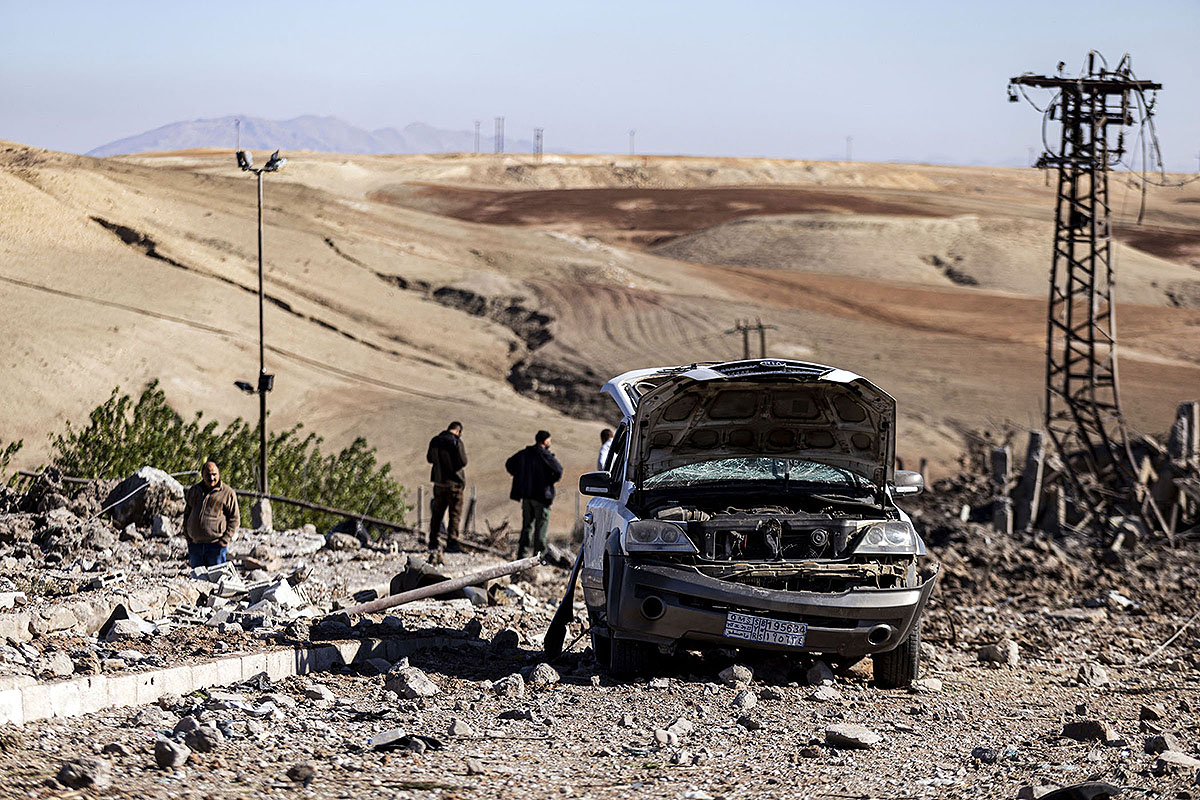
The bombing by Kurdish activists in the pedestrian zone of Istanbul on November 14, which killed six people and wounded more than 80 people, together with the angry reaction of Ankara, which refused to accept American condolences, again drew the attention of the world public to the events in Syria and their impact on the region. This week, Turkey again launched retaliatory actions by attacking Kurdish positions in Syria, and Turkish President Erdogan, returning from Qatar, where he attended the opening of the World Cup, also blamed Moscow. "Despite our repeated warnings to Russia, which is responsible for clearing northern Iraq and Syria of terrorists in accordance with our 2019 Sochi agreement, Moscow has not fulfilled and refuses to fulfill its duty," he said.
According to his words, Turkey "will not remain silent against terrorism" and "will take measures if the Russian Federation does not do so". These actions, however, received a negative response in the US Congress, where a member of the House of Representatives, Frank Pallone, warned that Turkey had bombed civilian infrastructure. "This is another reason why I am working to prevent the sale of F-16 fighter jets to Turkey," Palone emphasized.
A CRISIS WITH NO END
Turkey Syria Explainer...
The Syrian crisis remains a kind of bleeding wound in the Middle East. Syria, which was artificially created by the French after the end of the First World War on parts of the Ottoman Empire, today has split into three hostile enclaves: Arab-Sunni, Arab-Alawite and Kurdish. Bashar al-Assad, with the military support of Iran and the Russian Federation, controls two-thirds of the country's territory, where only a third of its pre-war population lives. Most Syrians were not with Assad. About eight million live in neighboring countries in refugee camps, four to five million in territories occupied by Turkey and four million in the northeast of the country, in the Kurdish region of Rojava and the Euphrates basin.
Turkey plays a special role in the events in Syria: the country is actively using a combination of military and political measures to gradually expand its influence and consolidate the already achieved positions. Earlier, Ankara already conducted military operations in northern Syria ("Euphrates Shield", "Source of Peace"). Turkish leader Recep Tayyip Erdogan continuously announces the launch of a cross-border operation, to finally create a 30 km deep security zone in the south of the country. The main target of the operation should be Kurdish forces in northeastern Syria, which Ankara considers terrorist.
It is obvious that Turkey's goals differ significantly in individual regions. In the regions of the provinces of Idlib, Aleppo, Raqqa and Hasakah, which are controlled by the Syrian Arab-Sunni opposition and which were practically occupied by Turkish troops, Ankara is renewing the role of the Ottoman Empire in new historical conditions. There are Turkish flags, classes in schools are in Turkish, the Turkish lira is introduced into circulation... Erdogan officially declares that Assad will never be able to gain access to these regions.
Recep Tayyip ErdoganFREE HANDS: Tayyip Erdogan
Erdogan believes that the territories controlled by government forces and their foreign allies (IRGC of Iran, Lebanese Hezbollah, foreign Shiite mercenaries, Wagner, parts of the Russian armed forces) are victims of "state terrorism" of the Assad regime. Northeastern Syria and the east bank of the Euphrates River are controlled by the Kurdish militias of the Democratic Union Party (PID) and local Arab tribes, who are united with the support of a small military contingent of the US armed forces. The Turkish authorities have a hostile attitude towards them, and Erdogan is trying, under the pretext of alleged links between the Syrian PDS and the Turkish PKK, to carry out more and more punitive military operations against the Kurds and annex Kurdish territories.
Approximately thirty million Kurds live in the Middle East – primarily in Iran, Iraq, Syria and Turkey – and Kurds make up nearly one-fifth of Turkey's population of seventy-nine million. The Kurdish Workers' Party (PKK), founded by Abdullah Ocalan in 1978, has been leading a rebellion against the Turkish authorities since 1984 for greater cultural and political rights, primarily with the aim of establishing an independent Kurdish state, which Turkey considers an existential threat to its own survival. It is a conflict that resulted in almost 40.000 deaths.
During Erdogan's long reign, tensions between Turkish authorities and Kurdish groups have risen. In particular, the PKK, the People's Democratic Party (HDP) - a leftist pro-Kurdish party and the People's Protection Units - YPG (the armed wing of the Syrian Democratic Union (PID) linked to the PKK), have increasingly agitated against the government, carrying out numerous attacks on Turkish targets in the southeast .
KURDS IN THE SYRIAN WAR
The Syrian conflict dates back to 2011, when the armed rebellion against the government of President Bashar al-Assad began. The uprising began as a peaceful demonstration, but quickly turned into a bloody conflict between the rebels and government forces.
It is interesting that the former Israeli Prime Minister Ehud Olmert (2006-2009) said a few days ago that Tel Aviv "dragged" Syria into a de facto civil war due to Syrian leader Bashar al-Assad's refusal to "depend on us".
Olmert specifically spoke about "the biggest mistake that Assad made": "... If he had signed a peace agreement with me in December 2008, there would not have been a civil war... because I think that peace between us and the cessation of hostilities were connected." All this, according to the words of the former Israeli prime minister, would "open the door to Washington". According to Olmert, former US President George Bush told him that he wanted Assad to "know for sure" that "the road to Washington leads through Jerusalem".
The Kurds, who make up about 10 percent of Syria's population and are concentrated in the country's northeast, have been largely out of the conflict. But that changed in 2014, when Islamic State jihadists overran eastern Syria and northern Iraq, creating a so-called "Islamic caliphate" across the UK. The rise of IS has brought the United States directly into conflict with them, and President Barack Obama has assembled an international coalition to fight IS, ordered airstrikes and sent the US military to support local forces on the ground.
The coalition turned to the Kurdish militia, which was already fighting jihadists in Syria, and forged a tight partnership that grew into the Syrian Democratic Forces, or SDF, including fighters from other ethnic groups. The Syrian Kurds are considered one of the most significant and influential actors in the ongoing conflict in Syria, mainly due to their direct participation and relative success in the fight against the Islamic State of Iraq and the Levant and the support they receive from the major powers - the USA and Russia.
In addition to Turkey, Syrian Kurdish fighters are fighting Islamic State, mostly as part of the Syrian Democratic Forces (SDF) – an alliance of Arab and Kurdish fighters backed by the United States – and have carved out a semi-autonomous region in northern Syria. In September 2014, the leader of the PKK, Abdullah Öcalan, called on the Kurds to start an "all-round resistance" in the fight against the Islamic State; later that month, the Kurdish-held city of Kobani was besieged and eventually captured, leading to an exodus of tens of thousands of Syrian Kurds to Turkey. The ensuing battle for Kobani left more than 1.600 dead, but Kurdish-led SDF forces eventually regained control of the city in January 2015. The SDF also liberated the strategic Syrian city of Manbij from Islamic State in August 2016, although forces of the IPG (part of the SDF coalition) clashed with Turkish-backed rebels trying to take control.
In July 2015, a two-year ceasefire between the Turkish government and the PKK collapsed after an Islamic State suicide bombing killed 30 Kurds near the Syrian border. After an attempted coup in July 2016, Erdogan cracked down on suspected plotters, arresting some 50.000 people and stepping up airstrikes against PKK forces in southeastern Turkey. He also began leading military operations in Syria against the YPG and the self-proclaimed Islamic State.
After the YPG and SDF consolidated control over territory captured from Islamic State in northern Syria, Turkey and Turkish-backed Syrian militias, including the Free Syrian Army (FSA), moved to retake towns and drive out the Kurds. Turkish troops and the FSA launched an assault on the city of Afrin in January 2018, capturing it in March 2018. Turkey has continued to threaten attacks on other Kurdish-held areas in Syria, including Manbij, and despite sharing a common enemy, many Turkish the airstrikes were aimed at Kurdish fighters, not Islamic State soldiers.
Kurdish SDF fighters seized the opportunity in 2012 to establish broad Kurdish autonomy in northeastern Syria. They named their enclave Rojava and quickly formed their own administration. It consists of self-governing sub-regions in the areas of Afrin, Jazeera, Euphrates, Raqqa, Tabqa, Manbij and Deir Ezzor. Diplomatically, the Kurdish-led administration has had only limited results, failing to gain recognition from any country, including the United States. And the Kurdish push for political autonomy in Syria has raised fears in Turkey, which sees the SDF as deeply connected to the PKK.
The heads of the administration of the region emphasize that it is officially a "secular state" with direct democratic ambitions based on an anarchist, feminist and libertarian socialist ideology, which promotes decentralization, gender equality, environmental sustainability, social ecology and pluralistic tolerance for religious, cultural and political diversity. and that those values are reflected in its constitution, society and politics, stating that it is the model for a federalized Syria as a whole.
AMERICAN WITHDRAWAL
If the Kurds were able to establish an independent state in Syria amid the chaos that has engulfed the region, it would accelerate secessionist movements in other Kurdish areas of the Middle East. Increased terrorist activities by Kurdish separatists are also a growing concern for the United States - and its allies - which designated the PKK as a foreign terrorist organization in 1997.
Washington really appreciates the contribution of the Kurdish militias to the defeat of the vanguard of international terrorism - the Islamic State. Relations between the US and Turkey have been strained since Erdogan renewed calls for the extradition of Fethullah Gulen -- a Turkish political and religious leader in self-imposed exile in the United States -- who Erdogan believes masterminded the July 2016 coup. Relations have also been strained by the close relationship of the United States with Kurdish groups - the US continues to supply weapons to Peshmerga troops fighting the Islamic State in Iraq and arms to the Syrian YPG due to all closer relations between Russia and Turkey.
The turning point came in October 2019, when Donald Trump announced the withdrawal of American troops from Syria, effectively leaving his former Kurdish allies in the lurch, thereby giving the green light for a Turkish attack. For such a decision, Trump referred to the First World War, when, as he said, "the Kurds did not help the Americans", although at that time the Kurds did not have an army, nor could they do anything to help the Americans and other allies.
Until then, the occupation of the territories left by American troops and Kurdish formations was carried out on a "first come, first served" basis, i.e. cities and territories are taken by those who reach them first. The Syrian army captured two of the largest cities in the region - Raqqa (the former "capital" of the entire Islamic State, which the Kurds and Americans recaptured after a months-long battle in 2017) and Manbij (the former main base for the reception of IS foreign fighters). The largest power plant in the country near the city of Tabka came under the control of Damascus.
If Tabqa and Raqqa are deep in Kurdish territory and therefore easily captured within hours of the US military leaving them, then Manbij is close to the Turkish border. There, on the evening of October 14, Syrian troops clashed with pro-Turkish Islamists who tried to capture the city. Official Kurdish sources reported on "light weapons fighting". In the evening, the Syrian media reported on attacks by Russian artillery, which had been deployed in the Manbij region for a long time, on Islamist positions. The Ministry of Defense of Turkey announced that the Chiefs of General Staff of Turkey and Russia held urgent telephone conversations about the "security situation in Syria".
Turkey had the upper hand in these negotiations: it controlled a significant part of the Syrian opposition. These forces could be deployed in a key place for Damascus - Idlib province - the last region where power officially belonged to the Islamists, who continued to actively fight to oust Bashar al-Assad.
TRIPLE ALLIANCE
On October 14, the Syrian Kurds decided to call on Russia and the official government of Syria for their protection. The mediator in the negotiations was Russia, which since the fall of 2015 effectively controls the foreign and domestic policy of Damascus. On the morning of October 14, Syrian army units entered Kurdish territory, and Vladimir Putin said that "all foreign troops must leave the territory of Syria."
Syrian President Bashar al-Assad in this "deal" was supposed to get almost a third of the country, which he had not controlled for more than five years, along with several major cities and commercial facilities, without a fight.
Kurdish autonomy, but only at the local government level, has been formally preserved, and its further fate should be decided after the adoption of Syria's new constitution.
Then, on October 22, 2019, Russia and Turkey signed the agreement in Sochi, which the Turkish president is referring to these days. Erdogan declared it "historic", while Russian President Vladimir Putin called the deal "crucial".
Under the agreement, Ankara agreed to a 150-hour ceasefire to allow the Syrian Kurdish militia (YPG), the main force within the Syrian Democratic Forces, to withdraw 30 kilometers away from the Turkish border.
The Sochi agreement is considered more comprehensive than Ankara's agreement with Washington. According to the 10-point plan, Turkish-Russian patrols will secure a separation zone in Syria 10 kilometers wide from the Turkish border. The memorandum of understanding, however, does not achieve Erdogan's goal of Turkish forces securing a 450-kilometer-long separation zone on Syrian territory, which goes 30 kilometers deep into Syrian territory. A much smaller strip of Syrian land, 120 kilometers long and 30 kilometers wide, is under the control of Ankara.
Since then, Turkey has been trying to achieve this goal, which is why it has launched several military operations. In June of this year, Turkey announced a major operation aimed at clearing the region and returning up to 2,5 million refugees from Turkey. Ankara planned to build 200-250 thousand houses in the emerging security zone.
After the operation, as the newspaper "Turkiye" wrote, it is planned that the remains from the tomb of Suleiman Shah, the grandfather of the founder of the Ottoman Empire Osman, will be returned to the former place, which was blown up in 2015. The tomb, from where Ankara evacuated the ashes, was located on a small peninsula on the Euphrates River in Aleppo province, 37 kilometers from the Syrian-Turkish border.
A new escalation followed in August, when at least 13 civilians were killed in two clashes on the Syrian-Turkish border. The border standoff comes amid growing fears that Turkey will launch its fourth offensive against Kurdish positions since 2016.
The leader of the Kurdish Democratic Union Party, Saleh Muslim, said that Turkey's ground military operation against the Syrian Kurds "is almost ruled out, because Russian President Vladimir Putin did not agree to Turkey's ground operations against the Syrian Kurds either at the summit in Tehran or in a private meeting with the Turkish President Recep Tayyip Erdogan in Sochi, Russia". Also, the presence of various Russian-Syrian and other forces in the north and northeast of Syria created an obstacle for Turkey's ground operations in those regions.
HISTORICAL COOPERATION
The current cooperation between Russia and the Kurds is better understood through the prism of their close historical ties. For two centuries, during the Tsarist and Soviet eras, Russia communicated with the Kurds recognizing their strategic importance for its regional policy, as evidenced, for example, by its support for Kurdish national movements and the creation of Red Kurdistan in the Caucasus, or the short-lived Republic of Mahabad in Iran. At the same time, Russia pragmatically pursued its own interests, withdrawing support for Kurdish independence when the situation demanded it.
In the post-Soviet period, Moscow maintained limited cooperation with the Kurds to maintain its remaining influence in the region and curb what it saw as Ankara's support for Chechen fighters. It is also worth noting that, unlike NATO, the US or the European Union, which have officially designated the Kurdistan Workers' Party (PKK) as a terrorist organization, Russia has never blacklisted the PKK. Furthermore, Russia does not share Turkey's view that the PID and YPG are structures controlled by the PKK inside Syria.
In the initial phase of the Syrian crisis, Russia tried to distance itself from the Kurdish factor, which is in sharp contrast to the policy of Washington, which actively cooperated with Kurdish armed groups in Syria. Understandably, Moscow has sought greater flexibility and wiggle room in engaging with Middle Eastern partners on the future of Syria and the Assad regime.
At this stage, Russia provided tangible support to the Syrian Kurds exclusively on the diplomatic front, insisting on their inclusion in the peace talks in Geneva, despite Turkey's opposition. Thus, by refraining from publicly endorsing Kurdish claims to their own statehood, Russia unofficially recognized the legitimacy of the Syrian Kurds, facilitating their participation in the Syrian peace process. On the other hand, Moscow's efforts to include the Kurds in political negotiations represent an attempt to avoid the fragmentation of Syria and preserve the unity of the Syrian state, but also to provide the Kurds with broad autonomy. The Kurdish future in Syria depends on Russia, the Syrian authorities and Turkey.
Bashar al-Assad and his Arab-Alawite and Baathist entourage, under the considerable influence of Tehran, continue to ignore the interests of the Kurdish minority in Syria and rule out the legalization of the Kurdish Autonomous Region or the federalization of the country. Damascus does not recognize the autonomous region of Rojava and demands the disarmament of Kurdish militia units. Erdogan is using it for increasingly aggressive steps in northern Syria.
In such conditions, Kurdish political forces in maneuvering between Russia, official Syria and Turkey, strive to find the best position for Kurdish interests, both in Syria and in the region. Saleh Muslim, who advocates so-called "Kurdish democratic autonomy" within an undivided Syria, has visited Moscow several times to discuss possible scenarios.
Muslim said: "When I look back, I conclude that Turkey was never sincere in its desire to make peace with the Kurds." If Turkey had turned to the Kurds, if it had worked with the Kurds, it would have become the most powerful country in the Middle East."
What is happening in the country and the world, what is in the newspapers and how to pass the time?
Every Wednesday at noon In between arrives by email. It's a pretty solid newsletter, so sign up!
The gnats are wreaking havoc in parts of Rome. Bird droppings rain down on the Romans every day. They can't disperse them even with trumpets, so they move around the city with umbrellas
The number of people deported to the US in the fiscal year ended September 30 was about nine percent higher than the previous record of 442.640 deportations.
An outage of Microsoft servers due to increased load has left users around the world without access to Microsoft 365 applications. Problems have also been reported by large companies and government institutions
Milorad Dodik says that his son Igor is among the candidates for prime minister of Republika Srpska because he is one of the most promising members of the Alliance of Independent Social Democrats.
At the moment when the institutions of the Republic are destroyed, when Vučić's octopus is still alive, when people are disgusted by the injustice and the stench left behind by the Essenes regime, we have, as Machiavelli said, only civic virtue as the fuel with which we can return to the beginning
The four independent members of REM are an example of perseverance and civic responsibility. Rodoljub Šabić even, upon leaving the premises of REM, after the sentencing of the Informer, experienced that the Essenes insulted him, hit him with their hands and feet. But that too will soon be over
Vučić pardoned the batterers and Dijana Hrkalović. The election winners should abolish the sultan's power that allows one man to run afoul of the entire judicial system
The archive of the weekly Vreme includes all our digital editions, since the very beginning of our work. All issues can be downloaded in PDF format, by purchasing the digital edition, or you can read all available texts from the selected issue.