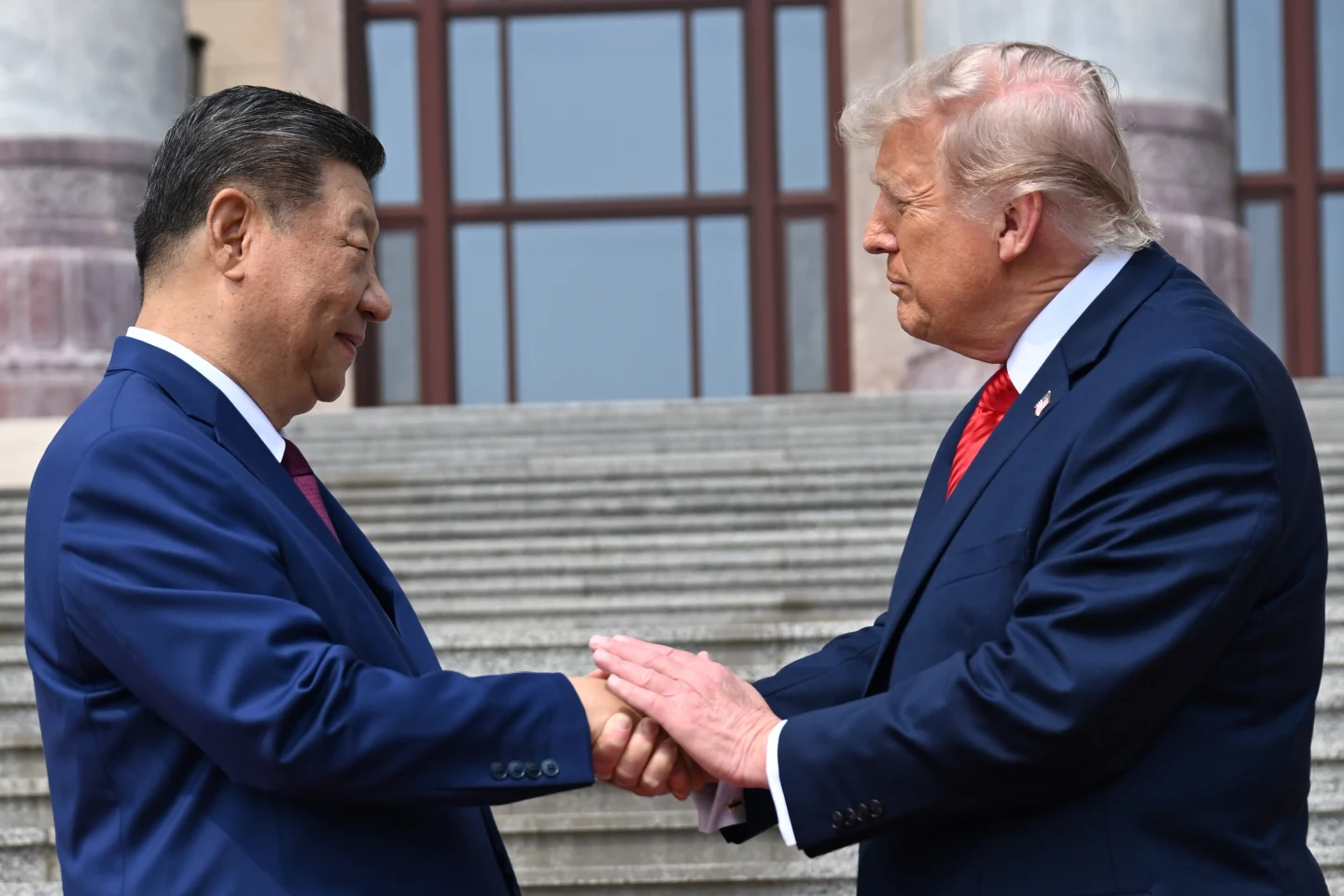
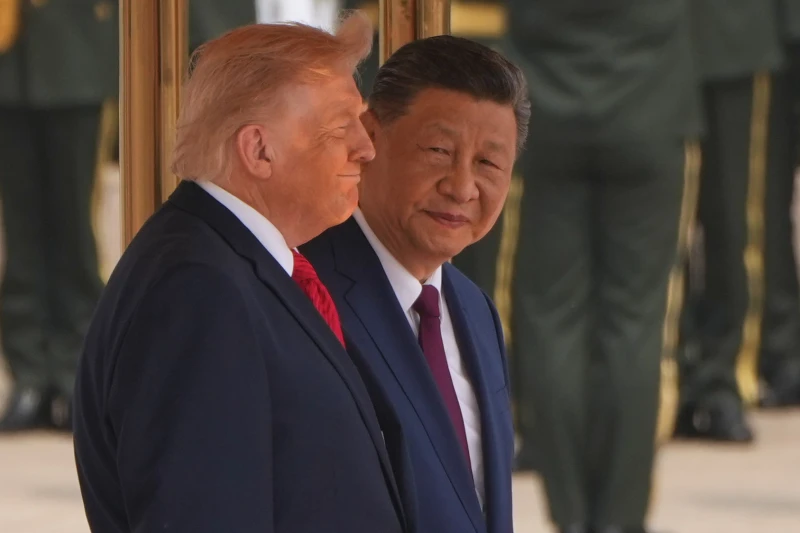
Donald Trump's visit to China goes beyond classical diplomacy and represents an attempt by Washington and Beijing to, despite growing rivalry over trade, technology, Taiwan and the Middle East, preserve stable economic relations and prevent global tensions from escalating into open conflict
Another high-level summit between China and the United States of America has ended. Two-day visit of the American president Donald Trump Beijing, the first of its kind in almost a decade, was held at a time of heightened tensions between the world's two largest economies. US relations and Kine are considered the most significant bilateral relationship of contemporary international politics.
At a time of deep geopolitical upheaval, the two leaders had a handful of topics to discuss - from the trade and technological rivalry of the two countries, to tensions over Taiwan and the South China Sea, to the US-Israeli war against Iran and the global energy crisis. The head of the White House, who after the deterioration of relations with almost all Western allies and the political turmoil in the Middle East is facing serious pressure at home, needed at least one visible foreign political success.
"Constructive strategic stability"
At the meeting in Beijing, Chinese President Xi Jinping hailed a "new era of relations" between the two countries, defined by constructive and stable ties. The two leaders agreed to establish "constructive strategic stable relations" as a new guideline for bilateral relations.
This wording, which was used for the first time, hints at the intention of Washington and Beijing to ease the tensions that marked the previous years and to make mutual rivalry and cooperation more organized and predictable. It is crucial for China to avoid direct confrontation with Washington, despite increasing American pressure. They are reflected in attempts to limit China's growth with trade and technological barriers, but also through the strengthening of Washington's alliances in the Indo-Pacific region with countries such as Japan, South Korea, Australia and India, which are perceived to varying degrees as rivals of the People's Republic of China.
Nevertheless, at the meeting with Donald Trump, Xi Jinping did not fail to warn his American colleague that Taiwan, which China considers part of its territory, is "the most important issue in China-US relations." He pointed out that "wrong management" of that problem could lead to a "very dangerous situation", in which "the two countries could enter into conflict or even conflict", the Chinese state media reported.
CNN published a video of the US president standing next to Xi in front of the Temple of Heaven in Beijing, while reporters twice asked him if the issue of Taiwan was raised during the conversation with the Chinese leader. Donald Trump did not even respond to those questions, and after a short moment of silence in which he stood together with Xi, he walked away from the journalists. This attitude is in complete contrast to the policy of former US President Joseph Biden, who stated just a few years ago that the US would "defend Taiwan militarily" in the event of an invasion by China.
Nevertheless, the presence of US Secretary of "War" Pete Hegsett in the US delegation carried symbolic weight, which shows that the issue of Taiwan and security in the Indo-Pacific remains important for America as well. Washington wants to show that it is ready for dialogue, but at the same time that it does not intend to give up its military presence in the region. After all, before his visit to China, Trump caused a lot of attention by declaring that he would discuss with Xi Jinping the latest US arms sale to Taipei worth $14 billion, which Beijing strongly criticizes.
Photo: AP Photo/Mark SchiefelbeinDonald Trump and Xi Jinping
What does Washington want?
Washington sees China as a strategic rival capable of reshaping the global rules of the game through trade and technology, supply chains, artificial intelligence and even international institutions. In that framework, Trump has focused on short-term, tangible gains on trade disputes and security issues, while seeking to project American power to the domestic public and allies.
This visit is also an attempt by the head of the White House to improve his reputation among American voters, which has been seriously shaken this year as a result of the war with Iran. That conflict has further increased inflationary pressures in America and significantly increased the possibility that Republicans led by Trump will lose their majority in one or even both houses of Congress in the November elections. Despite the robust US economy, CNN writes that "the gap between a strong US economy and weak voter sentiment could have serious political consequences".
But even Chinese citizens, despite the strong economic growth of the country, are not spared from financial pressures. This particularly applies to young people aged 16 to 24, among whom the unemployment rate has been above 16 percent for months.
Against the "militarization" of the Strait of Hormuz
The two sides agreed that "the Strait of Hormuz must remain open" in order to ensure the smooth flow of energy and the stability of global trade. The Chinese president also expressed opposition to the "militarization of the strait", as well as any attempt to charge for its use, with the message that Beijing is interested in buying more American oil in order to reduce dependence on that supply route. Calming tensions over Iran suits China, given that its economy is largely dependent on stable energy prices and smooth trade flows. Both leaders also agreed that Iran must never possess nuclear weapons.
After the meeting, Trump said that Xi Jinping told him that China would not supply military equipment to Iran, and that Beijing was "ready to help" in reestablishing free navigation through the Strait of Hormuz. The question, however, is what China expects in return, because every transaction - and Trump knows this best - has its own political and economic price.
The White House said the leaders also discussed continuing efforts to stop the flow of fentanyl into the United States, as well as increasing Chinese purchases of American agricultural products. By the way, it is curious that at the bilateral meeting between the presidents of the USA and China, there was not a single woman among the officials at the negotiating table - neither on the American nor the Chinese side.
The growth of Chinese influence
China, however, is not the same country today as it was during the first meeting of the two leaders in Beijing. The growth of China's global influence is also reflected in the statistics accurately recorded by the Asia Society Institute for Political Studies (ASPI). The data shows that "from 2013 to 2025, foreign heads of state and government made as many as 894 official visits to the People's Republic of China, while the United States recorded 619 such visits in the same period." In the same period, Beijing also hosted leaders from a larger number of countries - from 174 countries, compared to 163 that visited Washington. All this indicates that China is not only expanding its diplomatic influence, but is becoming a more important political and economic center than the US in many regions.
Because of all of the above, the summit is an attempt for the two most powerful countries in the world to establish a new model of relations that should prevent economic and technological rivalry from growing into an open global conflict. Or, as Xi Jinping put it during the toast at the gala banquet: "Achieving the great revival of the Chinese nation and making America great again can go hand in hand."
And Xi Jinping, according to announcements, another dear guest will arrive in Beijing at the end of May - the President of the Russian Federation, Vladimir Putin. After him, the president of Serbia, Aleksandar Vučić, will come, who claims that he will be given an even nicer welcome in China than the presidents of America and Russia.
What is happening in the country and the world, what is in the newspapers and how to pass the time?
Every Wednesday at noon In between arrives by email. It's a pretty solid newsletter, so sign up!
An outage of Microsoft servers due to increased load has left users around the world without access to Microsoft 365 applications. Problems have also been reported by large companies and government institutions
Milorad Dodik says that his son Igor is among the candidates for prime minister of Republika Srpska because he is one of the most promising members of the Alliance of Independent Social Democrats.
The first trilateral talks between Ukraine, the USA and Russia after nine months ended with an agreement on the exchange of prisoners, but without progress towards a ceasefire. Experts warn that key issues - territories and security guarantees - are still far from being resolved
At the moment when the institutions of the Republic are destroyed, when Vučić's octopus is still alive, when people are disgusted by the injustice and the stench left behind by the Essenes regime, we have, as Machiavelli said, only civic virtue as the fuel with which we can return to the beginning
The four independent members of REM are an example of perseverance and civic responsibility. Rodoljub Šabić even, upon leaving the premises of REM, after the sentencing of the Informer, experienced that the Essenes insulted him, hit him with their hands and feet. But that too will soon be over
Vučić pardoned the batterers and Dijana Hrkalović. The election winners should abolish the sultan's power that allows one man to run afoul of the entire judicial system
The archive of the weekly Vreme includes all our digital editions, since the very beginning of our work. All issues can be downloaded in PDF format, by purchasing the digital edition, or you can read all available texts from the selected issue.