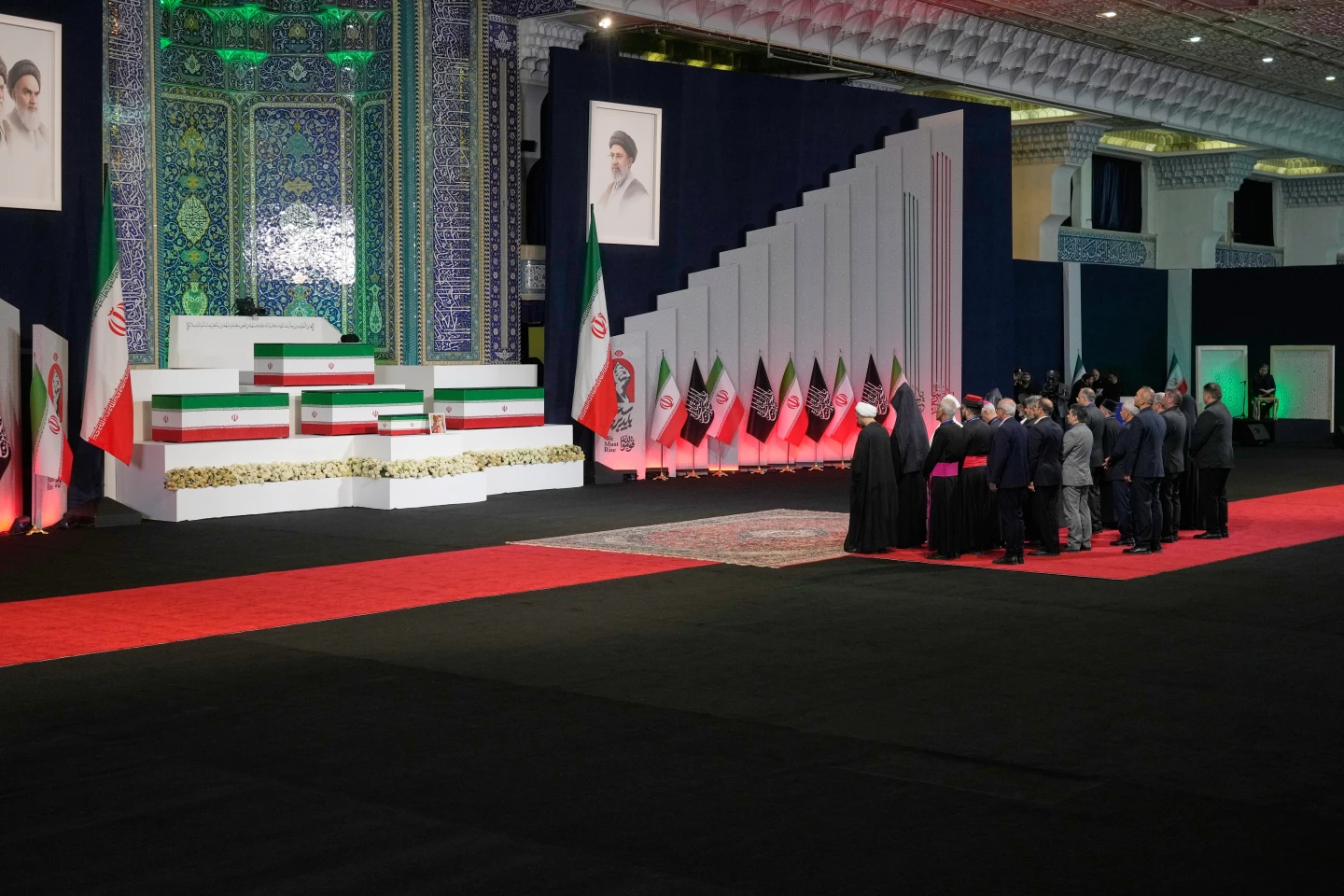
Funeral ceremony for Ali Khamenei will be "the largest rally in history" Tehran, announced the local mayor.
Iran is preparing for six days of rites and burial of the supreme leader who ruled the country for 37 years. He was killed in a rocket attack by Israel and the US at the end of February, along with some other family members.
It is unclear whether and in what condition the remains were removed from the ruins seen on satellite images. The ceremony was held until the fragile cease-fire agreement with Washington.
But Akbar Pourjamshidian, who is in charge of organizing the ceremony, says it should "strengthen national unity". The question is how much he will succeed in this, writes DW.
The system won.
Unlike Ayatollah Khomeini – who led the country for the first ten years after the 1979 Islamic revolution – his successor Khamenei ruled in detail, appointing his own people to almost every position.
This is according to Merzad Borujerdi, professor of history and political science at the University of Missouri. Under Khamenei, relations with the outside world were not only strained, but several waves of demonstrations were bloodily suppressed internally.
"But Khamenei, as head of state, was guided by the tactic of not making concessions to opponents. Not only to critics of the regime, but also to reform forces within the system," added Borujerdi to DW.
That is why society's distance from the political system is also a result of Khamenei's policy, the professor continues: "Many people are fed up with this system."
But the system has won for now, says one women's rights activist from Tehran, who asked not to be named. "It's hard for the protesters who experienced oppression in December and January to come to terms with that," she says.
Not long before the American and Israeli attacks, Iran experienced a large wave of protests that began for economic reasons. But the attack strengthened the regime in the saddle. Densely populated areas and the petrochemical industry were bombed, thousands of jobs were destroyed, he says.
"This gave the supporters of the Islamic Republic new momentum," says our interlocutor. And the opponents of the government realized that they could not hope for any help from the outside. That they are alone.
In a country of almost one hundred million people, the government will find a large number of supporters to take to the streets in honor of the late Ayatollah. From Saturday (July 4) there is a three-day ceremony in Tehran - non-working days have been declared.
Great success in negotiations
Khamenei will be buried on Thursday (July 9) in the holy city of Mashhad in the north of the country, where he was born. The day before, the procession will pass through Najaf and Karbala, the holy Shia cities in Iraq.
Tehran uses the funeral to influence the region and the world. Delegations from nearly a hundred countries have been announced.
According to Borujerdi, supporters of the government will take to the streets not only because of their loyalty to the late leader. "Two military superpowers attacked Iran, and the Islamic Republic still exists. For many supporters of the system, this is proof that it survived, despite heavy losses."
And not only that. The general impression is that Iran has fared very well in the framework agreement with the US. This includes the stated intention of the US not to interfere in Iran's internal affairs, as well as the gradual lifting of sanctions.
"The country did not receive so many concessions either after the war with Iraq or within the framework of the Atomic Agreement," says Borujerdi.
Hamidreza Azizi, a Middle East expert at the Berlin-based Foundation for Science and Politics, says the spillover of the conflict into Lebanon has made Hezbollah there closer to Tehran than ever.
He notes that tough negotiations on peace terms have shown Khamenei's policy to continue. After all, his son Mojtaba Khamenei became the new supreme leader. But Azizi warns that the particularly powerful Revolutionary Guard still has reservations. The final outcome of the negotiations is uncertain, he says.
Real journalism costs money, and we will not be bought by tycoons and corporations. Support us with a one-time or monthly donation. The time for it is now!