The Israeli military's biggest attack on Iran in decades, carried out overnight under the code name "Rising Lion", targeted all key segments of the Islamic Republic's nuclear program. During the operation, leading physicists, including Fereydoun Abbasi, were killed, and technological and military facilities were also hit. The world woke up this morning with the question: has a nuclear conflict just been avoided - or has it just begun
In a sudden Israel's attack on Iran tonight, the largest in the last several decades, was hit on everything nuclear in the islamic republic. The operation, which was carried out under the name "Rising Lion" jointly by the Israeli army IDF and the intelligence service Mossad, was obviously planned long in advance and when it was launched, it was carried out very systematically, it was justified as an urgent, preventive action because, allegedly, Iran was close to assembling its first nuclear bomb.
A day later, it is possible to talk about two scenarios. In one, Israel made the biggest mistake since its founding and started a nuclear war in which it now faces apocalyptic retribution, and the world is about to plunge into some kind of wicked nuclear denouement. In the second, Iran's nuclear program was razed to the ground overnight, and while tensions will continue, the bomb will no longer be a key issue in the Middle East.
I am of the opinion that some wicked nuclear scenario is not certain, although the situation has suddenly become, as it happens, very complex. We, engrossed in our topics, are of course taken aback by these scenarios. While we rightfully live our dramas, blockades and protests against the regime that robbed the citizens of the state, here is a little context of what is actually happening.
Photo: Ronald Zak/APFereydun Abbasi
Last night, Israel killed the most influential nuclear physicist in Iran, Fereydoun Abbasi. Casual readers of my book The Alchemy of the Bomb may remember him from the chapter on Tehran, as the tough and enigmatic physicist who, when asked by a reporter about uranium, silently looks down the marble hall and says, "We're considering every possibility." To most in the West, Abbasi was known simply as "the mastermind of Iran's nuclear program."
He is 2010-2011. was the only survivor of a series of Israeli assassinations of Iranian physicists. He was driving with his wife to the university and noticed a motorcyclist who placed a bomb on his car, after which he stopped and ran out of the vehicle with his wife, which then exploded. Fifteen years later, the Israelis still managed to liquidate him.
In addition to Abbasi, five other nuclear physicists from two universities in Tehran, the entire hard core of Iran's nuclear program, were killed. Although everyone is replaceable even in the most rigid system, killing all the scientific leaders of a nuclear program at the same time is not easily compensated. Since this morning, American journalists have compared Israel's action to "sorting out a family business" in the cult last scene of the movie "The Godfather", when the new head of the mafia family, Michael Corleone, kills all his enemies, real and potential, during the baptism scene.
Iran's nuclear program has been a hot topic for decades. The roots of the program go back to the time of Shah Reza Pahlavi, when nuclear technologies arrived in Iran through, ironically, the American program "Atoms for Peace", so that after the Islamic Revolution in 1979 and the comparatively strong development of physics in this great country, they became a threat, above all for Israel and its survival. Today, Iran has one Busher nuclear power plant with a Russian VVER-1000 reactor of 1000 MW, while it is building two new ones in the same place with the Russians. Alongside it is a whole series of nuclear technology centers, secret and public, the most famous being Natanz, south of Tehran, which was hit in Israeli attacks, but no traces of radiation were recorded. The possibility that Iran could, like the other nine nuclear powers, assemble its nuclear weapons is one of the biggest topics of international diplomacy.
Along with the tensions that accompany the war in Gaza, where the proxy armies of Iran, Hezbollah and groups in Yemen have occasionally clashed with Israel, as well as constant attacks and occasional drone war between these two countries, Iran and the US have tried on several occasions in the last decade to move towards solving this issue. Since Donald Trump became the president of the USA, these two countries have been trying to renew negotiations on the famous Iran nuclear deal for some time. The agreement, known by the name Iran Agreement, but also by the acronym JCPA, was adopted in 2015 with the great mediation of Europe. At that time, it seemed that the Iranian nuclear program and the US sanctions against this country would be ended at the same time, so life would go well. It failed after Donald Trump in the previous term, due to suspicions of violating the agreement and an Iranian document obtained by the Mossad, left the agreement.
Photo: AP Photo/Vahid SalemiMajor General Mohammad Bagheri, Chief of Staff of the Armed Forces of Iran, was also killed in the Israeli attacks
New attempts to make an agreement were not to the liking of Israel, which was worried that in the negotiations led by Trump, Iran would keep the program and one day build nuclear weapons. A day earlier, the IAEA issued its toughest assessment yet that Iran is in fact violating nuclear regulations. Analysts were alarmed by reports that Iran was enriching uranium to 60 percent (85 percent is needed for weapons, but only a few percent for civilian use), and a whole host of other reports worried the West.
And then, last night, Israel systematically launched an attack on all of Iran's nuclear capabilities, from human to technological to military.
In addition to the assassinations of physicists and a number of residences, several nuclear facilities were hit from a distance and suffered considerable damage. Military leaders were also killed, including the commander of the Revolutionary Guard, as well as the commander of the aviation. The Americans did not participate in the attack, the Israelis, as is their custom, carried it out themselves, but there is no doubt that the USA will protect Israel from the retaliation of a large and dangerous neighbor. Statements from Washington are already criticizing Tehran, and US President Donald Trump is saying that the 60-day deadline he gave to the now-dead Iranian leaders has expired. Meanwhile, you see, Iran launched a swarm of drones, but many of them were shot down. The Middle East is on the brink of a new war.
However, what happened to the nuclear program? Did he survive the assassination?
I am of the opinion that, as it happens in these circumstances, the main "nuclear event" has already happened. Iran's nuclear program has not had a difficult moment in its decades of existence. Now that, after the attack, the matter has become public, harsh words, missile exchanges and new tensions await us, new victims on all sides, and perhaps even a more serious conventional war provoked by nuclear issues. And many years of the consequences of the latter negotiations.
However, it is hard to imagine that the program survived and that we could now move towards a nuclear exchange - the first question is whether Iran even before the attack with 60 percent enrichment had the capacity to do anything at all, and secondly, would Israel embark on an attack on nuclear capacities that it has been preparing for decades, and leave Iran capable of a nuclear response and with one detonation level the narrow terrain between the Mediterranean and the Jordan Valley? Hard, really.
Tomorrow there will be war in the east, but only the sun will rise in the sky.
What is happening in the country and the world, what is in the newspapers and how to pass the time?
Every Wednesday at noon In between arrives by email. It's a pretty solid newsletter, so sign up!
Thousands of people gathered in Tirana for a new anti-government protest. Demonstrators threw stones at police and set fire to the entrance to the Ministry of Agriculture, while law enforcement responded with tear gas, water cannons and rubber bullets.
The French Ministry of the Interior estimated that there were around 410.000 people at the protests, while the CGT union stated that there were close to 800.000. In Paris, the police used tear gas and water cannons
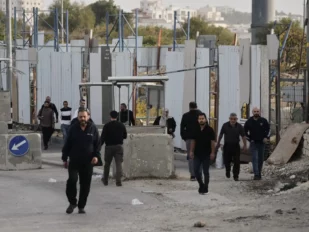
The Israeli human rights organization "Bethlehem" has condemned the plan for the "forced displacement of Palestinian residents" from a settlement in Hebron.
"Now they are talking about the threat from Russia and the beginning of preparations for war with Russia, which, in my opinion, is a kind of political schizophrenia," said Russian President Vladimir Putin
There is, literally, no difference between the one who claims it is day in the middle of the night, or the one who claims to be a giraffe, from the claims we read on billboards: that Vučić is working to unify Serbs and that Serbia is doing better and better day by day.
The pre-election arrests due to the alleged "overthrow of the state" testify to the regime's panic. The bad news for them is - they can't arrest the whole people who decided to defend themselves from progressive beatings and election theft
The ring that tightens around Ćaciland Student list is getting narrower. Because there are more and more spoiled people who see the false prophet for what he is: a street obscener who is fighting Serbia
The archive of the weekly Vreme includes all our digital editions, since the very beginning of our work. All issues can be downloaded in PDF format, by purchasing the digital edition, or you can read all available texts from the selected issue.