
The World
Data leak: More than 400.000 Russians killed in war in Ukraine
Largest ever leak of Russian casualty data shows more than 400.000 Russians killed in Ukraine war

Croatia is establishing itself as a leader in the regional arms race, investing huge resources in the modernization of the army. Is it a strategic need or racing for no real reason
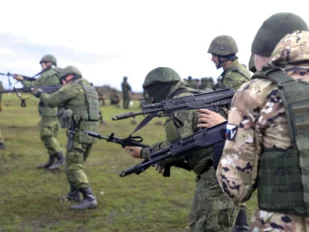
Mandatory military service in Croatia, it is already obvious, will not be introduced at the beginning of next year, as the government's official announcements stated until recently, writes Deutsche Welle (DW).
Everything is moving forward, given that the reception of a large number of recruits has not yet been organized, neither in terms of spatial capacity, nor technically. Even a sufficient number of professional staff for their training is not provided. But, in turn, it is known that only the financing of the army is increasing significantly, and for several years to come. It grew gradually in the previous four years as well, but soon it should exceed two percent of GDP, which is the amount demanded from Croatia by the most influential partners from NATO.
Part of that money will be directed to the maintenance of a larger number of people in uniform, while a larger amount of funds than ever before will be spent on the import of very expensive weapons. French Rafale military jets have already been partially delivered; recently, the purchase and sale of Bajraktar drones was agreed with Turkey, and Leopard tanks with Germany; The USA will sell its HIMARS missile systems to Croatia. Each of these purchases is hotly debated, considering the need or not for certain items, price or efficiency. In any case, it is certain that in Croatia allocations grow so suddenly and abundantly for almost nothing else.
Conditions are dictated by geopolitics
"We will definitely not stop with that," Croatian Defense Minister Ivan Anušić said last week. Because, as he adds, "there was no investment in the Croatian army for a very, very long time."
And he also says that "when you neglect the armed forces for so long, then you have an obligation to quickly and strongly equip them", explaining that "that is what we are doing right now". At the same time, "the conditions, that is, NATO's guidelines, were 20 percent, so we crossed that limit" - we are talking about the share of the cost of weapons in the total military budget. Regarding the investment of two percent of GDP in the army, Anušić announced: "Very soon the conditions will be three percent - because of the geopolitics that surround us."
"We cannot know precisely how the Croatian army will be organized after the imminent introduction of mandatory military service, but everything will be harmonized with NATO standards and models, which, among other things, stipulates Croatia's commitment to an annual investment of two percent of GDP for the army" , Božo Kovačević, a former Croatian politician and diplomat, told DW. Today, he is a lecturer at the Dag Hammarskjeld College of Diplomacy and International Relations in Zagreb, as well as a foreign policy analyst, and he believes that the situation surrounding the growth of the army and arming of Croatia is accompanied, as he said, by a kind of general hysteria.
"This applies to high politics and the media public, and it is a direct consequence," Kovačević believes, "of the American disquiet with the fact that they cannot be alone forever as the untouchable number one in the world." The attempt to maintain the position of absolute hegemon results in an increase in overall tension. The United States simply does not want to seriously talk with competitors of equal strength for a long time, but only to impose conditions, and China and Russia do not agree to that. At the same time, it is the main reason for increasing the chances of igniting wider conflicts. Here, Croatia behaves like others in NATO, which is quite expected."
It will sink into addiction
"A larger allocation for the army is also necessary because it has been neglected for a long time, so I would agree with more than that two percent." But, I think that this method and approach is completely wrong", evaluates Kovačević. Namely, he believes that Croatia has not considered and rationally approached the strengthening of its army, which it intends to equip almost exclusively with foreign equipment. And it could and should, in his opinion, invest in research and development in the long term, e.g. air defense systems and some types of weapons. Even better than that, he believes, would be dual technologies, which imply application both in the army and for civilian purposes.
Such values could then be exported, but Croatia, he says, no longer considers even the elementary possibility of its own production. "In this way, however, we are constantly making ourselves more and more financially and technologically dependent, and that is a wrong conception." And the cost of maintaining imported equipment will be increasing, and domestic capacities will continue to stagnate. We will completely lose the ability to undertake such a thing, we will be left without that intelligence, as well as for the production of other consumer goods. And foreigners," says Kovačvić, "don't sell the most modern things they have, but still keep it for themselves."
"Logical, because that's how they maintain their military advantage over others, while Croatia sinks into a spiral of dependence on other people's loans and technology. Finally, in this way, it comes under a permanent and comprehensive type of control from the outside," said Božo Kovačević categorically.
On the other hand, Branimir Vidmarović, also a foreign policy analyst and international relations expert at the University of Pula, is inclined to point out first of all the specific regional political context within which Croatia operates. Of course, we are talking about the Balkans or Southeast Europe, and in fact, above all, about the close neighborhood.
Fear of the new Great Serbian policy
"It seems that in this part of the world we are dealing with a kind of small arms race, specifically between Croatia and Serbia." At the same time, nothing particularly challenging, without some real security predispositions. This is why the military budgets of those two countries have been increasing in recent years. Here, Serbia is perceived as a country geopolitically opposed to Croatia, because it strives to maintain a partnership with both the West and the East, but it is reforming in line with NATO, which is much less talked about," Vidmarović told DW, emphasizing Serbia's partnership with the National Guard. the US state of Ohio.
Although American weapons arrive in Serbia, such as armored vehicles called Humvees, Chinese ones also arrive there, e.g. the FK3 air defense system, or even Russian, such as the Repellent anti-drone system. Moreover, in this sense, Serbia is probably the most diversely armed country on the continent, and its arms sales are no different. It distributes artillery and other ammunition, as well as weapons, to all countries, including Ukraine and Israel. During that time, joint exercises of the Serbian Army and the American National Guard have been held without interruption for 15 years, and exchanges and training have been organized.
Various activities are organized within the mentioned program, although this is practically unknown in Croatia, while the image of Serbia as a collaborator of Russia, politically and more broadly, is enhanced. Vidmarović therefore notes that the USA is turning Serbia into a reliable Western stronghold in the Balkans, however controversial it may sound in Croatia. "Anyway, all the evidence points to that." That's how Serbia is arming itself with Western weapons," he adds, "but here a part of the establishment is causing fear of the new Great Serbian policy, everything is read in that key. In particular, there is a fear that this would happen if Russia militarily defeats Ukraine."
Profit as a motive
"Our logic is affected even more by the desire to be better than our neighbors, with the influence of NATO's demand for the two percent of GDP. During the first mandate of Donald Trump, the Baltic countries, and several of them in the East, drastically increased their military budgets. Croatia did not, and now believes that it will be very resentful if it avoids it again. And there are also domestic political points in the circumstances of a growing sense of insecurity, where virtually everyone is being militarized. The whirlwind of conflict escalation is accelerating, and that is why the government that introduces additional firmness and order can significantly profit from it politically," says Branimir Vidmarović.
"After all, we don't know to what extent the Western military industry is currently pressuring governments like ours to actually buy more weapons." If we go by the logic that Trump publicly said with a large dose of coercion that Europe must switch to American gas, then there is probably a stronger compulsion to saturate the European defense with American weapons as much as possible," Vidmarović estimates. In the end, it is quite certain that the entire militarization, in Croatia or much more widely, has as its reason (and) the financial profit of the biggest market protagonists, and not only the ideological-political, or elementary, general security.
Largest ever leak of Russian casualty data shows more than 400.000 Russians killed in Ukraine war

At least 11 people died in two chain collisions on the Trakia highway in Bulgaria. 86 vehicles were involved, and around 50 people were injured

The global race in the development of artificial intelligence has boosted Chinese exports. Increasing dependence on foreign markets is straining Beijing's relations with its trading partners
New negotiations between Ukraine, the USA and Russia are planned for November 10 and 11 in Abu Dhabi. This is the first meeting in this format after nine months

A serious accident occurred on Monday at a steel factory near Izmir, when an explosion claimed at least 17 lives. According to the first information of the local authorities, the accident was preceded by the fall of the crane and damage to the gas pipeline

At the moment when the institutions of the Republic are destroyed, when Vučić's octopus is still alive, when people are disgusted by the injustice and the stench left behind by the Essenes regime, we have, as Machiavelli said, only civic virtue as the fuel with which we can return to the beginning

The four independent members of REM are an example of perseverance and civic responsibility. Rodoljub Šabić even, upon leaving the premises of REM, after the sentencing of the Informer, experienced that the Essenes insulted him, hit him with their hands and feet. But that too will soon be over

Vučić pardoned the batterers and Dijana Hrkalović. The election winners should abolish the sultan's power that allows one man to run afoul of the entire judicial system

Time explores: The construction of the St. Sava Temple
Did the money paid by the Government to SPC end up in Moscow through Alta Bank? subscribeThe archive of the weekly Vreme includes all our digital editions, since the very beginning of our work. All issues can be downloaded in PDF format, by purchasing the digital edition, or you can read all available texts from the selected issue.
See all



