
The World
Data leak: More than 400.000 Russians killed in war in Ukraine
Largest ever leak of Russian casualty data shows more than 400.000 Russians killed in Ukraine war

Are you interested in what the defected Federal Security Service (FSB) officer Aleksandar Litvinjenko wrote in the book "Ljubljanka - Criminal Group"? Or what are Jehovah's Witnesses? You type in a search term and - the police knock on your door
Upper house Russian On July 25, the parliament approved a new law on censorship which introduces fines for anyone caught browsing the internet or accessing content officially labeled as "extremist". The law will come into force when signed by the president Vladimir Putin, he writes Deutsche says.
That comprehensive law doesn't stop there: it also provides for penalties for promoting VPN services - tools that many Russians use to bypass state censorship on the Internet and access blocked information.
After the lower house, State Duma, supported the law on July 22, a small group of people protested in front of the parliament building. It was the first protest in a long time. One of the banners read: "For a Russia without censorship. Orwell wrote a dystopia, not a manual." Police quickly arrested the man holding him.
The classic dystopian novel "1984." by George Orwell, published in 1949, and interpreted as a warning against totalitarian government, inspired by the author's observations about repression in Nazism and Stalinism.
Among the protesters was Boris Nadezhdin, who was supposed to run in the 2024 presidential elections as the only liberal candidate. However, the election commission refused to accept his candidacy.
"The first stage was banning websites. Now they are banning people from even browsing the internet. It's already close to thought crime," Nadezhdin told DW, alluding to Orwell's novel and its central theme of punishing citizens for thinking that deviates from state ideology.

What is "extremist" content in Russia?
The new law stands out even among dozens of censorship laws passed by the State Duma before and after Russia's full-scale invasion of Ukraine in 2022. According to the bill, only the search of the so-called "extremist materials" on the Internet will now be considered an administrative offense, punishable by a fine of up to the equivalent of 55 euros. Until now, punishments were only provided for actively sharing prohibited material, such as posting critical comments on social networks.
What is considered extremist material is determined by a list compiled by the Russian Ministry of Justice. It currently contains more than 5.000 items. Officials and lawmakers argue that the law targets those who systematically search for banned content, not average citizens who browse it occasionally. However, they did not clarify what exactly is considered a "systematic search".
The register includes leaflets, brochures, books, newspapers, films, video clips, works of art and songs. In theory, it should contain content that incites inter-ethnic hatred, as well as the writings of the leaders of the German Nazi and Italian Fascist parties. In practice, the list also includes works that criticize the government or oppose authorities.
One of them is the book from 2002 by the Russian defected former officer of the Federal Security Service (FSB) Alexander Litvinenko. Entitled "Ljubljanka - Criminal Group", the non-fiction book describes how Russian security services allegedly orchestrated the 1999 bombings of residential buildings in Moscow and other acts of terrorism to help Putin come to power.
The black list also includes the materials of the Jehovah's Witnesses religious movement, which Russia declared extremist in 2017.
In 2023, journalists from the independent Russian media outlet 7×7 reported that the list of "extremist" materials was growing by hundreds of new items each year. Between 2011 and 2022, almost 15.500 administrative procedures were initiated due to the distribution of "extremist" content. That's an average of 1.300 cases per year, most of which resulted in fines of up to around 50 euros.
Growing number of "extremists" in Russia
The law caused widespread public outcry, even among otherwise pro-Kremlin-oriented public figures who criticized it on social media. Margarita Simonyan, the editor-in-chief of RT state television, complained that the new law would prevent her from researching and "calling out" extremist organizations.
Since the start of Russia's invasion of Ukraine, authorities have added dozens of prominent Russians and organizations critical of the war to a list of banned extremists and terrorists. Among them are writers, musicians, journalists and popular bloggers, such as writer Boris Akunjin or TV presenter Alexander Nevzorov.
Meta, the owner of Facebook and Instagram, was declared extremist in March 2022, after announcing it would allow posts supporting the killing of Russian soldiers on its platforms, which Russia labeled "Russophobia."
Deputy Speaker of the State Duma Sergey Boyarsky, a member of the ruling conservative United Russia party, tried to reassure citizens by claiming that using social networks under the Met or searching for materials created by people declared extremists would not be punishable. According to him, the penalties will only apply to searching content that is officially classified as extremist.
In reality, it is difficult to predict how the Russian police will enforce the new law. "Everything will depend on the specific man in uniform who is given the power to interpret your guilt," Dmitrij Zair-Bek, head of the First Section legal project for human rights, told DW.
According to him, it is likely that, as is already happening, the mobile phones of Russians will be searched more often during border controls.
Belarusian script
Another possible scenario is that Russia adopts the surveillance methods used in neighboring Belarus. There, platforms like Instagram, Xx and YouTube, which are blocked in Russia, are still available. However, subscribing to banned channels on those platforms is prohibited.
"Censorship in Belarus also exists in physical space. The police are looking into citizens' phones on trains and in student dormitories. It is almost impossible to refuse control," Dmitry Navosha, co-founder of the international sports portal Tribuna.com, told DW. Access to his site is not restricted in Belarus, but the site was declared extremist after Navosh repeatedly publicly criticized Belarusian leader Alexander Lukashenko and the violent crackdown on protests in 2020.
As a result of the extremism flag, visitors to the sports portal risk punishment just for viewing the content.
At least 10.000 political prisoners
Since the start of the attack on Ukraine, Russia has significantly tightened restrictions on free speech, including banning the spread of what it considers "false information" about the war, as well as expanding the "foreign agent" label for media and organizations deemed politically active with foreign funding.
In the spring, Russia's State Investigative Committee reported that since 2022, 605 criminal proceedings had been initiated under two new articles of the Criminal Code - one for spreading "fake news" about the Russian military and the other for "discrediting" the armed forces.
Under those laws, Russian citizens have been fined or imprisoned for calling Russian actions in Ukraine a war, instead of a "special military operation," as well as for posting on social media about events such as the massacre of civilians in the Ukrainian city of Buchi, which was blamed on the Russian military.
At the end of 2024, the human rights organization "Memorial" reported that at least 10.000 political prisoners were in Russian prisons. When President Vladimir Putin signs this new law, the number of people who will be punished for expressing a free opinion could increase significantly.
Source: DW
Largest ever leak of Russian casualty data shows more than 400.000 Russians killed in Ukraine war

At least 11 people died in two chain collisions on the Trakia highway in Bulgaria. 86 vehicles were involved, and around 50 people were injured

The global race in the development of artificial intelligence has boosted Chinese exports. Increasing dependence on foreign markets is straining Beijing's relations with its trading partners
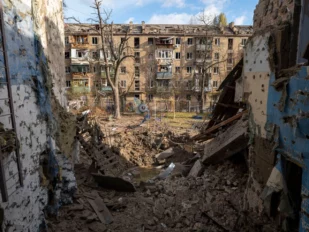
New negotiations between Ukraine, the USA and Russia are planned for November 10 and 11 in Abu Dhabi. This is the first meeting in this format after nine months

A serious accident occurred on Monday at a steel factory near Izmir, when an explosion claimed at least 17 lives. According to the first information of the local authorities, the accident was preceded by the fall of the crane and damage to the gas pipeline

At the moment when the institutions of the Republic are destroyed, when Vučić's octopus is still alive, when people are disgusted by the injustice and the stench left behind by the Essenes regime, we have, as Machiavelli said, only civic virtue as the fuel with which we can return to the beginning

The four independent members of REM are an example of perseverance and civic responsibility. Rodoljub Šabić even, upon leaving the premises of REM, after the sentencing of the Informer, experienced that the Essenes insulted him, hit him with their hands and feet. But that too will soon be over

Vučić pardoned the batterers and Dijana Hrkalović. The election winners should abolish the sultan's power that allows one man to run afoul of the entire judicial system

Time explores: The construction of the St. Sava Temple
Did the money paid by the Government to SPC end up in Moscow through Alta Bank? subscribeThe archive of the weekly Vreme includes all our digital editions, since the very beginning of our work. All issues can be downloaded in PDF format, by purchasing the digital edition, or you can read all available texts from the selected issue.
See all



