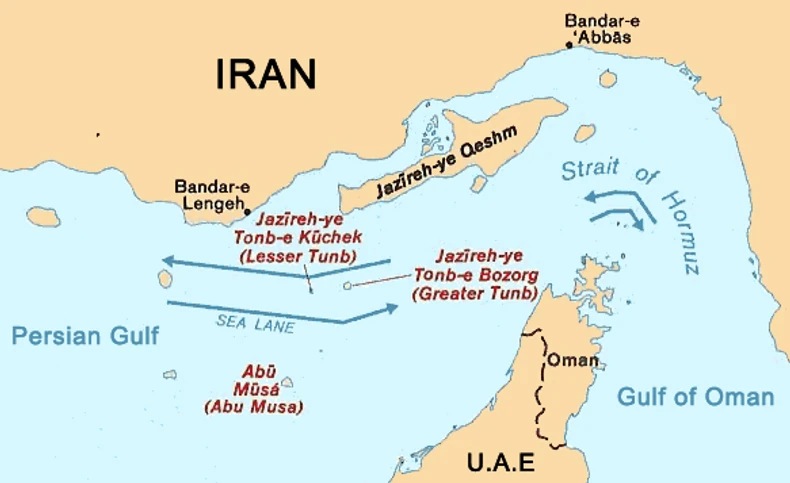
The Strait of Hormuz is considered the world's most important passage for transport OILHostilities between Iran and Israel caused fears that ship traffic and the flow of crude oil could slow down, he reports Deutsche says.
The Strait of Hormuz is a key sea passage between Oman and Iran, connecting the Persian Gulf with the Gulf of Oman and the Arabian Sea. The US Energy Information Administration (EIA) describes it as "the world's most important oil transit bottleneck".
At its narrowest point, the strait is only 33 kilometers wide, while the shipping lane is only two kilometers wide in each direction, making it crowded and dangerous.
Large quantities of crude oil, extracted from oil fields across the Persian Gulf by OPEC member countries such as Saudi Arabia, the United Arab Emirates (UAE), Kuwait and Iraq, pass through this strait and are distributed around the world.
According to data from Vortexa, a consulting firm that analyzes the energy and transport market, it is estimated that around 20 million barrels of crude oil, condensate and fuel pass through this route per day. Qatar, one of the world's largest producers of liquefied natural gas (LNG), is heavily dependent on this strait for the export of its LNG.
What is the current situation in the strait?
The conflict between Israel and Iran has again drawn attention to security in this sea passage.
Iran has in the past threatened to close the Strait of Hormuz to traffic in response to pressure from the West. However, since the conflict broke out, there have been no major attacks on commercial shipping in the region.
However, ship owners are increasingly cautious, some have increased security measures, while others have canceled routes through that part, the AP agency reported.
Electronic jamming of commercial ships' navigation systems has increased sharply in recent days around the strait and the wider Persian Gulf, maritime sources told Reuters. This disruption, they say, affects vessels passing through the region.
With no end in sight to the conflict, markets remain tense. Any blockade of the strait or disruption of oil flow could cause a sharp spike in crude oil prices and severely hit energy importers, particularly in Asia.
Meanwhile, freight rates for tankers carrying crude and refined oil from the region have risen significantly in recent days. The cost of transporting fuel from the Middle East to East Asia rose nearly 20% in the three days ending Monday, Bloomberg reported, citing data from the Baltic Stock Exchange. Prices to East Africa, meanwhile, jumped by more than 40 percent.
Who will be most affected in the event of a supply disruption?
According to EIA estimates, as much as 82% of crude oil and other fuels that pass through the Strait of Hormuz go to Asian consumers.
China, India, Japan and South Korea are the main destinations: almost 70% of the total flow of crude oil and condensate passing through the strait.
This is why Asian markets would be the most affected in the event of a supply disruption.
How would closing the strait affect Iran and the Gulf states?
If Iran takes steps to close the Strait of Hormuz, it could trigger military intervention by the US. The US Navy's Fifth Fleet, which is based in nearby Bahrain, is tasked with protecting commercial shipping in the region.
Any attempt by Iran to disrupt the flow of oil through the strait could threaten Tehran's relations with Gulf Arab states such as Saudi Arabia and the UAE - countries with which Iran has been carefully building better relations in recent years.
Gulf countries have so far criticized Israel for attacking Iran, but if Iranian actions disrupt their oil exports, they could be forced to turn against Iran.
In addition, Tehran itself depends on the Strait of Hormuz to export its oil to customers, making the closure counterproductive, experts say.
"Closing the Strait of Hormuz would be counterproductive for Iran's relations with its only oil buyer - China. Iran's economy is largely dependent on the free passage of goods and ships through this sea passage, as its oil exports are carried out entirely by sea," the Reuters agency quotes JP Morgan analysts - Natasha Kaneva, Pratika Kedia and Ljuba Savinova.
Are there alternatives to the Strait?
The countries of the Persian Gulf, such as Saudi Arabia and the UAE, have been looking for alternative routes to bypass the strait in recent years. Both countries have established infrastructure that allows them to transport some of their oil in other directions.
For example, Saudi Arabia operates an East-West pipeline with a capacity of five million barrels per day, while the UAE has a pipeline connecting its onshore oil fields to the export port of Fujairah on the coast of the Gulf of Oman.
EIA estimates that in the event of an interruption of traffic through the Strait of Hormuz, around 2,6 million barrels of crude oil per day could be transported via alternative routes.