
The World
Data leak: More than 400.000 Russians killed in war in Ukraine
Largest ever leak of Russian casualty data shows more than 400.000 Russians killed in Ukraine war

This shout that begins the chorus Marseillaise - for many, including the French themselves, one of the most bloodthirsty anthems in the world - perhaps best reflects the state of mind of the French political and military leadership since the war in Ukraine pointed not only to certain shortcomings of the French defense model, but also to potential cracks in cohesion at the level of NATO and the EU (unpredictable Trump). And all this in the midst of radically changed immediate threats to peace on the European continent (unpredictable Putin)
In addition to bringing many revolutionary changes to the modern way of warfare, counting new technical means - first of all, the mass use of drones - the war in Ukraine he pointed out the great shortcomings in the field of defense of numerous Western countries (mainly members of NATO), including France. Since then, there has been a visible "militarization" of the political discourse, followed by a sudden increase in the defense budget, with the aim of modernizing the French army and adapting it to the current geostrategic circumstances.
CONVENTIONAL AND NUCLEAR NUMEROLOGY

Before we get into the more delicate considerations of politics and the budget, and to some extent French military doctrine itself, let's start with the always handy numerology. According to official data from 2024, the French army has 200.000 active soldiers and officers and 41.000 reservists - which makes it the second largest army in Europe (behind Poland with a little more than 202.000, and ahead of Germany with 181.000 active soldiers). In addition, of the most frequently mentioned "sockets", France has 222 "Leclerc" tanks, 196 fighter planes, 6 nuclear attack submarines, 4 strategic nuclear submarines for launching nuclear missiles and one also a nuclear aircraft carrier. In addition, let us recall that France is the only one in the EU to have a strategic nuclear military arsenal - colloquially, a nuclear deterrent - of around 300 warheads (carried by aircraft and submarines).
Since the end of the Cold War and the changes in the "constellation of international relations" at that time, France has given up nuclear tests (switching to simulations in 1996) and almost halved its nuclear arsenal, according to the doctrine of "strictly necessary" - which has since been modernized and is quite sufficient to seriously deter anyone who would "dare" to touch French territory.

Likewise, and especially since the 2000s and the beginning of "happy economic globalization", apart from drastic budget savings, France has significantly reduced military effectiveness and resources (abolishing mandatory military service in 1997). With the disappearance of the Soviet bloc, the threats became significantly more diffuse and undefined - rebel groups, terrorist organizations, large transnational criminal organizations and the like, so the military apparatus itself experienced changes both in the number of people and techniques, as well as in their purpose. Although at the very top of the world in terms of technical equipment and capacities - above all its own, therefore largely independent of American influence - and always ready for "projection" to any point on the planet of vital importance for France, compared to other great powers (the USA, Russia or China, to mention only them), the French army represents only an "expeditionary corps" which many also call a "bonsai" army - based on the ancient Japanese tradition of growing miniature trees, because it has everything that a "normal" tree should have, only "in a small way". "A little bit of everything, and quite a bit of nothing," the cynic would add.
Finally, although it represents a kind of "strategic island" - it is surrounded only by allies, and is not threatened by a "direct invasion" (Russia, for example), France is today most exposed to the already known "hybrid" methods of warfare - mainly in the cyber and information space (with sometimes visible consequences in the real world).
DEFENSE POLICY AND MILITARY BUDGET
From a strictly technical-technological aspect, the war in Ukraine pointed to France's big backlog when it comes to the production and use of drones, so a large part of future budget funds will be focused primarily on that type of warfare (and all in an effort to gain complete autonomy in relation to the US, whose drones are currently used by the French army). The rest of the increased investments will be focused on the modernization of the nuclear arsenal and the accompanying naval, aviation and space technology, as well as on increasing the number of personnel - primarily reserves to 80.000 by 2030.
However, the multi-decade reduction in investment in defense inevitably resulted in a drastic reduction and weakening of industrial production capacities, which today is best reflected in the fact that the total European ammunition production capacity is not sufficient to cover the "daily" level of ammunition consumption on the Ukrainian battlefield (not to mention the renewal, replenishment and modernization of its own resources). The army and industry were reduced to the necessary minimum, barely enough for their own needs (and above all exports - France is the second world exporter of weapons and military equipment, with an income of almost 20 billion euros last year), that is, occasional "projections" to other battlefields, and not for a war of "high intensity and long duration", as the war in Ukraine turned out to be.

According to established French practice, the military budget is the subject of a special law that is adopted (and amended if necessary) for a period of 4 to 6 years. With the deterioration of global geostrategic circumstances - the war in Ukraine and the Middle East, as well as threats to stability in the Indo-Pacific region (China-Taiwan-USA relationship) - a drastic increase in the French military budget, which for the period 2014-19 amounted to 190 billion euros, from 2019 to 2025 295 billion, so that in the latest version 2024-30. a total allocation of 413 billion euros was foreseen. However, according to the latest announcements by President Emmanuel Macron, the doubling of the military budget will be achieved as early as 2027, that is, by the end of his current, second mandate.
In his official address to the armed forces of France on July 13, President Macron announced an additional three and a half billion euros for the army in the next budget - for the year 2026 - the adoption of which, however, is still more than questionable, given the fact that Prime Minister Bayrou has to "pinch" at least 40 billion somewhere by September. Bajru has already proposed the abolition of two non-working days, at least one "empty year", i.e. a whole year without increasing the minimum wage and other social benefits, a drastic reduction in the number of employees in the public administration - above all in the already threatened healthcare and education, as the majority of French people suspect, and even potential taxation of certain layers of pensioners - anything but an increase in taxes. Against the background of the astronomical public debt of a paltry 3350 billion euros (114% of GDP) and an abysmal budget deficit of around 170 billion (5,8% of GDP), to increase investment in defense there is more and more mention of issuing some kind of loan (for the revival of the French army, a cynic would add), that is, it calls on French citizens to voluntarily participate in that financing, of course, each according to their means.
Both the EU and NATO
The drastic increase in the military budget also needs to be seen from the dual aspect of France's membership in the EU and NATO. Certain doubts about the solidity of NATO's internal cohesion were certainly shaken by NATO itself big boss Alliance, Donald Trump personally, with his vacillating hot-cold attitudes and even more unpredictable moves, with which he blackmailed the Western European partners by conditioning potential American support (in the spirit of Article 5 of the NATO Founding Treaty) with an increase in military budgets, which could best be seen at the last NATO summit at the end of last June, when the Europeans pledged to increase the military budget to 3,5% of GDP, i.e. 5% by 2035. On the other hand, the shaken confidence in the reliability of the American partner within NATO forced the EU to commit to providing a total of 800 billion euros for defense investment until 2030. All this, of course, was preceded by a radical change in Germany's course, after Chancellor Mertz decided to double the German military budget. All these tectonic disturbances in terms of defense policy, primarily within the EU, and the awakened awareness of the need for change at all levels - from budget to doctrine - were preceded by the Russian invasion of Ukraine and completely new threats to peace, primarily on European soil.
In that key, it is necessary to read the latest dimension of rapprochement between France and the United Kingdom, and after Brexit in January 2020, and the complex relations that these two countries have gone through in the meantime. During Macron's recent state visit (from July 8 to 10), that rapprochement was announced in London by Prime Minister Keir Starmer and Emmanuel Macron. After the previous Lancaster Treaty on military cooperation between the two countries from way back in 2010, today we are witnessing a kind of change in military doctrine because the French and British partners reached an agreement on "coordination of their independent nuclear deterrence capacities", which in translation means that France and the United Kingdom undertake to coordinate their nuclear deterrence strategies and a potential joint nuclear response by one or both partners in the event of an "extreme threat to the vital interests of either of them", whereby each of the partners retains complete independence and autonomy in deciding on the engagement of its nuclear force (regardless of the decision of the other partner). It is, of course, a clear signal of unity and strength of the only two Western European countries in possession of nuclear weapons, addressed to any potential aggressor, especially Putin's Russia, should it dare to launch new attacks on European soil. In addition, the British and French partners have expressed their readiness to send 40.000 soldiers to Ukraine for rear guard purposes once a truce is reached between Russia and Ukraine.
This step forward in military cooperation on European soil represents a radical change in the French doctrine of nuclear deterrence, whereby French vital interests no longer stop at the German border as in the time of De Gaulle, and the French nuclear umbrella potentially extends to the entire EU/NATO only if France so decides, which only adds power to the new French "strategic ambiguity/vagueness".

PUMPING NATIONAL UNITY
All the listed trends, decisions and moves to strengthen French military preparedness have so far been accompanied by the constant strengthening of the political discourse and public narrative (sometimes on the border of collective paranoia) about the necessity of national unity and cohesion, which culminated in the previous month, with successive statements first by Nicolas Lerner, the head of the French intelligence service DGSE, in an exhaustive interview given on July 8 (for the first time in almost ten years), then in a notable press conference of the chief of the Joint General Staff of the French Army General Thierry Burckhardt on July 10 (for the first time in five years) and finally Macron's speech on July 13, the day before the traditional military parade on July 14, the French National Day. Both high-ranking officers pointed to Russia as the first and greatest immediate threat to vital French interests, pointing to the increasingly frequent and increasingly complex methods of hybrid war directed against France - with a constant reminder of the crucial importance of achieving a solid national cohesion of French society, which according to many is susceptible to internal divisions in which perfidious Russian propaganda surprisingly easily finds fertile ground.
French President Macron went a step further in his acute perception of the situation by declaring that "since the Second World War, freedom and peace have never been more threatened on European soil", pointing out that "if you want to be free, you must be feared. And in order to be feared, you must be powerful", calling on the French to unite and take care of the "cognitive security" of every French citizen (alluding above all to sweet-talking Russian propaganda).
Finally, will political determination and voluntarism, with tireless pumping of patriotism and national cohesion, with all the drastic increases in the military budget, be enough to start and strengthen the weakened military industry (whose production capacities cannot be started by a simple "push of a button", while in the context of universal indebtedness, the promised "safe" orders for the domestic armed forces are persistently absent), and deter any potential opponent from any attack on French vital interests, or, on the other hand, the fiery cry from the title will turn into the first verse of Gainsbourg's legendary reggae-Marseillaise "To arms... and so on", the very near and above all uncertain future will inevitably show.
Largest ever leak of Russian casualty data shows more than 400.000 Russians killed in Ukraine war

At least 11 people died in two chain collisions on the Trakia highway in Bulgaria. 86 vehicles were involved, and around 50 people were injured

The global race in the development of artificial intelligence has boosted Chinese exports. Increasing dependence on foreign markets is straining Beijing's relations with its trading partners
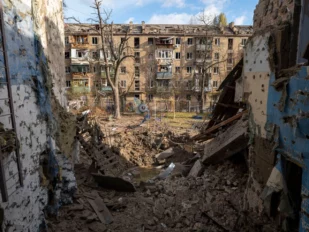
New negotiations between Ukraine, the USA and Russia are planned for November 10 and 11 in Abu Dhabi. This is the first meeting in this format after nine months

A serious accident occurred on Monday at a steel factory near Izmir, when an explosion claimed at least 17 lives. According to the first information of the local authorities, the accident was preceded by the fall of the crane and damage to the gas pipeline

At the moment when the institutions of the Republic are destroyed, when Vučić's octopus is still alive, when people are disgusted by the injustice and the stench left behind by the Essenes regime, we have, as Machiavelli said, only civic virtue as the fuel with which we can return to the beginning

The four independent members of REM are an example of perseverance and civic responsibility. Rodoljub Šabić even, upon leaving the premises of REM, after the sentencing of the Informer, experienced that the Essenes insulted him, hit him with their hands and feet. But that too will soon be over

Vučić pardoned the batterers and Dijana Hrkalović. The election winners should abolish the sultan's power that allows one man to run afoul of the entire judicial system

Time explores: The construction of the St. Sava Temple
Did the money paid by the Government to SPC end up in Moscow through Alta Bank? subscribeThe archive of the weekly Vreme includes all our digital editions, since the very beginning of our work. All issues can be downloaded in PDF format, by purchasing the digital edition, or you can read all available texts from the selected issue.
See all



