The centenary of Mussolini's coming to power, which ended on October 28, would have a completely different connotation if it weren't for the current electoral victory of the extreme right led by Giorgio Meloni. Everything would end with a few television shows, a series of lectures on the consequences of this fatal event for Italy, along with a few poorly attended meetings of the guardians of Duce's image and work, and that would be all. The fact that both events are marked as historical imposes a whole series of associations, which go beyond the framework of an exclusively historical narrative. Because this is no longer just about the past. It is the future that is thought-provoking and causes considerable concern.
ESCALATION OF VIOLENCE

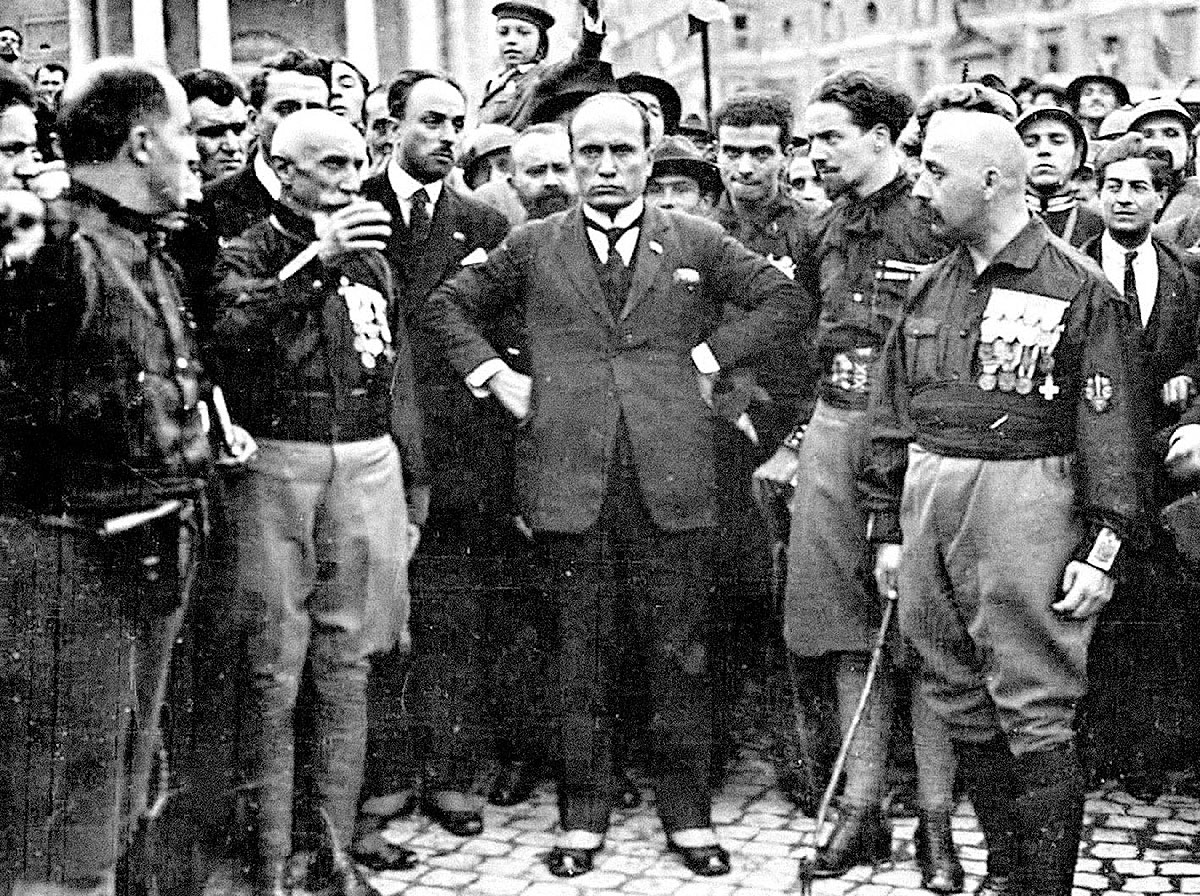
42-08 March_on_Rome_1922_-_MussoliniONE OF THE EVENTS THAT MARKED THE 20TH CENTURY: Mussolini's campaign on Rome
And what happened on October 28, 1922, a date that marked a turning point in the fate of Italian society, the state and the monarchy and opened a new chapter in the history of Europe and the rest of the world? Tens of thousands of members of the National Fascist Party (PNF) flocked to Rome in order to demonstrate the strength of the movement, which wanted to bypass the democratic procedure and "establish order" in a country torn by unrest, in Rome. At the head of the party, but not at the head of this expedition called the March on Rome, was Benito Mussolini, a man who brought his ostentatious, arrogant spirit into perfect harmony with the violent movements and groups that ran throughout Italy in the first years of the war spreading violence and fear. .
Like the rest of Europe, Italy is living through that painful period in the chaos of economic and social crisis, unemployment, hunger, disappointment and strong political turbulence characterized by the rise of leftist political forces and the pathological fear of a system ready to defend itself at any cost.
On the social scene, there were suddenly thousands of still armed demobilized soldiers who, in a heated political environment, wandered between the right and the left: while some groups saw themselves exclusively as members of the exploited classes, others aligned themselves with those centers of power that wave flags and myths about national power and prestige. The echoes of the October Revolution, which reddened the horizons of most of Europe, and in Italy caused a strong reaction from the ruling circles, so that the fear of encroaching Bolshevism will remain a leitmotif during the following decades and be a justification for even the most eyeless fascist atrocities.
The next two years, 1921 and 1922, will be marked by a strong escalation of violence, which was initially mutual, coming from both left and right and taking the form of a real civil war. The squadristi, armed violent groups, merge with Mussolini's fascists and become his punching fist. Thus, during the first quarter of 1921, 726 attacks were carried out on various civic or left-wing organizations and institutions in the Padua plain alone. It is assumed that during these two years the fascists liquidated around three thousand people, while their human victims since 1919 numbered 425 activists. In addition to black shirts and the same fez with a tassel, new symbols of the encroaching Italian fascism were also promoted: castor oil, a club and a "boxer" for a hand. A dagger has long been considered an integral part of personal equipment. They went to the action in a truck, ten or more of them, they broke down doors and destroyed everything they could get their hands on. More visible trade union activists, leftists or simply all those who offered any kind of resistance to violence were arrested and doused with castor oil, and then, so humiliated and shamed, they were led through the streets.
TAKEOVER OF POWER
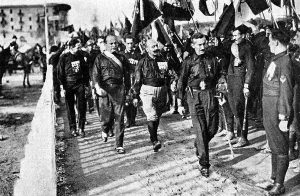
42-07 benito-mussolini-marching-into-rome-81f6c3-1024...
As the violence flared, the state government became increasingly disinterested in what was happening across the country. Moreover, in situations where mistreated citizens stood up to defend their lives and property, the police sided with the aggressors, while the prosecutor's office and the courts remained silent. Italy was slowly turning to fascism. Not the whole one, not the oppressed, mistreated and humiliated one, but the one who was silent. Institutions were collapsing like houses of cards, which, as the height of fascist hypocrisy, was presented as a weakness of the state that had to be replaced by a stronger, more determined and more unscrupulous bureaucratic apparatus. During these two years, Mussolini simultaneously encouraged and directed his squad members, and on the other hand, beguiled the civil politicians with his good will to resolve the matter peacefully. This tactic has had success. Alcide de Gasperi, the first post-war Italian Prime Minister and founder of the Christian Democratic Party, wrote at that time, in 1921: "We will not support the views of those who intend to condemn every fascist action under the guise of a general condemnation of violence as such. There are cases when force, and even when it appears in the form of violence, is in fact defensive, and therefore legitimate."
With such "democrats", Mussolini had nothing to worry about.
The royal government, frightened by these events, which, regardless of the many sympathies expressed, were nevertheless unconstitutional, prepared a decision on the introduction of a state of emergency, which had already been sent to the prefectures and military command centers. The army began to arrive in Rome under long pipes and heavy weapons. The only thing missing was the king's signature.
Fearing a possible coup d'état, but also taking into account Mussolini's departure from republicanism and his declaratively expressed attachment to the monarchy, the king decided not to sign the decree imposing a state of emergency. All orders issued up to that point in order to resist the fascists were revoked in the next few hours. Thus, the Eternal City opened its gates to the phalanxes of fascists, who came to take "what belonged to them". It was, of course, about the government. Absolute power.
Mussolini waited for the news about the success of his comrades in the town of Kavalaska, not far from the Swiss border, so that, in case of failure, he would have enough time to hide. That gesture of his, as well as his decision to take a train ticket for a prompt departure to Rome, right in the sleeping car, symbolically marked the character of this man, but in a certain way also profiled the image of Italian fascism as an arrogant, operetta mise-en-scene and empty rhetoric, which during in the next decades to annoy their "Axis" allies so terribly.
Two days later, on October 30, King Vittorio Emanuele III entrusted Benito Mussolini with the mandate to form a new government, which many thought would be short-lived. It was evident that the arrival of the fascists suited some, some had nothing against it, while the majority of political subjects of that time were not even aware of the impending danger. During the vote of confidence in Mussolini's government, the proposal received 316 votes of support, even though only 35 members of the fascist party sat in the benches. Many illusions were dispelled after a little more than two weeks, when in his famous speech in front of the Parliament, Mussolini said: "I could have turned this deaf and gray hall into a military bivouac, I could have dissolved the Parliament and formed a government exclusively of fascists." I could. But, until now, I didn't want that."
The message was unequivocal and extremely honest: I could, but I didn't want to. In the next twenty-three years, the undisputed and adored Duce did only what he wanted. What followed was the disastrous war adventure in Ethiopia, then the entry into the Second World War on the side of Hitler's Germany, the "racial laws" which legalized the mass deportation of Jews to mass killing camps, and then the unconditional and shameful capitulation of Italy in September 1943, with all the chaos that was that when it was born in the country, the devastating allied bombings, then the formation of a ridiculous fascist republic based in the village of Salo, civil war, bloodshed, retaliation…
HEIRS AT THE DOOR
Although fascist ideology continued to live in the political life of post-war Italy, first through the Italian Social Movement, founded by Mussolini's closest collaborators, then through the National Right, then the National Alliance, in this year's elections the Brothers of Italy, their political heir, achieved such a result for the first time which provided the party of Đorđe Meloni with the leading influence in the right-wing coalition and thus the prime minister's chair in the Government of Italy. Is this electoral success in fact a kind of March on Rome, carried out through an election campaign that was accepted by the "silent majority" with the belief that "everyone is the same" and that the time has come for at least something to rise in the deadness of post-Berlusconi politics? The victory of the (ultra) right in the last Italian elections is, in fact, another name for the defeat of the left-wing forces of the political center, unable to extricate themselves from the chaos of mutual unscrupulous struggle for power and privileges, the formation of unprincipled coalitions doomed in advance, big words and minor results. With the three-year covid crisis and the most recent one in Ukraine, and with many unanswered questions concerning each individual citizen and his immediate future, the idea has matured in a significant part of the electorate that the fiery rhetoric of George Meloni could be some kind of solution, or at least offer an illusion the same.
Fortunately, we are not living in the thirties of the twentieth century, but we are mired in the second decade of the twenty-first. To what extent this is luck remains to be seen. History warns us, but that means nothing today, if it ever meant anything.