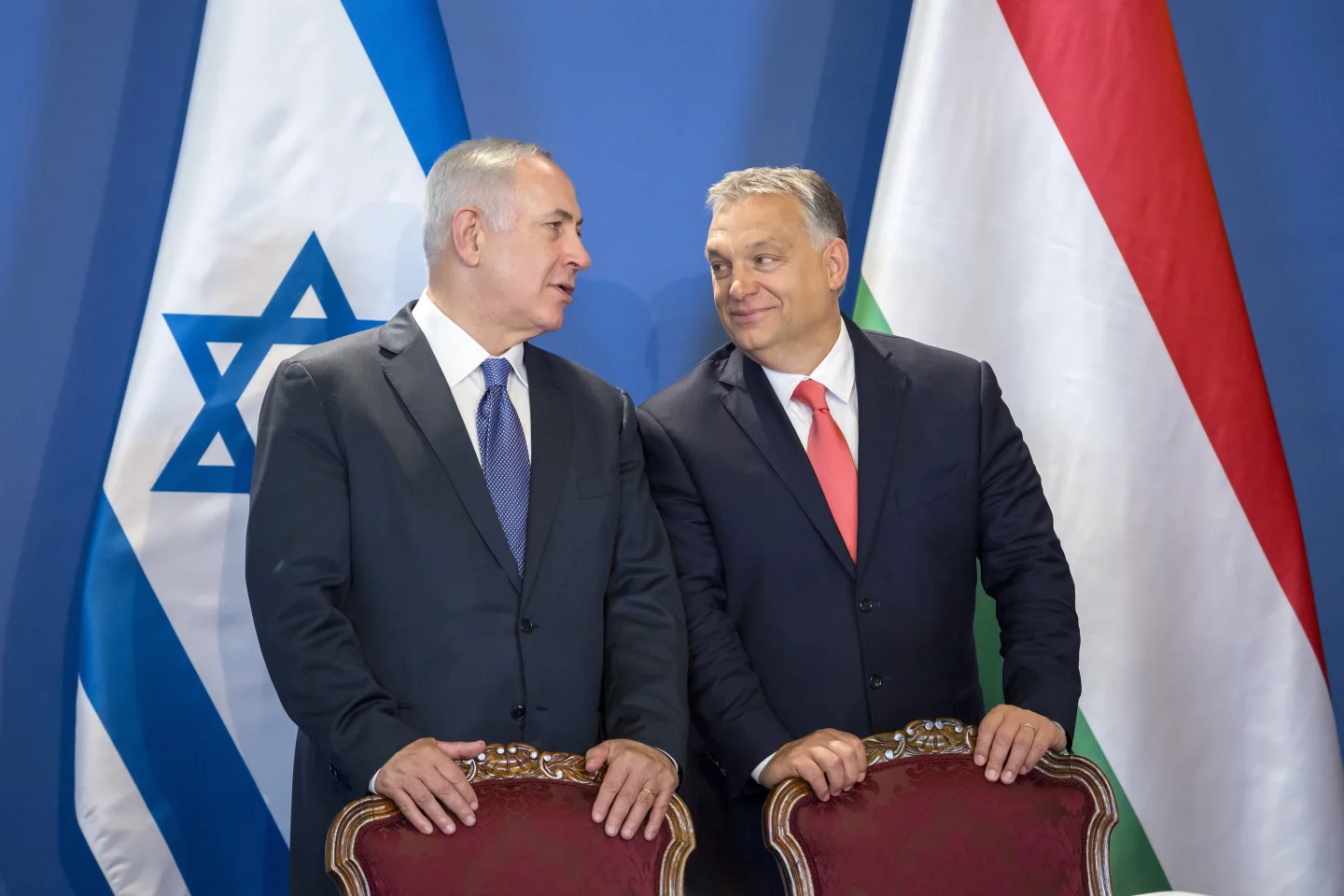
Hungary withdraws from International Criminal Court (ICC), announced Gergelj Gujaš, a senior official in the prime minister's government Viktor Orban.
He announced this decision of the Hungarian government just a few hours after the Israeli Prime Minister arrived on an official visit to this country Benjamin Netanyahu, for which the ICC issued an arrest warrant.
Hungary is one of the founding countries of the International Criminal Court more than two decades ago and has formally committed to arrest and extradite anyone for whom it has issued a warrant if they set foot on its territory. However, even before Netanyahu's arrival, sources from Orbán's government suggested the possibility of Hungary withdrawing from the ICC, "BBC" writes.
Call for Netanyahu
In November, ICC judges said there were "reasonable grounds" to suspect Netanyahu of criminal responsibility for alleged war crimes and crimes against humanity during the war between Israel and Hamas.
Netanyahu denounced the ICC decision as "anti-Semitic."
Just hours after the International Criminal Court issued an arrest warrant for the Israeli leader, Hungarian Prime Minister Orbán made it clear he would ignore the court's ruling and host Netanyahu, telling reporters he would "guarantee" that the ICC ruling "has no effect in Hungary."
The International Criminal Court has 125 members, and its jurisdiction is not recognized by, among others, the United States of America, Russia, China and Israel.
Although Israel rejects the jurisdiction of the ICC, in 2021 the court decided to have jurisdiction over the occupied West Bank, East Jerusalem and Gaza, because the UN Secretary General recognized Palestine as a member of the court.
What is the ICC?
The International Criminal Court (ICC) is a permanent international court established in 2002 with headquarters in The Hague.
Its primary role is to try individuals accused of the most serious crimes affecting the international community: genocide, crimes against humanity, war crimes and the crime of aggression.
It acts as a court of last resort, intervening only when national courts are unwilling or unable to prosecute the perpetrators of these crimes. Its jurisdiction includes crimes committed on the territory of member states or by their nationals.
The rise of the right-wing international
Hungary's withdrawal from the International Criminal Court is in line with the growing trend of right-wing populism and anti-globalism that has been present in recent years, especially stronger under the influence of US President Donald Trump.
Trump's famous slogan "Make America Great Again!", indicates exactly the turn to the national level of governance. Eurosceptics on the Old Continent have been wishing for the same thing for years.
"These networks connect rejection of migration, nationalism, traditional family models and anti-globalism," sociology professor Katrin Fangen from the University of Oslo previously told Deutsche Welle (DW). Fangen is a renowned expert on the transnational networks of the radical right.
"The goal of those networks is not only the struggle for greater political influence. Their ultimate goal is the redirection of the global ideological order - they are fighting for nationalism and social conservatism, and against liberal democracy," which is publicly abhorred by Serbian President Aleksandar Vučić.
Radical right-wingers, meanwhile, quickly learn from each other.
"Strategies and successes in one country are soon taken over by movements in other countries," says political scientist Thomas Greffen of the Free University of Berlin. He estimates that the level of networking of the radical right is historically unprecedented.
"Viktor Orbán, for example, declares: 'I was elected with a clear mandate to prevent migration to Hungary and I don't want European institutions, courts, civil resistance or foreign-funded media to hinder me from governing.' They despise opposition and compromises," says the political scientist from Berlin.
Protagonists of the radical right are bothered by the fact that, due to growing legal regulation, bureaucratization and supranational institutions, there are allegedly too many obstacles to the realization of the will of the majority. And in a "hypermajoritarian" or illiberal democracy, it is precisely this will of the majority that should prevail.
Sources: BBC/DW