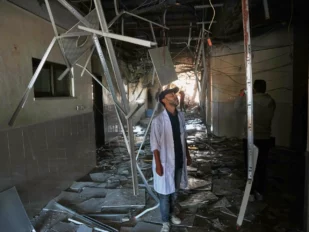
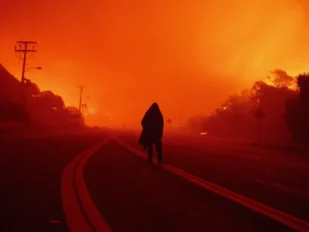
Donald Trump with a red cap with the inscription "Let's make America great again" and US Secretary of State Marco Rubio, enthusiastically crossing his fingers - this is how the American top brass watched the US attacks on nuclear facilities in the night between Saturday and Sunday (June 21-22) Iran. America first attacked Iran, a country of 90 million people.
Trump warned Iran that the US could continue attacks if Iran does not agree to peace. American B-2 bombers were used in the attack, and CNN sources say that the US also used a "bunker buster" bomb of almost 15 tons, which is the first known case of using this bomb.
What does the attack tell us?
For more than 30 years, Benjamin Netanyahu has been calling on allies, primarily the US, to attack Iran, arguing that this country is the biggest threat to world peace. He finally succeeded. While the first man of Israel, the country that first attacked Iran, is now probably celebrating because he moved the US to a historic decision, the question remains - how will Iran react? Will there be attacks on more than 40.000 American soldiers and 19 military bases, which are deployed in countries around Iran in the Middle East?
The historic US attack on Iran also showed the extent to which the European Union has no influence in the Middle East. It was an American solo action that was directly coordinated by Trump and Netanyahu.
"Donald Trump has pushed Iran, the Middle East, the United States and his presidency over a fateful threshold by attacking Tehran's nuclear program," writes Stephen Collinson, CNN's White House and US politics correspondent. "A summer night in June 2025 could be remembered as the moment the Middle East changed forever; when the fear of nuclear annihilation was removed from Israel; when Iranian power was sterilized and America's soared."
He adds that "there is a risk that the Iranian regime reacts by attacking US forces, targets or civilians in the region and the conflict escalates into a much larger war."
"The president has staked global security and his own legacy. He has no way of knowing what moves Iran will make," says a CNN reporter, while a BBC reporter says Britain can breathe a sigh of relief because it avoided a potentially difficult decision.
"The most realistic base for the attack was the British-run one in the Indian Ocean. If the US had asked to use that facility, and the UK government had agreed - then Iran would certainly have seen it as the United Kingdom joining the war. The fact that the attack took place without our participation is a relief for British policy makers," says the British public service reporter.
Trump: A historic moment for the USA
Just a few days ago, Trump said that he was giving Iran two weeks to sign a new nuclear deal, otherwise he would consider a military option. Apparently he was not telling the truth or he thought that deadline had passed.
"We have completed a very successful attack on three nuclear facilities in Iran, including Fordo, Natanz and Esfahan. All aircraft are now out of Iranian airspace," Trump wrote on the Truth social network.
He added that all the planes that participated in the attack are returning to the US and said that "this is a historic moment for the United States of America, Israel and the world."
Based on Trump's statement, where he says that Iran must agree to peace, it can be concluded that the US will not stop at this bombing.
Iran: The blow is not big
Confirmation of the attack also came from Iran.
First, the spokesman of the Crisis Staff of the province, Kom Morteza Heydari, said that "part of the area of the Fordo nuclear plant was under air attack", then the deputy governor of Ishafan Kbar Salehi announced that "several explosions were heard near the nuclear facilities in Natanz and Isfahan", BBC reports.
Hassan Abedini, the deputy political director of Iran's public service, said that all three nuclear facilities had been evacuated "some time ago".
Even if what Trump said is true, Iran "didn't suffer a big blow because all the materials have already been brought out," Abedini said.
Israel is delighted
Lawyer Efrat Eldan Shekter from northern Israel told the BBC she was "relieved and grateful" that the US had "taken decisive action against Iran's nuclear program", adding that she hoped it "marked a turning point towards a safer future for all".
In Tel Aviv, teacher Renee told Britain's Public Service that she had mixed feelings.
"I hope things will get better, but it's good to have support - it's always good to have support," she says. Asked how she feels about the risk of escalation, Renee says:
"We don't know what they have in the bag. We hope things don't escalate any further. We'll have to wait and see. We're all on edge here."