American universities are caught between two fires - the right of students to protest against Israeli retaliation over the Palestinians and pressure from donors and politicians. Everything reminds of the anti-war protests of the seventies, he writes Deutsche Welle.
American university campuses have been hot spots for the last few weeks. Many young people possess them. They stand in solidarity with the Palestinians and face accusations of anti-Semitism.
Some of them want to point out how exactly from Gauze can watch "genocide live" while "the democratic president of the United States fully supports it", explains Leigh Raiford, a professor of African American studies at Berkeley.
"There's a whole generation of people who won't vote for the Democratic Party, won't vote for Joe Biden," she says.
This is a turnaround compared to the situation four years ago, when Biden was carried precisely by the voices of young people and the voices of cries during protests under the slogan "Black Lives Matter".
The constant in both cases is the thirst for social justice.
For Biden, squaring the circle is an attempt to ensure that military support for Israel does not cost him his stay in the White House. He tried to strike a balance, insisting on a ceasefire in Gaza.
Universities in the puzzle
"Antigenocide camps" have sprung up on dozens of campuses across the US. It calls for a halt to Israel's shelling of Gaza, which began after Hamas, which Germany, the European Union, the United States and others consider a terrorist organization, carried out unprecedented carnage in Israel.
In the last seven months, 35.000 people were killed in Israeli retaliation. According to the Gaza Ministry of Health, which is run by Hamas, almost half of those killed were children.
Demonstrators in the US mostly demand that the country give up its resolute support for Israel.
Although Biden officially says the protests cannot sway his support for Israel, according to a report by Axios, the White House has reportedly paused one shipment of ammunition to Israel.
The reason is unknown, but it would be the first time that the United States, as the largest supplier of lethal weapons to Israel, would do something like this during this war.
The students are also demanding that the universities suspend cooperation with financial funds that have a hand in the arms industry or with companies linked to Israel.
Universities in the USA often receive millions in donations from such corporations.
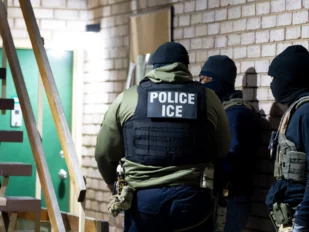
Under pressure from approaching final exams, but also from wealthy donors allergic to any criticism of Israel, many universities invoked security concerns when calling the police to break up protest camps. So far, around two thousand people have been arrested across the US.
Mutual accusations
Police in Georgia, Texas and New York were accused of using excessive force, and in Los Angeles of not doing enough when masked pro-Israel protesters attacked a pro-Palestinian camp.
Mutual accusations abound. From universities stifling every word in support of the Palestinians and every criticism of Israel to, on the other hand, the fact that Jewish students in the US are the target of threats and violence.
Some claim that university protesters are indirectly linked to Hamas. Or that they are not even students.
For example, New York police arrested 282 people at Columbia University and City College. At the first, 71 percent of those arrested are students or have an excuse for being on campus. At another college, which is public, there were 40 percent of them, while the rest came from outside.
"These kinds of calls for 'foreign agitation' are very dangerous," Professor Raiford told DW, noting that such discrediting of protests has a long tradition.
She mentions that anti-war protesters in the sixties and seventies were also called Soviet agitators, and that Martin Luther King was also labeled a "foreign agitator".
Conflict of two principles
Legally speaking, universities are caught between two fires. Freedom of speech is the ultimate good in the US, but laws also protect safety and free access to education.
There is a legal obligation to "fight discrimination and a responsibility to maintain order," Anthony Romero, executive director of the American Civil Liberties Union, wrote in an open letter to universities.
But he added that "it is crucial not to sacrifice the principles of academic freedom and free speech that are at the core of the educational mission of your esteemed institutions."
According to Professor Raiford, the mission to teach students moral ideals and that they "should change the world" in America collides with a system of higher education that serves to "consolidate the power of the ruling class."
You should always and everywhere talk
Gregory Payne, who heads the department of communication studies at Emerson College in Boston, says that the US is in a similar age of division as during the anti-war protests of the 1970s.
"Just like then, today we have a leadership fiasco from top to bottom," Payne told DW.
Emerson is a small college, but it has seen large protests. Boston police detained more than a hundred people near the campus in late April. The authorities stated that the protest camp was on public land and violated city order.
On the other hand, Biden and state governors are under pressure to include the National Guard in breaking up demonstrations. As Professor Payne says, it's a minor miracle that no one has been killed yet.
And it reminds of earlier times. In May 1970, the Ohio National Guard opened fire on anti-war protesters at Kent University. Four students were killed, nine were wounded.
"Essentially, what we need today is what we needed then - and what we need every day - dialogue," Payne added.