Za "Time" from Bonn
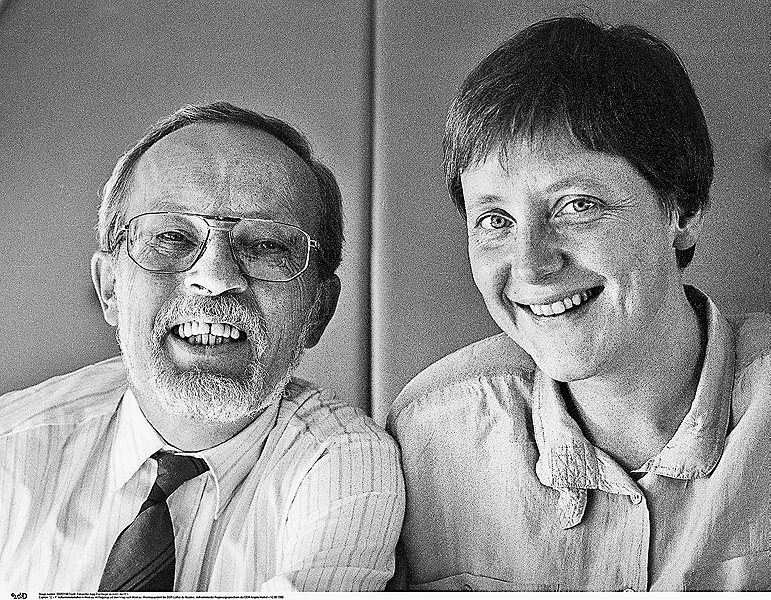
In theory, Angela Merkel could dedicate an entire shelf in her library just to biographies about herself. Younger versions of Angela Merkel would be smiling and frowning at her from the cover, and the last in a series of books would have been published ten days ago. The first life of Angela Msystem. (The first life of Angela M.). Authors Ralf Georg Reuth and Günter Lachmann wanted very much (and eventually succeeded) to stand out from the pile of biographies based on two things: first, this book thematizes only the first 35 years of Angela Merkel's life in East Germany (GDR) - until reunification; secondly, the writers did not even want to feign neutrality - from cover to cover the text is intoned conspiratorially, and the proclaimed goal is to expose the dark past of the most powerful woman in the world.

Already on the first pages, the author duo points out that the public today is dealing with a completely distorted image of the young Angela Merkel, the girl Kasner: The withdrawn daughter of an evangelical priest who grows up on a small East German farm and remembers well the tears her mother shed one summer morning in 1961 when the family learned about the construction of the Wall. which will also physically separate the two German states. The authors promise to destroy the myth that portrays the young Merkel as a social outsider dedicated to a scientific career, a citizen who has always viewed real socialism as a burden. Through the barbell of lies, the truth will come to light that only "career and power, which is an end in itself" are important to Merkel.
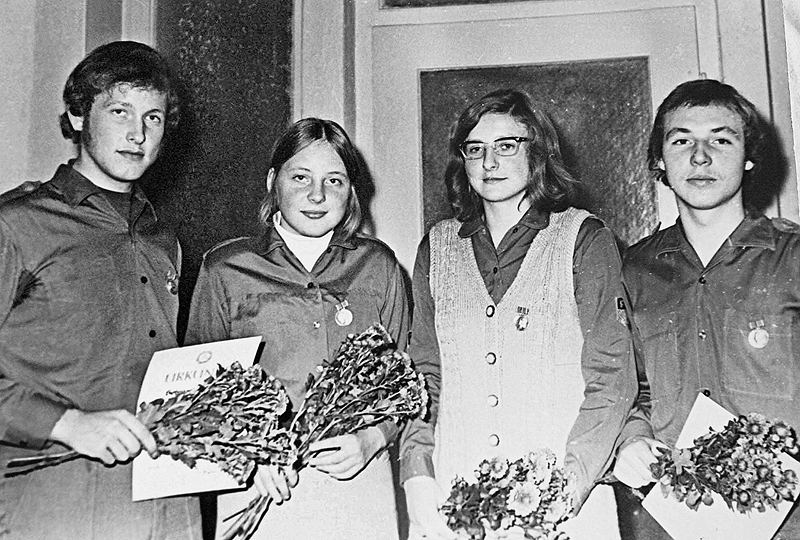
AGITATION AND PROPAGANDA: After Angela Kasner's childhood with a blue pioneer scarf around her neck, she studied physics with membership in the Free German Youth (FDJ - Freie Deutsche Jugend). Neither the pioneers nor the youth are material for an affair - after all, over the decades, the GDR sucked both the young and the old into the party state, leaving only the insanely brave and crazy. "I had a good time in the FDJ," said Merkel herself. "Mainly for leisure content." Many social activities were carried out exclusively through this organization." To the remarks from the West, the chancellor always replied that with the GDR one did not have to live in love, but one had to somehow to live Membership in the Communist Youth was a way of adaptation.
However, the authors of the new biography claim that Merkel went too far in her adjustment and they have a "crown witness" for their claim. It is Günter Walter, a former colleague of Angela Merkel at the Central Institute for Physical Chemistry at the GDR Academy of Sciences. In 1980, Walter was the secretary of the basic cell of the FDJ at the Institute, and he clearly remembers that at the beginning of the year, Angela Merkel was in charge of culture in that cell, and then of "agitation and propaganda". Although the witness is new, the accusation is old and Angela Merkel answered it a long time ago: "Agitation and propaganda? I don't remember agitating in any way, I was in charge of culture at our institute", which meant "procuring theater tickets and organizing literary evenings".
Ceo The first life of Angela M. in fact, it is based on a short quote from colleague Walter, which will be enough for the authors Reut and Lachmann to call Merkel "a functionary close to the socialist regime". To understand where Merkel stood in the pyramid, a wider context is needed. The basic organization FDJ, in which the chancellor allegedly campaigned, was only one of 72 such organizations at the Academy of Sciences in Berlin, and the communist youth at the Academy was only part of the mosaic in East Germany. They note the key thing in "Badiše Zeitung" when they write that "it would be far more interesting to find out how Merkel promoted real socialism with her words and deeds." There is nothing written about that in this biography."
SINS AVOIDED: The lack of facts, as is usually the case, is compensated by an excess of speculation. This is how the interpretation of the former minister of transport from the CDU Günter Krause, who was particularly harsh towards his former colleague from the Government, is repeated. "In the sphere of agitation and propaganda, the main task is brainwashing with Marxism." That's what she dealt with, not culture," claims Krause and adds: "I am simply annoyed by the fact that she does not admit that she was close to the system in the GDR." deals with the East German regime party SED. "When you say 'agitation and propaganda' today, it sounds like Goebbels himself is behind it," Schroeder told Deutsche Welle. "But the fact that she never joined the SED is much more important for the ideological assessment of Angela Merkel."
After the unification of Germany, the first mortal sin of a politician was precisely membership in the Party of Socialist Unity of Germany. The second sin - for which the East German prime minister-unifier Lothar de Maizière also fell - was cooperation with the infamous Stasi. According to her own statements, Angela Merkel refused that cooperation. It happened after a job interview at the Higher Technical School in Ilmenau - Merkel rejected the two agents who wanted to recruit her, saying that she was not a trustworthy person and that she would tell her husband everything at the first opportunity. This is how today's chancellor avoided becoming part of the network of 190.000 "unofficial collaborators" of the Stasi.
In this light, the other "scandalous revelations" from the new biography also seem unconvincing. For example, the fact that the only copy of her work on Marxism-Leninism - mandatory for all students - where she wrote "What is a socialist way of life" on 50 pages, was lost. Or the first mentioned (and documented) fact that Angela Merkel was in the leadership of the Union at the Academy of Sciences. Or the fact that since 1986 she had permission to travel to West Germany on business, which is a privilege granted only to trusted citizens - those whom the regime trusted would actually return from their journey. Or the memory of a guest from the West to whom Merkel allegedly said: "If we reform the GDR, it will not be based on the example of the Federal Republic of Germany." Or the report of a colleague, otherwise a Stasi "correspondent", that Angela Merkel is "firmly attached to our state". which was concluded from the discussion about the situation in Poland where at that time Solidarity threatened to shake the Soviet model of communism.
PAUL AND PAULA: The biography occasionally deviates completely from its protagonist in order to paint a picture of the changing conditions in the Eastern Bloc as it went from Stalin, through Khrushchev and Brezhnev, to Gorbachev. The highest (only?) value The first life of Angela M. lies in the factography because behind almost every line there are relevant statements or documents mentioned in 665 footnotes. Not enough to excite the public and just enough to fit into the gray of the series of biographies about Angela Merkel. "If the authors were modest, maybe their book would be read." "Unfortunately, they wanted to exaggerate," commented "Tagesspiegel". "The research that hardly adds a few details to the East German history of Angela M. is artificially inflated to expose the chancellor." Or the comment of the respected "Frankfurter Allgemeine Zeitung", which ridicules Reut and Lachmann's attempt to look for a conspiracy in everything: "The communist dialectic has confused us all, the authors of this biography are living proof."
It is no wonder that the author duo, during the writing of the piece, did not receive an answer to the extensive questionnaire that was sent to the chancellor's address. It's no wonder that, after the book was finished, the chancellor's reaction was a layman's answer: "I can only rely on my memory." It is important to me that I did not hide anything. "Maybe I didn't tell something because no one ever asked me," said Merkel. The symbolism was completed by the ambiance - because journalists asked the chancellor about agitation and propaganda right after the screening of the iconic East German film The legend of Paul and Paula, which Merkel chose to present at the invitation of the German Film Academy.
STRAW FOR THE OPPOSITION: Although it seems to have kicked up for no reason, the dust could be in the air for quite some time. Because the opposition, four months before the parliamentary elections, can benefit from any topic that can harm the reputation of Angela Merkel or her Christian Democrats. "He who worked at the Academy of Sciences in the GDR was certainly not state enemy number 1. Everyone over 45 knows that in the East," said Greens politician Antje Hermenau. And from the ranks of the biggest rival - the Social Democratic Party - they are asking Merkel to take an official position on her East German youth.
They will hardly get more than that brief response from the cinema. Even the famous leftist from East Germany, Gregor Gizzi, took Merkel to her defense and called the allegations in the biography nonsense. "There may be too little GDR in Merkel's office, given that she works poorly on the problems of the eastern part of the country," Gizzi told "Stern" magazine.
Before the September elections, the opposition seems to have to find other topics where it can make points. Citizen support for the CDU is a whopping 41 percent, followed by the Social Democrats with 29 percent and the Greens with 13 percent. The liberals, the traditional coalition partner of the Christian Democrats, are struggling with the census for the time being, but we should expect the CDU to "lend" them some votes by calling on their constituents to vote for the liberals. If there are no significant breaks, Angela Merkel will get a third term at the head of Germany, and biographers will have the opportunity to announce themselves again. Maybe this time their starting point for the conspiracy theory will be the chancellor's official Facebook page. There, Tolstoy and Dostoyevsky were listed as their favorite authors, and a trip on the Trans-Siberian railway from Moscow to Vladivostok was a lifelong dream.