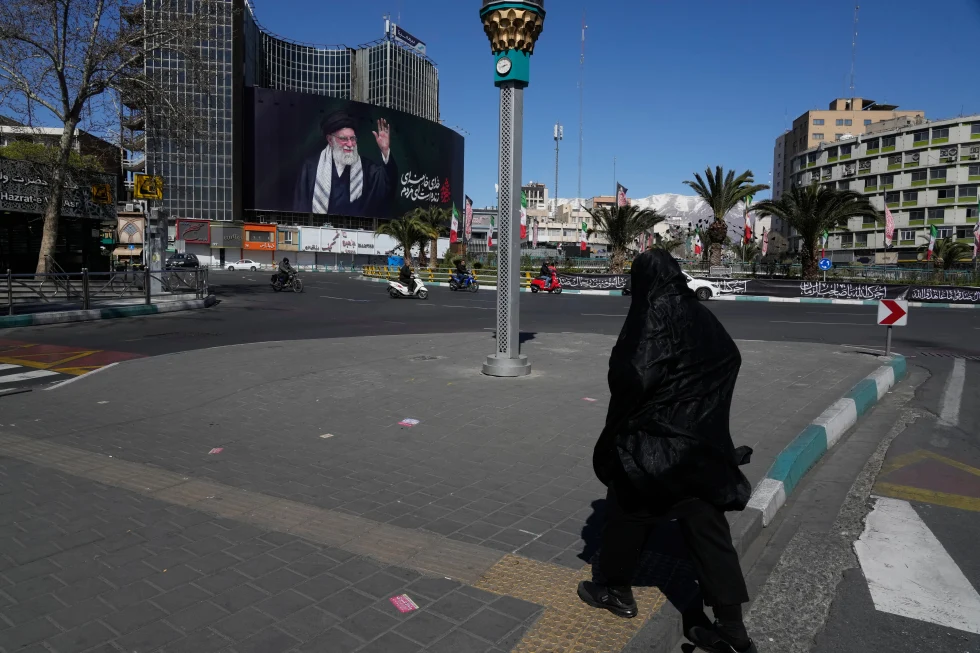
Streets of cities in Evropi during the weekend they were full of elation Iranians from the diaspora after the supreme leader of Iran, Ayatollah Ali Khamenei, was killed in US-Israeli attacks.
"The dictator is dead. This is the best day of my life," one man told DW as he danced on the cobbled streets of Brussels.
On the other side of that city, European Union officials were no less critical of the Iranian regime. They have imposed a range of sanctions on Tehran for human rights abuses and issued harsh criticism for its recent retaliatory attacks on Gulf states, writes DW.
But now they face a well-known diplomatic dilemma.
Are the US-Israeli strikes - which, in addition to Khamenei, killed at least 555 Iranian civilians, according to the Red Crescent - consistent with the rules-based international law and order that the EU so often claims to uphold? Union spokesmen spent much of Monday's press conference avoiding the very question reporters were asking.
"There are no stupid rules"
President Donald tramp said on Monday that the US was "ensuring that the world's number one sponsor of terror can never obtain a nuclear weapon" and was working to destroy Iran's missile capabilities.
But Washington did not even try to justify its attacks through international frameworks. In fact, Defense Secretary Pete Hegsett said the US was operating "regardless of what the so-called international institutions say" - and "with no stupid rules of engagement".
He also poked fun at the "traditional allies" of the US who, as he said, "don't know what to do with their hands, so they clutch their pearls and mutter something about the use of force."
It's a message that is getting very mixed reactions across the divided EU.
Germany vs. Spain?
The chancellor is in Berlin. Friedrich Mertz was careful not to criticize Washington ahead of his meeting with Trump this Tuesday.
"Legal assessments within international law would achieve relatively little" when it comes to political change in Iran, he told reporters on Sunday.
"Now is not the time to lecture our partners and allies. Despite our reservations, we share many of their goals," Mertz added.
In the Spanish capital, however, Prime Minister Pedro Sanchez sounded very different.
"We reject unilateral military action by the United States and Israel that constitutes an escalation and contributes to making the international order more uncertain and hostile," he wrote on Saturday.
But even legal experts disagree on this issue.
What does international law say?
For Mark Weller, a professor at Cambridge and director of the international law program at the think tank Chatham House, the answer is clear.
"There is no available legal justification for the current, continued attack on Iran," he said on Sunday.
"International law does not permit the use of force in response to the overall hostile attitude of another state, if it does not constitute an armed attack," Weller wrote in the analysis.
"Also, the use of force is not permitted as a form of armed retaliation for earlier provocations. Force is permitted only as a last resort, when no other is available, to protect the state from armed attack," he explained.
Weller says it is somewhat legal to use military force to save a population from its own government, but points out that the brutal crackdown on protests last month "probably has not yet reached the threshold" that would justify foreign intervention.
"Law does not work in a vacuum"
Rosa Friedman, professor of law, conflict and global development at the University of Reading, disagrees.
"As a legal expert, you have to look at this in a wider context. Law does not work in a vacuum," she told DW on Monday.
"Iran is a threat, not only to Israel, but to the entire region and for decades under this regime. And they have been very clear about the threats and their ambitions to possess and use nuclear weapons," she added.
Friedman said that legality and international law can be discussed at an expert level.
"But if you look at it in the context of the purpose of that right and the purpose of the United Nations," she added, "it's more than clear that those [US-Israeli] attacks, in the context of Iran's nuclear weapons development, are completely legal."
Are the US-Israeli attacks a dangerous precedent?
The fact is that this debate will largely remain within the confines of law textbooks – because it will not be fought in court.
The UN Security Council can impose sanctions or flight bans in cases of conflict, but Friedman says the US can veto any action against itself or its allies - just as Russia has prevented such action over its war in Ukraine.
Simply put: "More powerful states can do what they want much more easily."
Chatham House expert Mark Weller says this is precisely why governments should be more vocal.
"This reluctance to point out illegal behavior may encourage a broader sense that the use of force as a tool of national policy is once again becoming acceptable," he said.
And for Europe, it could come back like a boomerang.
"It will not be easy to counter further Russian aggression or potential Chinese expansionism if there are no longer clear principles to rely on - without provoking accusations of double standards and hypocrisy," Weller concluded.