
The World
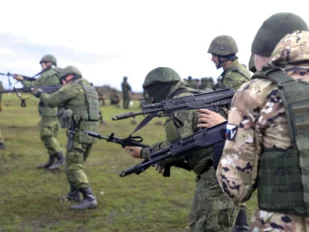
Data leak: More than 400.000 Russians killed in war in Ukraine
Largest ever leak of Russian casualty data shows more than 400.000 Russians killed in Ukraine war

Romania's extreme right-wing parties are seeing a sharp rise in the polls
"Last chance for Romania"- that was the name of the four-member governing coalition in Bucharest until a few weeks ago. When this alliance was formed in the summer of 2025, everyone hoped that good governance and radical reforms would stop the rise right-wing extremists in this country in the southeast of Europe.
That hope was completely buried. Romania's extreme right-wingers are recording a sharp rise in the polls, while the mainstream parties are sinking deeper and deeper into political tactics and infighting. writes DW.
It's been three weeks since the government of liberal Prime Minister Ilje Boloyan was toppled in a vote of no confidence - and by votes from within its own ranks. Since then, the parties of the democratic spectrum have not been able to agree on a new government and the name of the new prime minister, despite numerous attempts to mediate by the president of the country, Nikushor Dan.
But that's not all. While the toppled Bolojan cabinet is still only formally in office, the Social Democrats (PSD) – as the strongest parliamentary party and formally the pro-European option – are increasingly pursuing joint policies in parliament with the largest right-wing party, the Alliance for the Unity of Romanians (AUR).
Political scientist Raluka Alexandrescu therefore speaks openly about the "normalization of right-wing extremism" in the country.
The turning point in this normalization of extremists already happened on May 5, 2026, during the vote of no confidence in the government. The Social Democrats, who were part of the ruling four-member coalition until the end of April, launched this initiative hand in hand with the AUR and together overthrew the government.
Although there have been examples of cooperation between democratic parties and right-wing extremists in the Romanian parliament before, such a coordinated action to overthrow the executive power has never been seen before. This destroyed the political "sanitary cordon" towards the extreme right, which until then was supported by the Social Democrats themselves.
Although the PSD has since repeatedly reiterated that it has no intention of entering into an official alliance with the AUR, practice completely belies them. In mid-May, the Social Democrats, in the parliamentary Committee on Human Rights, together with three right-wing parties, supported a bill that would lift the ban on anti-Semitic, fascist and racist propaganda. Only after a sharp public outcry did PSD leader Sorin Grindeanu reverse the move, calling it an “accidental slip-up.”
However, last week PSD and AUR in the Senate again voted identically – this time for a law against non-governmental organizations, tailored according to the Russian and Hungarian model (Putin's and Orban's model). According to that proposal, NGOs must publicly announce the names of all donors who annually pay more than 1.000 euros, although extremely strict rules on the transparency of the NGO sector already apply in Romania. Several hundred organizations have protested, but so far without success.
Then on Wednesday (May 27th), social democrats and extreme right-wingers voted together for a law under the slogan "We will not give our country" (literally: "We will not sell our country"). The goal of the law is to prevent the previously planned listing of state-owned companies on the stock market and the sale of minority stakes. That project was initiated by the Bolojan government in order to bring order, efficiency and transparency to the work of state-owned companies burdened by suspicions of corruption, but also to provide income for the huge budget deficit.
It is more than symbolic that PSD initiated the law under the slogan "We are not selling our country" and voted for it together with AUR and two other extreme right-wing groups.
Today's social democrats, as heirs of the former communist apparatus, took power after the fall of dictator Nicolae Ceausescu in 1989 - first under the name National Salvation Front (FSN), and then as PSD. The slogan "We are not selling our country" then served as a motto during violent actions against anti-communist demonstrators, civil rights fighters and opposition parties, which were directed by that very Front.
The PSD party has never apologized for this. The former gathering place of old Ceausescu cadres, officers of the infamous Securitate and socialist factory directors, ensured a smooth transfer of power for the old elite after 1990.
The PSD remains an absolute symbol of corruption in Romania to this day. Ideologically, this party has nothing to do with classic European social democracy – it is a right-wing nationalist and populist movement that ruled in coalition with ultranationalists and extremists back in the 1990s.
However, in recent years, other parties of the democratic spectrum have also contributed to giving legitimacy to the extreme right. Among them is today's green-right-liberal party Union Save Romania (USR), which back in September 2021 together with AUR submitted a request for a vote of no confidence in the then government (which in the end did not even make it to the vote). Regardless of the outcome, it was the first major political event that dragged the extreme right into legitimate political streams.
Today, three right-wing parties in Romania – in addition to AUR, there are also the SOS Romania party and the Youth Party (POT) – together hold about 35 percent of the seats in both houses of the Romanian parliament. According to the latest opinion polls, if elections were held now, AUR alone would win 32 percent of the vote, putting it far ahead of the second-place PSD, which has 24 percent.
That is why early elections are not in the interest of the democratic parties. However, analysts in Romania fear that the current paralysis and tactical games of the social democrats will only further strengthen the extreme right before the regular parliamentary elections at the end of 2028.
As political scientist Cristian Pirvulescu warns: "The cooperation between the PSD and the AUR is a huge strategic mistake that could very easily turn the current crisis of power into a general crisis of the system."
This development of events is not only dangerous for Romania, but also for the whole of Europe.
Romania is the sixth largest member of the EU and a key NATO ally in the southeast of the continent, where the largest and most important military bases in the region are located. It shares the EU's longest border with Ukraine and is considered a quiet, but extremely stable and consistent partner of the attacked neighboring country.
If the pro-Russian, strongly anti-Ukrainian and anti-European party AUR were to come to power - even as a support for a minority government - the entire security system could collapse.
Real journalism costs money, and we will not be bought by tycoons and corporations. Support us with a one-time or monthly donation. The time for it is now!
Largest ever leak of Russian casualty data shows more than 400.000 Russians killed in Ukraine war

At least 11 people died in two chain collisions on the Trakia highway in Bulgaria. 86 vehicles were involved, and around 50 people were injured

The global race in the development of artificial intelligence has boosted Chinese exports. Increasing dependence on foreign markets is straining Beijing's relations with its trading partners
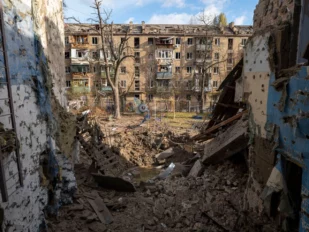
New negotiations between Ukraine, the USA and Russia are planned for November 10 and 11 in Abu Dhabi. This is the first meeting in this format after nine months

A serious accident occurred on Monday at a steel factory near Izmir, when an explosion claimed at least 17 lives. According to the first information of the local authorities, the accident was preceded by the fall of the crane and damage to the gas pipeline

At the moment when the institutions of the Republic are destroyed, when Vučić's octopus is still alive, when people are disgusted by the injustice and the stench left behind by the Essenes regime, we have, as Machiavelli said, only civic virtue as the fuel with which we can return to the beginning

The four independent members of REM are an example of perseverance and civic responsibility. Rodoljub Šabić even, upon leaving the premises of REM, after the sentencing of the Informer, experienced that the Essenes insulted him, hit him with their hands and feet. But that too will soon be over

Vučić pardoned the batterers and Dijana Hrkalović. The election winners should abolish the sultan's power that allows one man to run afoul of the entire judicial system

Time explores: The construction of the St. Sava Temple
Did the money paid by the Government to SPC end up in Moscow through Alta Bank? subscribeThe archive of the weekly Vreme includes all our digital editions, since the very beginning of our work. All issues can be downloaded in PDF format, by purchasing the digital edition, or you can read all available texts from the selected issue.
See all



