
The happy, but also the disappointed, set out for him. Lonely, but also people eager to strengthen old ties and friendships. Curious, but also resigned. Anxious, but also calm. All of them have one thing in common - the will to live and change
The famous Christian Way to Santiago de Compostela in Spain (Camino de Santiago) is one of the three most famous pilgrimage routes during the Middle Ages, and especially the New Century. A road on which, as in the case of the routes to Rome and Jerusalem, it was necessary to experience redemption, that is, the forgiveness of sins. The path that was first of all mentally and then physically not easy at all, but spiritually it was worth as dry gold.
Millions of Christians used to travel to Santiago de Compostela, the capital of Galicia in Spain, several centuries ago. Today, the Road to Santiago is something else, although it has preserved its original purpose. Legend has it that the remains of St. James were once transported by ship from Jerusalem to Galicia, to the main cathedral in Santiago de Compostela. The number of pilgrims has changed over the centuries depending on political developments in Europe, but the Way to Santiago has never been forgotten.
Moreover, since the mid-eighties of the last century, hundreds and thousands of not only Christians, but also members of other religions began to go there again, in order to "find themselves" during the hike, that is, some real meaning of life.
EVERYONE CHOOSES THEIR OWN PATH
Today, the Road to Santiago is above all a great and liberal adventure. There are no strict rules for the pilgrimage, nor is it necessary to fulfill the requirements to walk to Compostela. There are a total of nine routes to reach Santiago. You can choose the shortest, Portuguese route along the coast (starting from Porto), or the longest, which starts from Seville.
You can hike for several days or weeks. Or even months. You can walk a little, and take a bus or train a little. You can cover 5 or 25 kilometers a day. It's all up to you. It is important that you go and experience that something in yourself, because of which at the end of the Way, in front of the cathedral in Santiago, you will know that you have consciously closed one and opened a new chapter of life that you were eagerly waiting for. More than 100.000 pilgrims or adventurers/tourists, whatever you call them, visit Santiago de Compostela every year. In principle, they cover at least one hundred kilometers to their destination, and a maximum of one thousand.
Those who are more faithful to tradition before setting off on the Path not only prepare well mentally and physically, but also at the beginning of the route acquire a passport in which they will collect stamps during the following weeks of hiking. Those seals will serve them at the end of the Path as a confirmation that they have successfully completed all sections. The passport is the proof that they passed through the path recognized by the Saint Kakov Pilgrims Association as the only official path.
However, today there are fewer of them. Most of the passengers go for their money, as it suits them best, and they arrive at their destination when they feel like it.
Photo: Ilija Djukic...
THE JOURNEY STARTS FROM YOUR HOME
Another old Gallic legend says that the right way to Santiago is the one that starts from your house, that is, it only counts if you walk the distance from your doorstep to the cathedral. As mentioned, there are nine routes.
The French route (Le Puy route) is the most popular and leads from the south of the country over the Pyrenees to Santiago. The Portuguese road has two routes – from Lisbon (longer) and Porto (shorter). The Northern Route is very difficult because it requires daily crossings over the Pyrenees, while the Primitivo Route is the only original, "original" route from the ninth century. The Via de la Plata route starts from Seville, while there are also the Route from Muccia and the Route to Finisterre.
In addition to walking, you will also be recognized for a pilgrim's passport if you came to Santiago exclusively by bicycle, but then you must travel at least 200 kilometers with it.
There is no age limit for traveling on the Path, although it is advised that minors set foot on the route accompanied by adults. Most people go on their own arrangements, although through certain Christian organizations it is also possible to afford a complete adventure. In that case, they will also find you accommodation along the way, as well as desirable combinations with transportation to Compostela if you get tired somewhere or for some other reason cannot walk further.
The journey is not only an adventure that nourishes the soul and body, but it is also a great chance to discover something new in and about yourself.
THERE IS TRUTH IN THE WINE
The road to Santiago has always interested me, primarily from the point of view of adventure. I had no idea how much could be gained from that hike in just a few days. To start the journey, I chose Porto, which I came to by plane from Barcelona.
Why Porto? Not only because it is one of the most beautiful cities in Europe and the Portuguese route to Santiago is the shortest, but also because I will have the opportunity to taste probably the best wine in Europe before departure. After I got the "green light" from the locals of Porto with one drink and the blessing to go, I set out to discover the north of that country, and then the south of Galicia.
I decided to hike 20 kilometers a day and then cover the same distance by local bus. I wanted, as I often do, to combine the beautiful and the useful, and to get to know beautiful cities like Guimarães and Braga for the first time during the Road.
Unfortunately, already in the "cradle of Portugal", where Guimarães is being beaten (the birthplace of the first King Alfonso I), I had to deal with a very difficult challenge. I learned that an unprecedented massacre took place in an elementary school in Belgrade. I was, like everyone, shaken and wanted to return home to my loved ones as soon as possible. Because it falls harder when you are not there. And then, in the spirit of the Way, I accepted it as another temptation, a challenge that must be overcome, which the rest of Serbia did that day and the following days.
After Guimarães, I arrived in Braga, following the signposts in the shape of a yellow shell at the entrance, the symbol of the Way to Santiago. They offered me a pilgrim's passport and the first seals, but I didn't want to commit myself to that, but to make my own way to the end.
On the Way, I then met many people with different pilgrimage goals. Two atheist couples (there were some of them, of course) were walking in the meadows of Pacos de Ferreira in front of me, believing in a new, purely symbolic beginning of life. A gentleman next to me, carrying a too heavy hiking backpack on his back, vowed that for the love of a sick woman, he would cross the Road one more time in his life. Three beardless teenagers from the Netherlands tried to learn the Portuguese language during the Way with cans of beer in their hands. The two girls were hiking just to test their own strength.
There were many examples, especially after entering Spain and Vigo. From there to Santiago, everything was somehow easier because the road is better marked, and the traffic infrastructure is better than the one in Portugal.
COMPANION (NE) IT COULD BE ANYONE
Every pilgrimage has a written or unwritten code of conduct. On this one, if someone wants to walk with you, they should first politely ask you if it would be okay for them to walk in your company. If you agree to the company, and then you repent, it is enough to tell that person that you now need peace and to be with yourself. Anyone will accept that explanation without any resentment.
If you are walking with strangers, as a rule, the reasons for going on the Path are not revealed in the conversation, but only the feelings. All travelers greet each other with the words: "Buen Camino!", to which you reply the same.
The easiest way to get hiking company is to hang a yellow shell, a symbol of the Way, on your backpack or in some other visible place.
The shell found on the coast of Galicia acquired various mythical meanings over time. The depressions on the shell of the shell, according to the belief, represent exactly all the routes that exist to Santiago de Compostela. There are two versions of the shell myth.
The first one says that after the death of Saint James the Apostle, his disciples sent his body to the Iberian Peninsula, to Santiago. Due to a storm in the open sea, the body fell into the sea and disappeared. However, a few weeks later, fishermen find him, covered in shells.
Another version says that the body of Saint James was also sent to Santiago by ship and without a crew. As a wedding was taking place on land at that moment, the groom who was on a horse got scared and fell into the sea with him. By some miracle, the groom and the horse then appear unharmed on the shore, covered in shells.
Photo: Ilija Djukic...AND OBJECTIVE: The Cathedral of Santiago de Campostelli
ARRIVAL AT THE DESTINATION
Santiago de Compostela is the capital of Galicia and a place that seems to have remained in the past. The ambience is so historically believable that you always have the feeling that some knight on horseback is going to come out from around a corner.
The impression is reinforced by the constant ascent towards the cathedral, because at every corner local musicians reward you with music. Of course, as in other Gallic cities, old Celtic music is dominant in Santiago. In fact, at least a third of shop signs are in Gaelic.
As I approach the cathedral, I notice more and more people with radiant faces. Naturally happy, not to say refined. Everyone is there for the same reason - to reach the goal. There is no entrance fee to the cathedral, and it supposedly houses the relics of Saint James, which, according to legend, bring good luck if, according to legend, you approach them with a pure heart and with the greatest desire in which you sincerely believe.
In a special part of the cathedral, there is a room for prayers, where members of almost all religions of the world enter. There were also Indians, Chinese, and Arabs. There is no division, everyone is one.
In casual conversations with other adventurers, I conclude that everyone has heard about what happened in Serbia and that no one cares about it. On the way out, I receive a gift from an elderly gentleman from a nearby stand.
"How far did you go, sir?" he asked me. After I pointed out to him that I didn't take a pilgrim's passport at the beginning of the route and that I had covered about a hundred kilometers on foot in a few days, he treated me to a piece of Gaelic cake.
"Try it. Many have eaten this before you and me. You can't go home without tasting this", he says and hands me a piece, as well as a souvenir magnet that says "Camino de Santiago".
I surrendered to the Way and he took care of me. I highly recommend it. As it is said, "it is not possible to discover new oceans, if you do not have the courage to lose sight of the coast".
What is happening in the country and the world, what is in the newspapers and how to pass the time?
Every Wednesday at noon In between arrives by email. It's a pretty solid newsletter, so sign up!
The global race in the development of artificial intelligence has boosted Chinese exports. Increasing dependence on foreign markets is straining Beijing's relations with its trading partners
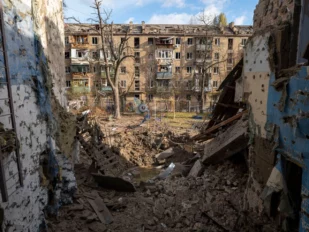
New negotiations between Ukraine, the USA and Russia are planned for November 10 and 11 in Abu Dhabi. This is the first meeting in this format after nine months
A serious accident occurred on Monday at a steel factory near Izmir, when an explosion claimed at least 17 lives. According to the first information of the local authorities, the accident was preceded by the fall of the crane and damage to the gas pipeline
At the moment when the institutions of the Republic are destroyed, when Vučić's octopus is still alive, when people are disgusted by the injustice and the stench left behind by the Essenes regime, we have, as Machiavelli said, only civic virtue as the fuel with which we can return to the beginning
The four independent members of REM are an example of perseverance and civic responsibility. Rodoljub Šabić even, upon leaving the premises of REM, after the sentencing of the Informer, experienced that the Essenes insulted him, hit him with their hands and feet. But that too will soon be over
Vučić pardoned the batterers and Dijana Hrkalović. The election winners should abolish the sultan's power that allows one man to run afoul of the entire judicial system
The archive of the weekly Vreme includes all our digital editions, since the very beginning of our work. All issues can be downloaded in PDF format, by purchasing the digital edition, or you can read all available texts from the selected issue.
