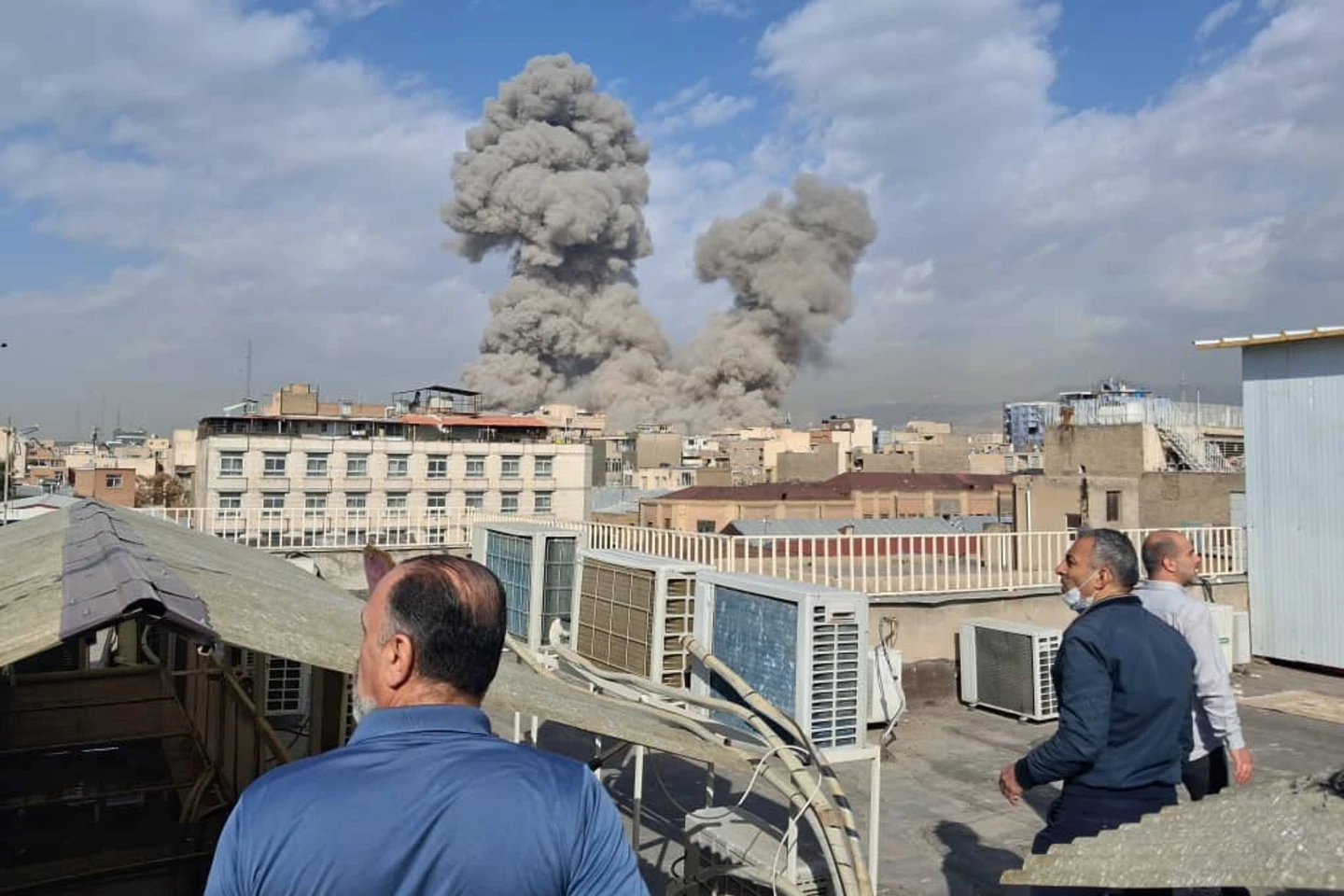
The advantage is no longer only in weapons, but in the speed of decision-making. Whoever processes data faster reacts faster.
If you weren't quite sure what X, formerly known as Twitter, was for, this weekend definitely cleared it up for us. When something important happens somewhere, on this one networks reactions are the fastest. The proof is the attack SAD and Israel on Iran on Saturday morning. According to information published by X's manager Nikita Beer, this network generated, day after day, more than 500 billion user seconds, for about a hundred billion more than on July 15, 2024, the day Trump appeared at the Republican Electoral Convention, two days after the assassination that he survived - which was the previous record.
On X, all generals are there, regardless of whether the battle is over or just beginning. Maps, videos, amateur and expert analysis are offered, each vying for some of those billions of user attention. News is published before the media confirms it. Artificial intelligence it is used to thicken that informational fog by mixing reality and fiction until the user's head spins like a real merry-go-round.
But that's nothing compared to what artificial intelligence has brought to the real world, one where real bombs and missiles hit real people and objects. The IT industry owes its development to the military, a lot of money from the military budget was set aside for the development of computer systems that would assist people, after all, the Internet was born from a military project. Artificial intelligence has been introduced into military systems since ten years ago, and today we are witnessing that the side with better IT has an absolute advantage on the ground.
Sometime since 2017. Pentagon has started using algorithms to review hours and hours of drone footage, many times more efficiently than a live officer who bothers to look at a screen for hours. There is no need to talk about how many people can be replaced by one program. Today, AI not only recognizes objects in images, but connects communications, recognizes patterns, suggests priorities and accelerates decisions. It does not press a button, but decides what will appear on the screen as important.
U Ukraine we have already seen drones that, when they lose their signal due to interference, "know" where to continue because they have a computer capable of "thinking". In the attack on Iran, the pattern is similar: first the air defenses are blinded, then precision strikes follow. Today, such operations are almost unimaginable without software that collects a huge amount of data from radars, satellites and sensors in real time. War is still fought with steel, but it is organized by computer code.
The advantage is no longer only in weapons, but in the speed of decision-making. Whoever processes data faster reacts faster. And whoever reacts faster sets the pace. In this sense, the algorithm becomes a strategic resource, as important as energy or ammunition.
This is precisely why, the day before the attack on Iran, the main news in the world was that the US Department of War (formerly Defense) put the company Antrofik on the list of "dangerous to national security". Antrofik is not a Chinese or Iranian company, but an American one, and they developed one of the best chat bots - Claude. The matter is further complicated by the knowledge that until Friday at five in the afternoon they were in active negotiations with the Pentagon to develop artificial intelligence support for military systems for two hundred million dollars. It stuck because the firm was unwilling to accept wording in the contract that did not expressly prohibit the use of their model in autonomous weapons systems or mass surveillance. This means that their systems could also be used to monitor US citizens, which is a very sensitive political issue at the moment.
Secretary of State Pete Hegsett gave them the aforementioned deadline and a minute later declared them enemies, so to speak, and finished the job with rival OpenAI who didn't seem too embarrassed. This is the first serious public collision between a technology industry that cares about ethics and a military structure that calls for security, about which there is no debate.
The real question is where is the limit up to which the algorithm decides, where does a living human continue. And is artificial intelligence moving the line of that front day by day.
What is happening in the country and the world, what is in the newspapers and how to pass the time?
Every Wednesday at noon In between arrives by email. It's a pretty solid newsletter, so sign up!
The Higher Public Prosecutor's Office in Belgrade ordered the collection of information on reported abuses. We are looking for documentation from Partizan and the Football Association of Serbia, as well as checking whether the entire agreed amount has been paid to the club.
Prisoners in Croatia's largest prison briefly refused to enter their rooms, citing overcrowding and poor conditions. The Minister of Justice admits that overcrowding is a fact, and new prison places have been waiting for years.
Last night, the Ministry of Internal Affairs activated the "Find Me" system for urgent public notification in the case of the disappearance of the ten-year-old boy Boban Đorđević from Velika Plana. The boy was found in Belgrade at the Prokop Railway Station.
How solvent is the Security and Information Agency? Is Serbia condemned to the saying that "everything passes, but only the Service remains"? And that's what the director of Bija, Vladimir Orlić, is bragging about
I can say that we have a rare opportunity to watch on television the epic fall of a regime and media that believed they were unsinkable and invincible. After that, I expect an equally interesting continuation of the program from the Student list, in which we will see how the flyers are vetted
At the moment when the institutions of the Republic are destroyed, when Vučić's octopus is still alive, when people are disgusted by the injustice and the stench left behind by the Essenes regime, we have, as Machiavelli said, only civic virtue as the fuel with which we can return to the beginning
The four independent members of REM are an example of perseverance and civic responsibility. Rodoljub Šabić even, upon leaving the premises of REM, after the sentencing of the Informer, experienced that the Essenes insulted him, hit him with their hands and feet. But that too will soon be over
Vučić pardoned the batterers and Dijana Hrkalović. The election winners should abolish the sultan's power that allows one man to run afoul of the entire judicial system
The archive of the weekly Vreme includes all our digital editions, since the very beginning of our work. All issues can be downloaded in PDF format, by purchasing the digital edition, or you can read all available texts from the selected issue.