Serbia is at the very bottom of the list of countries in terms of the percentage of land used for organic production. Organic food producers in Serbia tell "Vreme" that growing organic food is primarily a matter of enthusiasm
The latest published Eurostat data say that Serbia is at the very back of Europe when it comes to the share of organic production in agriculture, because only 0,83 percent of the total used agricultural land is used for such production, which means 27.550 hectares out of a total of 3,2 million hectares.
Such a modest organic production placed Serbia in a group of countries that includes Turkey, Malta, North Macedonia and Albania.
In other countries of the region and Europe, the share of organic production is much higher, so in the region, Croatia uses nine percent of land for these purposes, and Italy even 19,5 percent.
The champions of organic production are the Estonians, who in 2024 used 22,5 percent of the land for such production, followed by Portugal (21,2 percent), the already mentioned Italy and Switzerland (18,3 percent).
Organic production is a system of growing plants and animals that uses natural resources, preserves soil fertility and protects the environment. It prohibits the use of artificial chemicals, pesticides and genetically modified organisms (GMOs), and is based on strictly controlled and certified methods.
Considering that Serbia, especially in some of its parts, has extremely fertile soil, it is a great pity that organic production is not more prevalent, especially if we take into account that the basic postulates of organic production are the principles of health, ecology, justice and the principle of care and care.
"Vremena" interlocutors, organic producers of all food in the world is wasted, indicate how adherence to those principles is reflected in their gardens and how the situation in Serbia could be improved.
Many more producers than the statistics show
Pavle Đorđević, owner of the organic farm "Organela" and member of the management board of the organization "Serbia Organika", first of all points out that there are far more people in Serbia engaged in organic production than the statistics show.
He states that the statistics do not recognize them, because they are not officially certified producers.
"With the certification of producers who would like to officially enter this type of production, the increase in the organic production sector would be significant. Such a measure requires the support of the state. When organic production is mentioned, everyone always points out that it is a big potential, but not much is being done on it. Previously, subsidies for organic producers really increased, which is partly thanks to the association Serbia Organica, but a long-term strategy is needed, with an action plan and activities in accordance with that strategy," says Đorđević.
However, he also notes that when the subsidies were increased, the refund for certification was also abolished.
"It would be necessary to return the money refund measure for certification, because previously, if, for example, we spent 1.000 euros for a certificate, the state would return half of it. Some municipalities have local funds from which they return money to producers, but at the state level, that measure no longer exists," says Đorđević.
He also notes that the subsidies determined many years ago should follow the trend of growth, because inflation is high, since only the increase in the price of fuel increases the costs of transporting organic products.
He mentions the promotion of organic products as another necessary step.
"The advantages of organic food are great, and it's not just a matter of whether the products have been sprayed with chemicals or not, but the whole range of organic compounds that are found in the fruit precisely because of the way they were grown. In addition, there is a relationship with nature, because organic producers do not pollute nature. The more organic producers you have, the better it is for both nature and the country. It is, therefore, a matter of care for the entire ecosystem, and thus care for people," says Đorđević.
Photo: TimeOrganic production
Perma models changed everything.
When asked how demanding organic production is, he points out that until two years ago, he would have said that it was very demanding to start organic production.
"Earlier, we used tractors for plowing, we tilled the soil and implemented various agrotechnical measures: However, we sold the tractor, we no longer plow, and we completely switched to perma models, models such as the plant trail," says Đorđević.
Perma models are a sustainable system of organic production without classical plowing and digging. They are based on the layering of organic mass, by stacking thicker and smaller branches, dry leaves and compost, which imitates natural processes from the forest, retains moisture and provides nutritious soil for growing vegetables.
The trail of the plant resembles raised beds made of hay, leaves, grass clippings and fruit that for some reason is not usable. After everything is arranged in layers, plants are planted in such beds.
Đorđević explains that in this way there is no need for hoeing, and watering is also reduced. Also, there is no need for additional fertilization. He also points out that such a system greatly facilitated the organic cultivation of plants.
He states that before adopting the perma model in organic production, he tried to acquire greenhouses, a tractor and attachment machines, which requires a large amount of money that cannot be invested at once.
National quality guarantor sign
He explains that "there is no fear" when it comes to organic products from Serbia that are sold in supermarkets, and which are marked with the National Organic Product Mark.
"The organic sector in Serbia is quite regulated, and the random controls that are carried out prove that. I trust domestic producers of organic food more than foreign ones, because it seems to me that they are under stricter control. I am not sure if, when some food is imported, only the papers are checked or if analyzes are also done," says Đorđević.
He points out that the organic production sector in Serbia is small, that the producers know each other well, and that people opt for this type of production mainly because of love, and only then because of the financial benefits, "because first of all you have to be enthusiastic".
He explains that each organic food farm has its own philosophy and target group, so large farms supply larger organic stores.
"We are a small farm, but we are networked with other organic farms within the 'Kolubara' biodistrict, and we go to the market together. We grow certain crops, and other producers of other crops, and thus we complement each other. That is why in our sector it is important not to have too many fruits of the same variety and species, but that the production is diverse, since we supply families and some restaurants and catering companies," says Đorđević.
He explains that prices in the production of organic food should be based on the producer's costs and his planned profit.
"Prices should not be set in relation to what the prices are on the markets. We have had situations where some organic products were cheaper than conventional products, but, of course, we also have products that are much more expensive than conventional products, depending on what and how much it produces, and depending on the demand and the time invested," concludes Đorđević
Organic production for own needs
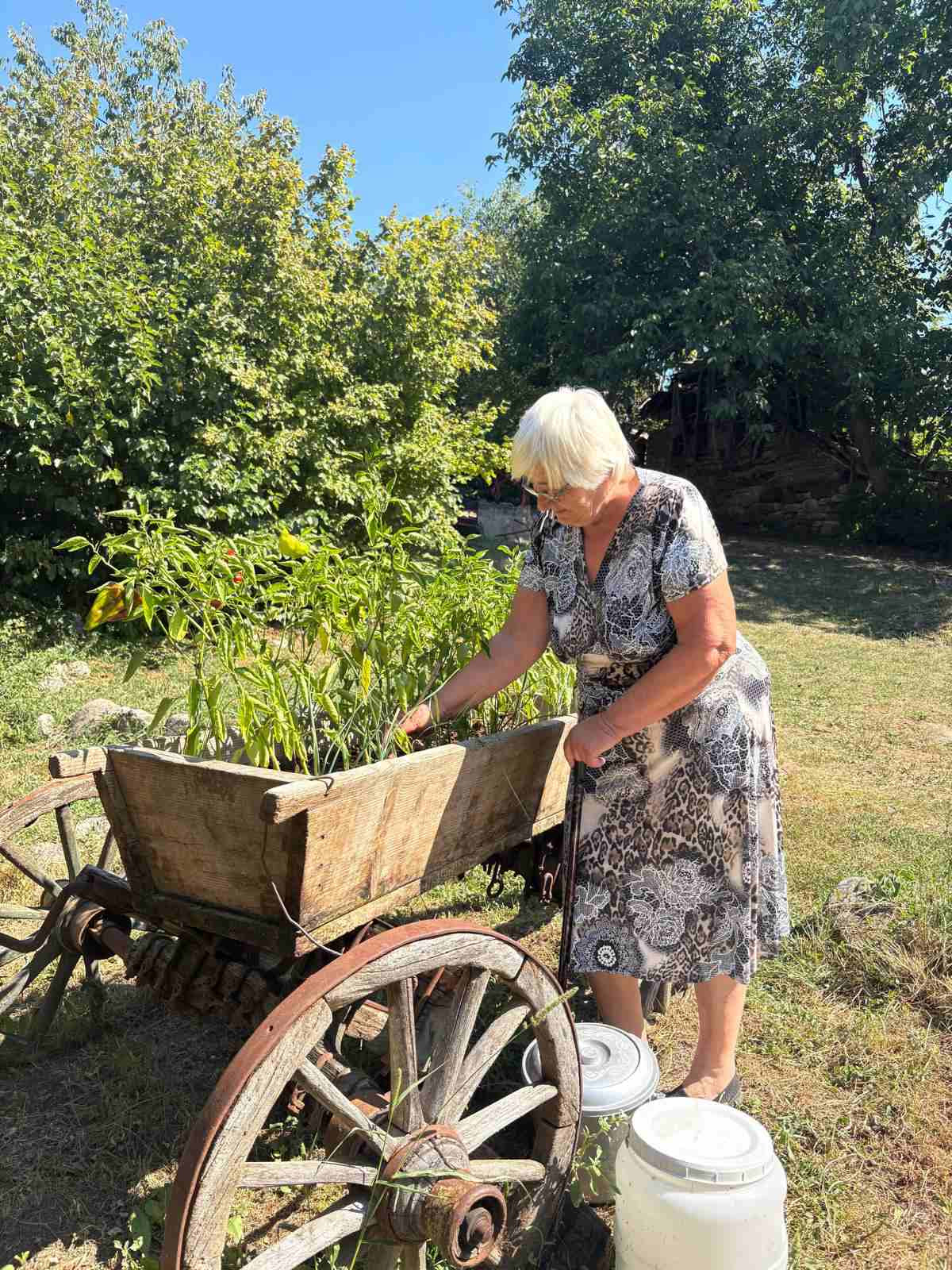
Organic production, on the other hand, can be extremely useful for all those who want to satisfy their own needs for healthy and quality products in this way. Minja Nikolić from the village of Temska near Pirot explains to Vreme what such organic production looks like.
She emphasizes that she has a small piece of yard, with little soil, since the house is on a rock, so she had to bring forest soil into her garden, and that's how she started with organic production.
"Just bringing in the forest soil, with leaves and branches, helps me a lot. I don't plant much, but I try to have everything I need for the household in that small garden. I have herbs, and I plant peppers, tomatoes and potatoes, and they are all organic products."
Although this summer of 2026 is very dry, Nikolić points out that he tries very hard to use only rain water to irrigate his garden.
He also adds that he does not have any special soil supplements, but that he only uses uprooted nettles, which were left a little, as an addition to the plants, during watering.
"The quality of the product is perfect, but the quantity is not so much," says Nikolić with a laugh.
She states that, despite the fact that she does not produce large quantities of organic vegetables, she is very happy to produce seedlings herself.
"These are old seeds. I very rarely buy seeds or seedlings, I produce them myself," says Nikolić.
Photo: TimeMinja Nikolić in her garden
It is important that plants "love" each other
He points out that the organic production of vegetables does not take as much time as one might think. Financial investments, he adds, are not significant, and it is much more important that the planter knows what he is doing, that is, which plants are compatible with each other.
That's why he never plants green beans next to cucumbers, because he knows that then he will have neither green beans nor cucumbers. The same applies to the ratio of tomatoes to corn.
"I live in the countryside, and the women from the village wonder why my garden is overgrown with grass. I don't even pull the grass, and if I do pull it, I leave it aside and when it dries well, I put it over the ground. This keeps the moisture for the plants. I use a lot of straw, especially when I plant potatoes, so people don't care how many potatoes I get in a small area," says Nikolić.
He states that for an area of about an acre and a half, he spends no more than an hour a day for gardening. Of course, it takes more time when the plants are planted, but after that the garden is only watered.
"But that's why when it's time to harvest, my family and I enjoy the smells and tastes that I remember from childhood, especially peppers and tomatoes," concludes Nikolić.
What is happening in the country and the world, what is in the newspapers and how to pass the time?
Every Wednesday at noon In between arrives by email. It's a pretty solid newsletter, so sign up!
Justice must never again depend on who is in power, because it applies to both "ours" and "theirs". The winners fought for it. Other affairs can wait, even if it is foreign policy - Europe is here, it will not run away
All this is the logical cause of Vučić's hysterical reaction to the mention of regulating the local media space. A mild attack on Prva and Informer televisions led to protests by "loyalists"
When "Because I say so" or "Because Freud says it differently" becomes a sufficient argument, it destroys in one fell swoop everything that has been worked on for several centuries: the importance of verification based on objective and rational parameters, respect for different points of view, a culture of dialogue, basic equality between people, replacing dogma with doubt and free research
The Higher Public Prosecutor's Office in Belgrade ordered the collection of information on reported abuses. We are looking for documentation from Partizan and the Football Association of Serbia, as well as checking whether the entire agreed amount has been paid to the club.
At the moment when the institutions of the Republic are destroyed, when Vučić's octopus is still alive, when people are disgusted by the injustice and the stench left behind by the Essenes regime, we have, as Machiavelli said, only civic virtue as the fuel with which we can return to the beginning
The four independent members of REM are an example of perseverance and civic responsibility. Rodoljub Šabić even, upon leaving the premises of REM, after the sentencing of the Informer, experienced that the Essenes insulted him, hit him with their hands and feet. But that too will soon be over
Vučić pardoned the batterers and Dijana Hrkalović. The election winners should abolish the sultan's power that allows one man to run afoul of the entire judicial system
The archive of the weekly Vreme includes all our digital editions, since the very beginning of our work. All issues can be downloaded in PDF format, by purchasing the digital edition, or you can read all available texts from the selected issue.