
Culture
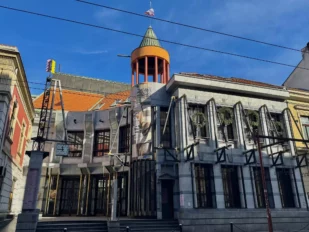
"Atelje 212" is 70 years old, and has one birthday wish
"Atelje 212" invites friends to tomorrow's 70th birthday celebration, and tells the city authorities not to agree to the collapse of culture

In order to bring the economy back into balance with the living world, we need to get rid of unnecessary work, reduce the working week, and invest in public goods. Give back what you take, not the capitalist "take more than you give back," argues Jason Hickel in Less Is More, published by Clio
Wars, migrations, climate destruction and pandemics raise the question of the responsibility of capitalism anew. And about the possible suicide of capitalism due to overdose. Not about killing the system, because despite the dissatisfaction, there is not enough explosive mass or detonator for change. Revolution is an exiled concept, Guevara is a recycled brand long ago, and Trotsky is not on Facebook. Admittedly, capitalism defends itself skillfully, its walls are made of rubber, it repels and absorbs, and even successfully sells anti-capitalism.
In this situation, a new anti-capitalist current of ecological economics is emerging (Herman Daly, Arturo Escobar, Nancy Fraser). English anthropologist Jason Hickel joined her with a book Less is more which was recently published by IP Clio, and fluently translated and a useful afterword was written by Ivan Radanović. The book convincingly hints at an ecological dystopia with growing inequality and poverty. Climate change (as unequivocally shown by the floods in Spain), global warming and excessive consumption are the consequences of the relentless pursuit of profit and unlimited economic growth.
Where is the solution
The argument is centered around the self-destructive imperative to grow GDP (gross domestic product), which Hickel calls the straitjacket of the development of modern capitalism. It is growth for the sake of growth, the excessive growth of rich countries from which the poor South suffers. Capital cannot stand still, an economy obsessed with the structural imperative of rapid growth is leading us to ruin. He is justified by the neoliberal ideology, which is already tired of cynicism.
All this is known. Where is the solution? Hickel stands for degrowth, for reducing the use of raw materials and energy in order to bring the economy back into balance with the living world. It is necessary, he writes, to get rid of unnecessary work, reduce the working week, and invest in public goods. Give back as much as you take, not the capitalist "take more than you give back".
The ideology of unlimited growth creates abundance for the minority and promises it for the majority. Economic growth is a substitute for equality, you have to work, suffer and believe. Hickel shows in a new way and with new arguments how modern globalization relies on the heavy industry of self-moralization of the rich who promote themselves as virtuous and wise because they work for the common good. They absolutize economic growth. It started back in the 17th century with the principles that time is money, poverty is a sin, and profit is salvation. They brutally chased vagabonds and beggars.
Hickel traces the morality of the rich back to neoliberalism. Capitalism cannibalized itself from the first colonialisms to the world wars. Today, the "omnivorous" encourages environmental destruction, the erosion of democracy and wars. Contemporary neoliberalism can be defined as the institutionalized peaceful conscience of the rich. As soon as the admiration of the rich is assured, it becomes easier to reconcile with unjust relations. And Rousseau's admonition that luxury is the ruin of virtue is dismissed as moralism. The moral knife and the cake are held by the rich.
Capital - a giant squid
Opposing the misery of this theory, Hickel documents two alternatives in two theoretically analyzed chapters: "More is less" and "Less is more". The first is existing capitalism whose DNA is self-destruction, GDP is an indicator of the well-being of capitalism and not of people, the currency of international political power. The growth imperative is pushing the retirement age, the beef industry is burning the Amazon, and oil companies are funding climate change denial. There is also resistance. But as soon as it encounters the limit of accumulation, capital twists like a giant squid to sink its tentacles into new sources of growth. Hickel shows dystopically but not pathetically that unlimited economic growth on a limited planet is not possible. Eating the environment is the intrinsic essence of economic growth that cancels out all decarbonization. He also mentions chemical leaks from lithium mines poisoning rivers from Chile to Tibet.
The most common resistances to destruction seek to replace dirty energy with clean energy. Hickel says that's not the answer. Techno-optimism is an illusion because it does not limit the insatiable economic growth. Eco-apartheid awaits us, where the green transition will be enjoyed by the minority, not the poor majority. It is more important to limit economic growth, reduce certain industrial activities, balance the economy with the natural environment.
It shows that less is actually more. It is not advocating for scarcity but for the moderation of consumption. We are threatened by an eaten up world because insatiable capital will not admit that after a certain level economic growth is no longer necessary to increase the quality of life. And more than that, because of the rush for economic growth, capital artificially encourages excessive consumption. The way out is to change the consciousness of consumers, to understand that less is actually more.
Defend the rights of nature and Mother Earth and process violence against nature as violence against people. The British anthropologist advocates an ecologically stable post-capitalist economy devoid of the endless pursuit of growth. After all, you don't need and don't have to work so much today. One should think about a four-day working week and an earlier retirement.
The dust of the demolished Wall
What is this book not? It does not belong to the chorus of neoliberal normality, but helps to expose it in a new way as abnormality. It is not a cultural criticism of capitalism from the right, but an economic one from the left. It does not deal with the greed of individuals but with the inhumanity of the system. It is not moralism but metamoralism. It does not reconcile with the teleology that the new normality of capitalism is the rest of our lives. It does not offer the consolation "It is not ideal, but it is realistic", nor does it well-intentionedly threaten "Forget the ideal". To some extent, it even manages to restore the hope and glow of the utopia that was covered by the dust from the demolished Wall in 1989. Part of this dust is the economy of unlimited growth.
Despite this, this reading awakens a strong self-doubt, aren't theses about the suicide of capitalism, at least in part, the empty self-consolation of the left, which lacks organization, intellectuals and action?
The book does not call for a barricade but warns of a dystopia. It does not question the property order, but growth. And yet, defeatism should not be transferred to writers who advocate degrowth economy and whose books do not carry the scent of rebellion. The passivity of the labor movement drives anti-capitalist intellectuals to other lines of analysis, mostly identity. The rainbow flash, the Trojan horse of the neoliberal agenda, is suffocating the red flame.
In a new normality that demands more tolerance for queer differences than social ones, there is no place for Hickel's incorrect anti-capitalism. His criticism is not even an active Manifesto of spilled mass discontent, much less a search for a revolutionary subject. But it more clearly separates left-wing and right-wing anti-capitalism. And that's something.
If, in the absence of an active left, the maximum hope today is offered by theories about the self-destruction of capitalism, how much self-consolation is there in them: "We are waiting for suicide, so murder (revolution) is unnecessary"? Although books are becoming less subversive, some, like this one, can be sobering, step by step, cumulatively, painfully and slowly. Sapienti clock.
"Atelje 212" invites friends to tomorrow's 70th birthday celebration, and tells the city authorities not to agree to the collapse of culture

In Belgrade, someone wrote graffiti on the window of the Salon of the City Museum, where the exhibition of the October Salon is held. The perpetrator should have been captured by security cameras

80 films are coming to the 32nd Original Film Festival, many of them with awards from the Cannes festival. It is organized by a citizens' association, without a dinar of state money

Tomorrow "Zvezdara Theater" will celebrate the 400th performance of "The Book of Milutin" by Nenad Jezdić's monodrama. Plays that have been in the repertoire for more than a decade are currently being played in Belgrade. The musical "Some like it hot", even - three

More than 400 artists and cultural workers signed the request of the Initiative for Free Culture, which calls for the dismissal of all the leaders of cultural institutions in Pancevo.

At the moment when the institutions of the Republic are destroyed, when Vučić's octopus is still alive, when people are disgusted by the injustice and the stench left behind by the Essenes regime, we have, as Machiavelli said, only civic virtue as the fuel with which we can return to the beginning

The four independent members of REM are an example of perseverance and civic responsibility. Rodoljub Šabić even, upon leaving the premises of REM, after the sentencing of the Informer, experienced that the Essenes insulted him, hit him with their hands and feet. But that too will soon be over

Vučić pardoned the batterers and Dijana Hrkalović. The election winners should abolish the sultan's power that allows one man to run afoul of the entire judicial system

Time explores: The construction of the St. Sava Temple
Did the money paid by the Government to SPC end up in Moscow through Alta Bank? subscribeThe archive of the weekly Vreme includes all our digital editions, since the very beginning of our work. All issues can be downloaded in PDF format, by purchasing the digital edition, or you can read all available texts from the selected issue.
See all



