Vladimir Oka
1. What, in your opinion, had a decisive influence on the collapse of civilization
and the war breakup of the SFRY: the Kosovo crisis that lasted for a long time, and intensively since 1981;
the constitutional crisis of the SFRY with veto rights of the republics, rotating leaderships,
one-year mandates; the constitutional position of Serbia "in the power of the provinces"; debtor
the SFRY crisis since the seventies; the "spring of nationalism" after the fall of the Berlin Wall in 1989, when three federations collapsed and 25 nation states were formed; the post-Titus vacuum of authority; the crisis of the one-party system; national leaders in other republics; the character of the words established in Serbia in the nineties?
In my opinion, mainly, maybe even exclusively, the following factors:
"post-Titus vacuum of authority": many wished, either to be "caliph instead of caliph", or the first in their village; "crisis of the one-party system": at the stage of development of Yugoslavia at that time, it was already time for multi-party democracy; "national leaders in other republics": not because they were "national" but more for the first reason (see above); "character of the regime established in Serbia in the nineties":
in my opinion, the character of Milošević's government in itself guaranteed conflicts both within Serbia itself and outside.
2. When Slobodan Milošević actually came to power: in January 1986, when he was elected president of the Central Committee of the Union of Communists of Serbia; In 1987, at the Eighth Session of the Central Committee of the Serbian Communist Party, when he eliminated Ivan Stambolic and Dragiša Pavlović (because of three words: "slightly promised speed"), or during the "Events of the People" in 1988 and 1989, when he was proclaimed Serbian leader?
Milošević came to power in Serbia by the parricide of Ivan Stambolić (which he later physically realized, probably fulfilling an ancient dream, and with minimal political justification). Shouting for "leader" was only the culmination of many years of activities to strengthen the position within Serbia.
3. How the leaders in other countries treated his government in Serbia
republics of the former Yugoslavia?
Partly themselves suffering from similar diseases and mania (mainly size), the leaders of the other republics mostly reacted instinctively to the Serbian government, without thinking much, or thinking about how to best use that convenient Serbian frenzy for their own internal goals. They were probably very happy to have such a neighbor. It is not surprising, then, that later they openly cooperated (though not always for the public).
4. How did the army, the old guard, the intellectual elite see it?
At first, the army blindly believed that Milosevic was "for Yugoslavia".
Later, after a bit of skilful personnel purge, the top of the army leaned towards exclusively "Serbian" interests. I don't know what is meant here by the term "old guard", but if you mean the Stambolić/Pavlović old guard of the SK, then it was very successfully removed from the road, and by its very characteristics it was incapable and powerless to fight against Milošević's type of populism. Intellectual elite? Which intellectual elite? If we mean the elite of the "father of the nation" type, then for them Milosevic was the ideal "conduit" for the realization of ancient desires and goals, mostly of the Greater Serbian type.
The other, from my point of view, the real intellectual elite suffered from the same problem as the "old guard". Powerlessness and unwillingness to stand up to bullying.
5. How deep was the support for Slobodan Milošević, given that he repeatedly received a large number of votes and gathered crowds at rallies, and that the response to the loan for the revival of Serbia in 1989 brought only a tenth of the expected inflow, and the invitation to Tens of thousands of conscripts escaped the JNA in Serbia in 1991?
In the first elections, the support was almost one hundred percent. Anyone who says anything stupid is slandering and lying - above all himself! It grew over time until a critical mass was reached around 2000. Unfortunately, it seems that even today that critical mass is equally small and on the verge of tipping back over to the SRS/DSS side. As for the loan, as always, patriotism is most interesting when it costs nothing. The same applies to military service. In the crowd, it is easy to shout "Go to battle!" to battle!", and it's quite another thing to stand out from the crowd and apply for that rifle.
6. Have you personally (1) been to one of the "Slobina meetings" at least once; (2) did you at least once raise three fingers, shout "Everybody, everybody, everybody", sing "Marched, marched King Petar Garda", voted for Vuk Drašković in 1992/93. (in any coalition combination) or did they shout "It's just someone who rattles" in 2000? (Don't be fooled by the statistics!)
Proudly no to all three questions. (1) and (2) are against everything that I feel as my own and good. Shouting childish slogans is not my style, in the case of 2000.
7. How did dissident circles and the emerging opposition in Serbia view the change at the top of the government in Serbia? How much of the supporters and opposition bloc in Serbia came from the so-called People's events?
Dissident circles obsessed with "Serbia" saw their big chance - and took advantage of it. The emerging opposition either came from the aforementioned dissident circles, and was against "communism", but for other parts of politics, or it was the type that did not know how to deal with scumbags and either disappeared quickly, or barely recovered and is still it's a bit floundering without real mass support.
8. After a one-year flirtation with non-party pluralism, multi-party pluralism was introduced in Serbia in 1990. In which group was there more verbal nationalism, in the SPS, which was created by the merger of the SSRN and the SK, or in the newly formed opposition parties?
In the opposition parties, because they did not have to live up to the part of the mass and membership that still believed that Milosevic was the incarnation of Josip Broz and the messiah who would preserve Yugoslavia.
9. What was actually the backbone of the ideology that Slobodan Milošević was guided by: communism, Titoism, self-governing reformism, Yugoslavianism, Serbian nationalism, populism?
Pragmatic populism without any doubt. Everything else was decoration to overshadow and seduce the simplicity. Authority.
10. Was the mention of the Swedish standard in the election campaign in 1990, Serbia's "high-speed railways" in 1991, and Beopolis, a project for the XXI century in 1995, a Potemkin fog, a distraction from the cacophony of war, or a goal that such a type of political elite could not realize?
Potemkin's village (or fog, anyway, because there wasn't even a wooden facade). Attention had to be diverted from blood and torment at all costs. If the people had been allowed to see the blood and suffering as they really were (not only in Serbia), things would, perhaps, have turned out at least a little differently. Better different.
11. From the "Balkan Butcher" to the Main Factor of Peace and Stability - what is the role of the foreign factor in the disintegration of the SFRY? Americans, Austrians, Germans, French and Russians?
First, whatever the role of the "foreign factor" really was, it is quite certain that it was not as it was presented by either the government or the opposition. I think the saying that if something can be attributed to stupidity/incompetence, there is no need to attribute it to malice. After almost a decade of living in Great Britain, I can testify that both in the "people" and in politics there is much more naivety and incompetence in dealing with the "Balkan mentality" than any desire to favor anyone. Not to mention the importance of good advertising, and you know whose propaganda was better in the last 20 years. Just as the "West" did not really understand our problem, the Serbian government did not really understand what kind of propaganda "works" from the outside. Unlike, for example, Croatia and Slovenia. Unfortunately, this all seems to be still the case.
12. Was there a common strategic goal between the then warring ruling structures in Serbia, Croatia and Slovenia?
No. Which does not mean that at times (longer or shorter, it doesn't matter) the paths to the goal were not parallel and complementary. I don't believe there was ever any common plan of action, except perhaps on an occasion-by-occasion, purely pragmatic basis.
13. What role does the attitude towards Serbs in other republics play in the politics of Slobodan Milošević? Were his statements like the one from 1989 that armed battles are not excluded, or the one from May 5, 1990, during his visit to southern Banat, that Serbia will not sit idly by in the face of any violence against parts of the Serbian people outside of Serbia, represent rhetoric of deterrence or revealing a war plan? How can one explain such an amplitude in his national policy - from military aid at the cost of sanctions to complete media and political ignoring, for example the collapse of the RSK in August 1995?
I couldn't wait to use this term: "coin to change." No dilemma. What else, when he alternately defended them and left them in the lurch, all depending on
own needs?
14. Why was such a large number of people on the other side of the law engaged during the war in the period of the disintegration of the SFRY?
Mercenaries are used in every war. Nothing more complicated than that. That these "ours" were at the same time proclaimed national heroes and the like is just decorum, at best, or a deliberate activity to maximize results (and profits). And of course, an illustration of the government's unscrupulousness. Everyone.
15. Why was there a great robbery of the people in the 2000s, and did it stop in XNUMX?
A good opportunity arose, the authorities needed "gray" profits for "gray" wars. The unscrupulous government does not care about the unscrupulous "bizmismen", and even less about whether the people are suffering or not. Is 2000 over? Probably, as a state policy.
The problem is to eradicate the resulting habits. As Johnny Štulić said: "a habit does not fade easily, it is difficult to create..." The only problem is that such bad habits are too easy to acquire and too difficult to lose.
16. Why were the Geneva and other conventions on the rules of war and basic human rights ignored to such an extent during the wars at the time of the disintegration of the SFRY: because of the character of those wars, because of the immorality of the leaders, because of the breakdown of institutions and order, because of the hatred induced by war propaganda, because of the memory of victims in the Second World War, or because of the accumulated tendency towards violence in individuals in the people and in the army?
All of the above except the last. "The accumulated propensity for violence in individuals in the people and in the army" certainly existed, but it could only emerge as a result of the other factors mentioned. Also, to which individuals? How many? There are always "individuals prone to violence" in society. It's just a matter of percentage.
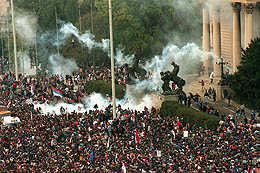
17. Would you rather say that the regime of Slobodan Milosevic was overthrown on October 5, 2000, or that it collapsed due to internal demoralization and moral decay?
Neither one nor the other. As can be clearly seen even today, his proclaimed goals (as opposed to the real ones, which were mainly a convulsive hold on power) are still popular among the majority of the people. The only question is that the tip of the scale has tipped in favor of the side that might still carry it out peacefully and "democratically".
18. How do you explain the sudden mass flight from the defeated leader in the period October - December 2000? How did the first democratic candidates behave in 1990, 1992, and those in 2000?
I don't quite understand this question? Are you referring to Milosevic's associates who left him during that period? If so, then the one about rats leaving a sinking ship applies. And so in Milosevic's rule, power itself (and the profit that goes with it) was practically the only and basic goal. As she began to crown herself, so did those who could still look for other hiding places. Democratic first-timers from various periods? They behaved mostly the same then and before and now. Nothing much has changed, only the "Milosevic" style has gone out of fashion.
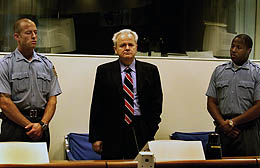
19. Did the Hague trial and the death of Slobodan Milosevic in the Hague cell change the public perception of him?
No. Not one iota.
20. Why, in the nine years after 2000, Serbia did not at least reach the economic level of 1989, i.e. why is the recovery taking so long?
Because the country is much more materially and morally broken than this question implies, and much more than most are willing to admit.
Mila Perkovic
(the text cannot be published due to insults that cause national hatred)
Misha Bern
1. The rise of nationalism, the fall of the Berlin Wall, which led to the unification of
us to disunity.
2.88-89.
3. Very bad, nationalist because everyone wanted to become the leader of the region and remain written in the history of their people.
4. The army was divided by nationality, and we did not have an intellectual elite, only a name made up of various troublemakers.
5. The support of the people was great as they say and they won the elections, the response to the loan was expected and satisfactory if you look at the fact that the late Đinđić also appealed for help and got nothing, and avoiding military service is now more catastrophic, it is only covered up by serving civilian military service. Has anyone wondered how many recruits are coming from the diaspora?
6. I was not such a supporter of slobism, even less a supporter of the false patriot Vuk Drašković, whose only goal is to strike Serb against Serb.
7. What a poor dissident, what an opposition, the West kept and paid for it and now we are reaping the fruits of their delusion.
8. What about the others, except SPS.
9. None of that, maybe social policy, saving the economy.
10. What are we diverting attention from now? With a thousand euros, a "Fiat", thousands of jobs, the famous Corridor 10, the SSP, a white Schengen or a colorful lie.
11. Well, that is known to the sparrows on the branch, it was easy for all of them to folkize when Russia was led by laymen, why don't they folkize now.
12. No.
13. The RSK broke on its own with the help of the opposition in Serbia.
14. So who are they on the other side of the law and why were they not sanctioned after 2000?
15. The people have always been robbed, they are still being robbed now, only in a slightly more cultured way, so they also got a little education.
16. Look at how much the Serbs have suffered over the centuries and it will be clear to a layman.
17. On October 5, Curto dismounted and Murto mounted, who still rides to this day.
18. The leader was not defeated, it was not faith but unbelief that fled. Democratic first-timers, here we see the fruit of their behavior, the state is getting smaller, indebtedness is increasing, incomes are decreasing, price increases are increasing and, who is defeated here?
19. Yes, from being a loser, he became a winner and synonymous with persecution.
20. Unfortunately, Serbia does not go forward, but backwards, what Serbia had in 89, the democratic brothers sold off, filling their pockets and budget, with which they are recovering today: the production of raspberries and four-leaf clovers, the "Fiat" of Mlađa, or a promise that there is no crisis here because the IMF arrived, with failed social policy, extinct Serbian banking? There is the defeat of democracy, and the victory of Milosevic.
Ivan Jovanovic
Yugoslavia was created after World War I to break up Austria-Hungary, the former Austrian colonies of Slovenia, Croatia and Bosnia were placed under the control of Serbia, which was then closely associated with France, England and the Russian Empire. From the beginning it was a state based on peace through the fear of dictators; then the King, later TITA. When the dictator was gone, the state fell apart in blood, just as it was created and maintained in blood. The disintegration of that state was used by all involved to rapidly gain power, money and territories.
Goran Vladisavljević
I first heard about Slobodan Milosevic sometime in 1987 when my father came home from work and said: "Tomorrow I'm taking Slobodan Milosevic to Greece!" That was the first time I asked myself who this Slobodan Milošević was. He later drove him to Gazimestan, in fact only as far as Pristina, after which he continued his journey by helicopter, and that's roughly where, due to his pension, all contact between my father and Slobodan Milošević ends.
The first time I had problems because of Slobodan Milosevic was several years later, in 1991. Then I received a scholarship from the Dutch government and just when I was about to leave for specialization, the Dutch consul in Belgrade, a certain Mr. Werner, told me: "Your scholarship is being canceled. You are a victim of sanctions."
The penultimate time I had problems with Slobodan Milosevic was in 2003. In a Japanese bank, I tried to send money to Serbia, but they told me that the money could not be sent.
- Why?
- We cannot tell you the reason, it is our business secret.
- But please tell me which condition I don't meet.
- We are forbidden to make financial transactions with members of the Milošević family!
- But my last name is not Milošević at all.
- Please excuse me, sir, for us Japanese Vladisavljević and Milošević are very similar, so we thought...
I experienced the last problem with Milosevic only a few days later. Although I had lived in Japan for months, I had never heard the word Belgrade mentioned in their Japanese diary until that evening. That evening, I even recognized two rivers on the diary: Belgrade and Đinđić. I didn't understand the rest of the news, but I saw an ambulance outside the Emergency Center. I remember that I couldn't sleep all night, that I didn't have internet in the apartment, that I was the first to come to work the next day, that I immediately turned on the computer and opened one of our websites. I was hoping for the title 'Wounded in Belgrade....'
Unfortunately the title read 'Bullet in the heart'. I immediately remembered Slobodan Milošević and thought that the fruits of the evil he sowed in Serbia will be felt for decades to come.
Between this last and the first problem I mentioned, there were countless other bigger and smaller problems I had because of that man: from waiting in lines, through Dafina, to the bombs over Belgrade and stolen youth. From an unknown passenger in the Falcon lounge, he became the Balkan executioner who is badly remembered throughout the world. And what happened in the meantime with me, the 'victim of sanctions', as Mr. Werner characterized me? I received some other stipends, 'bigger and better', as Milošević used to say about our broken bridges.
Sasa Mitrovic
The collapse of SFRY was influenced by the "post-Tito vacuum of authority".
Namely, the strongest guarantor of the survival of SFRY was Tito. The official propaganda, shaped by the "coordination" of the editors of the leading media at the time and the party functionaries in charge of the media, did not even try to hide it. Tito was synonymous with modern Yugoslavia (SFRJ) and the guarantor of its survival, and with his departure the question of its future opened up. Both the Party and the vast majority of citizens who did not belong to the Party were aware of this. Other listed factors contributed to the collapse
SFRY, but the key factor was the lack of a leader, i.e. authority they are after
equally desired by all Balkan peoples (perhaps with the partial exception of the Slovenes).
As an illustration, let's remember the episode with Anto Marković and the dashed hopes of a large part of the citizens for the survival of the SFRY (the appearance of a new, modern leader). Or, if we analyze the psychological profiles of the elected presidents among the key nations involved in the bloody disintegration of the SFRY (Milošević, Tuđman, Izetbegović), there is a striking, somewhat successful, tendency to imitate the former great leader in various aspects (image, way of ruling and behaving, etc.).
The disintegration of the SFRY during the war, however, was influenced by a mixture of factors, the most important of which is the low level of civilization of the Balkan peoples. If SFRY is viewed geographically from west to east, I would say that, unfortunately, this is most pronounced among peoples who spent a very long time under Turkish rule, i.e. Serbs and Macedonians. If we assume that, at the time of the dissolution of the SFRY, each nation had legitimately elected representatives, we can conclude that the character of the regime established in Serbia corresponded to the level of civilization of the Serbian people, i.e. that he (the regime) displayed the worst qualities, that is, the national traits of the Serbs - primitivism, intolerance, xenophobia, excessive aggression, simpletons, etc. Therefore, from the offered factors, I am inclined to choose "the character of the regime established in Serbia in the 1990s" as the culprit for the disintegration of the SFRY during the war.
2. SM actually came to power during the "People's Event".
Until then, there were intra-Party struggles that were not uncharacteristic for some previous periods in the Party's history. These struggles, however, had to be legitimized by the people as the rules of the game changed rapidly with the collapse of the Eastern Bloc. Namely, it was no longer enough to be an official elected by the Party, but the legitimacy of the new leader had to be provided by a convincing mass, because another critical moment in history had come. The last such moment was the end of the Second World War. war and the previous leader grew out of that, for us also civil, war in the fragmented Kingdom of Yugoslavia. That's why this new one had to grow out of "struggle" ie. street gatherings (these are the mentioned "battles we are in" from Gazimestan before the real, armed ones that are "not excluded". Without this final act of legitimization, the leader would not be ready to make all the drastic moves that will follow.
3. The leaderships in other republics were encouraged by the appearance of SM because it enabled them to dare to realize their no less dangerous, nationalist and other goals.
4. The army was disoriented and, as the most "Yugoslav" institution, it was also the biggest victim of the collapse of the SFRY in terms of material and human resources.
The old guard (the Party) did not have a unified position and could not redirect the course of events.
The majority of the intellectual elite looked favorably on the coming to power of SM
The minority was belittled and marginalized.
5. Support for SM was as deep as the support for the ideas he represented in people's minds. At first overwhelming, that support grew with each new peace-making turn of the SM
However, one is verbal support for ideas and the other is personal material support in the form of money or response to recruitment. There are rare moments in the history of any country where someone has succeeded in mobilizing people in this way, and I don't see why SM's failure in this aspect would indicate a lack of support for its policies.
On the other hand, I think that the response to the loan for the revival of Serbia was very large (it is about hundreds of millions of dollars) and I would not underestimate it even though it brought a small part of the expected funds. How many people in Serbia today would do the same?
6. I belong to category (2).
7. Dissident circles believed that it was about intra-pariah calculations. Later, they were divided into supporters and opponents of the government, which began flirting with nationalism.
The situation is similar with the emerging opposition in Serbia, which was predominantly nationalist-oriented, i.e. dissatisfied with the "too mild" national rhetoric of the authorities.
Not only supporters of the defeated faction of Ivan Stambolić participated in the "Event of the People", and that is a distinct minority of citizens. Therefore, the commoners of the future SPS as well as SPO, SRS and DS participated equally.
8. There was more verbal nationalism in the opposition parties, possibly with the exception of the DS (before the start of the endless process of fractionation).
9. Populism in Yugoslavian wafer. When that coating "worn off", it showed
wafer of Serbian nationalism.
10. Elections in the Balkans are won on sweet promises and the SPS has always had good propaganda in this regard. Therefore, I would say that this was a distraction from the cacophony of war, although I do not rule out that there were people within the ruling class who sincerely believed in those projects, and so, in a way, they themselves were manipulated.
11. Germany and Austria had more influence at the beginning of the crisis. Let's remember the recognition of new states at the beginning of 1992 and the "Danke Deutschland" episode, while the USA was reserved for a long time. With the prolongation of the war in Bosnia, the USA assumed an increasingly active role, in order to decisively influence the Dayton Agreement and the bombing of the Serbian forces in the RS and Serbia itself later due to the conflict in Kosovo. In the years after 2000. they often take a leading role from the EU in solving certain issues in the Balkans, such as the process of independence of Kosovo, etc.
France and Russia did not play a more active role in the events in the Balkans or, at best, were outvoted by other influential states (an example of the Contact Group was an attempt at a "balanced" approach of the great powers to the crisis in the former SFRY).
12. No, except in certain episodes such as the agreement between Tuđman and Milošević on the partition of Bosnia.
Each of them had the goal of conquering as much territory for themselves as possible. This means that the Slovenes should keep the Avnoje border of Slovenia, the Croats the same plus something to "take away" from Bosnia, and the Serbs to take as much territory as possible from any of their western neighbors. If it occasionally coincided with the tactical goals of one of the opposing warring parties - temporary friendships were made.
13. I tend to believe that the statements from the beginning of the reign "represented the rhetoric of deterrence", because the citizens were not yet ready to engage in an armed civil conflict, and therefore not even to hear about some kind of war plan. Actually, I think that the government of SM didn't even have any war plan, it was developed in accordance with the development of events on the ground. We would value the SM government too highly if we assumed that it had any plans at the beginning of the disintegration of the SFRY.
including war.
The (variable) amplitude in national politics can be explained by the ideology of populism, which is based on the desire to attract the support of as many people as possible. Variations in nationalist rhetoric were a fine (precise) instrument in implementing this ideology.
14. A civil conflict of such proportions caused a moral and any other kind of crisis in the average citizen who did not express excessive optimism towards personal participation in that conflict.
In such conditions, the engagement of criminals devoid of moral restraints and "trained" for free, mostly in Western countries, is a logical move by all warring parties to the war that followed the collapse of the SFRY.
15. The great robbery of the people is the second loan for Serbia, this time for its survival on the war path. However, this loan was not voluntary, but everyone paid it equally through the devaluation of their work (salary 5 marks) and acquired capital ("old
foreign currency savings"). On the other hand, the state in turn provided certain concessions to citizens (buying white goods on checks without cover, buying apartments for "old foreign currency savings", living for 100 DM per month) so the term "great robbery of the people" is quite conditional. Rather, this robbery was at the expense of state resources (deterioration of factories and companies, lack of investment in the improvement of technological processes, etc.), which is one of the reasons for Serbia's economic weakness 15 years after this robbery, i.e. today.
Nevertheless, the great enrichment of individuals occurred, without any doubt, as a consequence of their involvement or merit in the execution of state affairs that in the 90s were largely in private hands (import of gasoline, weapons, export of capital, etc.). The economic crisis and all its accompanying effects are a direct consequence of Serbia's participation in the war in the 90s and are a sad testimony to the inability of the authorities in Serbia to maintain any kind of economic stability during the war years, which was also possible for a much poorer Serbia in some of the previous wars.
The looting of the people stopped sometime in the mid-1990s, as the resources were more or less exhausted. To a lesser extent, it happened again after the bombing of Serbia, with the introduction of the solidarity tax, the devaluation of the dinar and the awakening of inflation.
16. It is difficult to choose one of the offered factors because all of them, to a certain extent, influenced the non-compliance with wartime conventions. Nevertheless, the breakdown of institutions and order has a decisive impact, i.e. the military structure that is responsible for the implementation of these conventions through the imposition of compliance with the military rules of service and punishment for non-implementation thereof. If there was a clear legitimate and legal military structure that could enforce military discipline and the rules of military service, this would certainly happen to a much lesser extent.
17. The regime collapsed due to internal demoralization, but October 5 would also never happen spontaneously, i.e. the regime would not surrender without a fight, even a staged one.
18. Mass flight from a defeated leader is a normal phenomenon in human history and is not characteristic only of a certain nation or group of people.
I did not understand the question regarding the behavior of the first democratic candidates. If it refers to the behavior of the defeated members of the regime, I think that there was no organized persecution at the level of the new authorities, but it came to the fore more at the local level, where people know each other and where passions are even more pronounced (remember the episode with " crisis headquarters of DOS" immediately after October 5, 10, where members of the former regime were replaced en masse solely on the basis of that fact).
19. Yes, to some extent, they recovered the previous image of Milosevic as a protector of "Serbian national interests" in relation to the image of a "corrupt politician whose only ideology was to stay in power at all costs".
20. For the recovery to the level of 1989, it will, logically, take much more time than it would have taken to fall to the level of 2000. +even if it were to be worked on as the most important national goal. However, factors such as an incompetent and inexperienced government (compare the experienced "autocrat" Dacic with the inexperienced Djelic), undefined national goals (wandering between Kosovo, the West and the East), the demoralization and exhaustion of the citizenry due to continuous crises and the insincerity of the international community in relations with Serbia make it difficult many times this goal.
I think that the standard from 1989 is increasingly a mythical goal that today's Serbia even has no chance of reaching in the first half of the 21st century.
Milivoje
From this angle of looking at the events in question, jokes like the one about Titus and Sith are created... False dilemmas are deliberately created. The time you mention was marked by the fall of the Berlin Wall (the end of the "cold war", the defeat of some and the victory of others). How one determined himself according to those factors, that's how he passed.
If the Serbs had chosen the winning side here, they could have had ten instead of one Arkan and all of them would have been heroes and not criminals (like Thaci and the like...). Not even the relevant intellectual elite chose the winning side. Now everyone is rooting for Milosevic, just like Tito for Stalin...
Elvis Becirovic
As a historian, I believe that the appearance of Milošević speaks in favor of the fact that after 1971 and the removal of the "liberal" Perovićka, Tepavac, Serbia had no more democratic potential... Even the members of the SK Serbia party since Draža Marković and his right turn to the CKSKJ in 1982, they were not immune to the Great Serbian call in the 80s -
so Stambolić and Pavlović had no chance in 1986...
Talking about the opposition in Serbia in 1990 is unnecessary, because the SPO had no other matrix of political activity than the SPS.
The only true opponents of the Milošević regime were the late Ivan Đurić, Zoran Điniđić and Dragoljub Mićunović...
Slobodan Milić
Milosevic's coming to power in Serbia was a great encouragement for me until June 28, 06, when I finally realized that this was another deception, neither the first nor the last, in my not-so-short life. That's when I began, first of all reading The Struggle, later watching Studio B, to realize that I was not alone in my thoughts. But there were really few of us. In the environment where I lived and worked, I was a black sheep, so many people asked themselves in mutual conversations: "What about Milić, he seems to have lost his mind?" My fight was persistent to prove that this is a big scam. It was not worth it that the war had started, nor that sanctions had been introduced, nor enormous inflation, nor Jezda and Dafina, nor my claims that in these circumstances, many hiding behind "partism" are getting rich while the vast majority of the people in Serbia aspired to poverty and misery. Some people sobered up when Sloba introduced sanctions on Republika Srpska. Neither the "flash" nor the "storm" helped the people understand the essence. The mere fact that everyone was running away from us like the devil from the cross was not enough for the people to understand that the main (I must admit, not the only) problem is in Serbia. The theft of local elections and months of protests slowly (showed) that the balance of forces for and against Milosevic began to change to his detriment. The sale of Telekom bought social peace so that most of '1989 and '97 passed in peace, except for Kosovo where the Albanians, seeing their chance of the century, took matters into their own hands. Instead of solving the problem in cooperation with the international community, Milošević is using force that has not passed either in Slovenia, Croatia, or Bosnia and Herzegovina. The referendum was a big farce, and how "principled" he was was soon seen when (against the will of the people) he allowed the international verification commission to come to Kosovo. The unsolved murders of people close to him were a model for his way of ruling. Bombing followed. Nothing has changed in his politics, I guess waiting for it to
disintegrated NATO, until they started targeting electrical energy facilities. Then the people remained without electricity (and water) for a long time, which forced them to bend their backs and hand over Kosovo, which we will never get back.
Nothing because of displaced persons...
Let's just remember the refugee columns in 1995 from Kninsk Krajina (so-called RSK). What ignoring. The year 2000 is coming, a year of great changes, but seemingly, the structures have hardly been touched. The late Djindjic was forced to make a pact with the devil, which he eventually paid for with his life.
After his murder, no person appeared on the political scene who was ready to take responsibility like him. Ćeda and his LDP inspired a little hope, but the departure of his comrades from the party (Leka, Samardžić, etc.) made me suspect that everything is not exactly as Ćeda says. The only hope, in my opinion, is Nataša Kandić, Sonja Biserko, both Biljana, but they are so demonized that there is no escape for us, but I hope we will not fail. We in Serbia have to understand that all evil started with us and only when we understand that can we hope for something better.
Igor Mihaljević
1. The absence of a modern, civil society, immune to bestiality
individuals, institutions and politics of the former republics.
2.1986. What remained was the routine of bringing the game to an end.
3. Sporting - they used every mistake of the opponent.
4. The military is confused, the old guard is emotional, the intellectuals are wrong.
5. Very deep, due to the classical and political lack of education of the citizens.
6. I don't go to rallies. Of all the above, I voted for the opposition in the local elections in 1996 and for DOS in 2000.
7. Case by case. Honestly, I don't know.
8. Same phrases, different mannerisms - same effect.
9. Populist oligarchy.
10. One of many.
11. The European Union, and its individual members, for the first time seriously demonstrated their impotence in solving international conflicts, which continues and has never, nor will it, realistically help Serbia, if it did not personally benefit from it. The US has shown and proven that the decisive threat and use of military force is the most effective method in achieving the plans of the State Department.
12. As always.
13. Exceptional. Classic abuse for the sake of achieving personal ambitions.
14. There are some, they are willing to work and have no morals and conscience.
15. Because they could. Today it is less brutal and justified by other reasons.
16. See under 1.
17. Collapsed.
18. A logical defense mechanism, survival made possible by the indecisive and corrupt.
19. In reasonable people, no.
20. Corruption at all levels and unavailability of EU pre-accession funds.
Milan Uzelac
an accident that affected millions
civilizational collapse
verbal nationalism
the backbone of ideology
Potemkin fog
the role of foreign factors
amplitude in his national politics
people on the other side of the law
enrichment at the misfortune of the people
internal demoralization and moral decay
Can you explain to us the meaning of the above phrases - phrases - sentences?
I find it a little strange that such a respectable newspaper should use such ossified language (if I used the right adjective)
(You will get some answers over time in our New Speech section. See edit.)
BS Misković
1. Of course, all of the above contributed to the scope of the collapse and the breadth of the crisis, but the constitution-making mania of the trained village teacher (E. Kardelj) is still the root cause.
Uča did not stop until he passed who-knows-what-in-order Constitution, crowning the opus with the "Constitution of '74" by which every republican party, applying it consistently, was directed to autonomy and, finally, "autocephaly", i.e. independence. But - with a catch-22 for Serbia: although it is a Kobayagi republic like the others, it had to not only listen to the voices of its subordinate regions, two in total, but was forced to obey them. That Constitution, as a seed of discord, quietly undermined the very possibility of survival in any community. The slogan about brotherhood, especially its part about unity, on which the Reds based their coercion, and through it they stayed in power, was dismissed with a stroke of the teacher's pen. Of course he formulated the Constitution in that way, of course it benefited his blood and soil, it would be a miracle if he took more care of us than 'ours', their name was not mentioned.
If the Constitution is - and it should be - the foundation on which the house is built, then it is no wonder that the house has been smashed to pieces. What masters, Uča and arsenic-Lupenovsky Hochstapler-Bonvivant, that much held water. So the first and basic cause of the shameful civilizational impasse, from which it is very difficult to run back to the exit and then wander around looking for the 'right way' and the society that has been repulsed, is the inability to work for one's own cause. The incompetence of our lawyers, lack of courage, cowardice, the Mephistophelian attitude of "widely closed eyes" while the house is being built, succumbing to constant propaganda about the oppressors, the majority, military tradition, about nationalism, even. Ketmanism, in one word.
It was only then that the creation of a constitution by trained amateurs-nationalists came to our heads, but it is our own fault.
2. He (S. Milošević) did not come to power in 86, he was installed on the throne, first through imagination and then through democratic centralism (what an oxymoron) as soon as he caught sight of the flower in Mira's hair and never took it off. (further follows the illegal provision of psychiatric diagnoses, prim order).
3. I don't really care. My heads came to me. Not really mine, ours. Which is to say, yours.
4. The army does not see, it first listens and then orders the same. The old guard? You mean lumpenproletarians converted into small-towners from various new Belgrades? Are you thinking of Stabolić, Minič, Marković? I can think, and I would not like to imagine, their shoes smell. The intellectual elite, all joined the Writers' Club. Made evenings, of course intellectual, nothing poles or shouting out the window.
5. I am afraid that the support for Sloba and slobism was and remains strong. No one is given money lightly, not even for a loan. But support, a circle on the paper ... for that wonderful man who loves his wife and thinks of all of us, here we have water, even though our electricity was cut off a long time ago ... many people in villages and cities did that and did it until 5/X, but also after him. Remember that Koštunica got a little unrecognized power at the time with barely more than one percent of all of us. Both in cities and in villages.
However, I am most appalled that ideas that resemble slogans and slogans - together with the representative party, communists in diapers - have been returned to the stage by those who scared us the most with those same faces and names.
Yellowed demagogues, the biggest populists because they are also the biggest (agitation) propagandists, helped the continuity of slobism to which every regiment is prone. We see this both in bread for 3 dinars and in 200.000 new jobs. Lie as much and as often as possible, Goebbels would say if he were alive.
6. (1) Of course I wasn't at 'his' rallies, otherwise I wouldn't be writing this and like this until now. (2) But of course I did and I still raise three fingers, if only because no one else in the world has such a sign. I didn't sing to Gauleiter or the King, I don't know the words, and I don't have partisans or Chetniks in my family (an unprecedented miracle, but possible).
He made a noise and tore his shoes at 'our' happenings, and then he became disappointed, came to his senses and - remained a non-party member. I feel sorry for that constitutional lawyer who was declared a drone, he didn't buy us on nicknames and slogans. He did not "lightly promise us speed", like the former, nor rapid reforms, like the former.
7. Funny question, because we all know how many of us there were on March 9 at Terazije and how many of us really remained after the tanks. Even better, how many of them were there at Television when Borislav V. Pekić received a blackmail from a similar authority again. If that was the nucleus - along with a couple of weakened academics and brave employees from the Association for Freedom of Expression (if that was the correct name), and let's not forget Turajlićka, who like Marija defiantly removes a sign with a street inscription - then the number of 'us' is 5 /X an accurate indication of how many have crossed over to the other shore in the meantime. Second, to be honest, in the beginning, the whole 'event' that started in Kosmet seemed stimulating, as a possible spark to overthrow the entire regime. It seemed anarchic, it seemed naive to me as a layman (and then younger, if it's justified) spontaneous and even cute. At least I cheered how much a man does when it comes to being weaker. When it...:)
8. Do you really measure nationalism? Kantarom, electronic, how? Or: What are you, non-national, so you can do it? It's like you're measuring whether I like Topčiderska Zvezda more than you, I think because of 'that' bench.
9. Kleptocratic anomie. To translate, thieving lawlessness, that was the ideology of the Family. Since both members of the married couple were victims of the Napoleonic complex, in their case Tita's, let's give them credit as patients: Perhaps, as enraptured and delusional as they were on the Split waterfront while they were looking at Svedržac in a military parade uniform, they set off - and it's better to say , She started - with an idea, with a vision not to steal but to be great. It's further...some say history, I would say Theft. And without eyes. Idealess, without any ideology. Should we mention crates? And why then, at the moment when... in our faces from the screen he rudely explains the fabulous feasting of his only son, we didn't, like in that movie, everyone, but everyone, went out to the windows and started shouting that 'I won't put up with this shit anymore' ?
10. Let me improvise on the given topic: Is the mention of the Brussels Agreement, which has just been signed, the bombastic performance of the Turin Fiat, promises to build the Corridor, the Ada bridge, a few more bridges, ring roads and bypasses, money from shares for an entire free summer , and let's not get started on the powerful workplaces, there was a Potemkin fog, a diversion of attention from the government's multi-party disarray and from the party's cacophony, where the central office would support the first the violin of the provincial branch, but so that no one notices it, or is it a goal that this type of political elite cannot realize?
Next time I vote for Krkobabic, he was the only one who at least achieved something. He defeated the budget, but remained in the cabinet!? Obaška, everyone knew all that, in advance.
11. The role of the foreign factor is the clearest. She is selfish. No more, no less. Which is to say, how much we allowed and how much we are doing now. Or we had to. Or they really wanted to. And we are not ourselves, except philosophically, so as Dylan says, you have to serve someone.
12. Sorry, silly question. How do you imagine that three sides, two of which are at war with the third - started from Triglav with uniformed unarmed people dying, ended after almost three years of UN protection with civilians blackened?
How can they have a 'common strategic goal'?!? If you meant breaking up the federation, then two players are to blame. This one of ours did not plan to give up Brdo near Kranje.
13. An extremely intriguing question. But little space for the etiology of that sectarian obsession with monoideal megalomaniacal omnipotence. By peace. Plus, give me money!
(again an unauthorized psychiatric diagnosis, ed.).
14. Naive question. Why does every country in every war always open the gates of all prisons? Demand for cannon fodder. And that these characters will grow into Davy Crockett or some local Arkan, that is inevitable.
15. Robbery happens whenever you have unchecked power. First we had a substantial Family that steals, now we have a Company, because the rulers are not alone. There are at least 13 of them in the corporation. Some claim even more, it's hard to count them, gathered for a grain of power, but sweet. I believe them, as soon as they can hang out.
16. The question suggests a wrong answer. One could even say that conventions are there to be broken sometimes. I happened to be "on the ground" at that time (first Krajina, then Bosnian Krajina, also Krajina) and as a witness on behalf of the Geneva MK Red Cross, I know that those conventions were not violated to a greater extent. Rather smaller, it depends on what we liken it to.
Let's face it, there were camps, there is also Abu Ghraib. There was human roasting on a spit, there was also depleted uranium. You have all kinds of wars, not only in Rwanda. All the dirtiest and most inhuman. In war, it seems, the beast gains the right of citizenship, it is its hour.
17. Alas! I would like to say that we brought it down, that we took the poles... but then we would have blood and looting again. No, he collapsed in an impasse, at least for the Main.
True, even the chief of police remained faithful to him. Afterwards, he killed himself in the middle of the steps of the Assembly.
18. Simple: the ship is sinking, the mice are gray and miserable but not silly, they run to the winner. We are now full of mice. The largest political and propaganda company was born with them.
Opposition '90 – moral boulders. I have to call them that because I admire people who had a backbone and wanted to sleep peacefully, if the rest of us are already stunned, we won't go to the window. Many of them remained gentlemen, moral and consistent. At least not on the same side. Some go about their business wisely. Some are delaying the last days in the Assembly. And some have cheated and attached themselves to the tainted guy.
Opposition '92 – Vuk Drašković. I know he will like it, but unfortunately there is not much more to add. Except, the King as my boyhood dream to watch the golden carriages in the parade, that's it.
Opposition 2000 - Since January, it has been an enterprise for the takeover of power, which, with a good judgment, puts forward the only clean one among them, morally and politically, but also financially. The same Company still manages it, although with more and more foremen and plant managers.
19. Whatever. His peacock-like screeching and agonizing death could only strengthen many in the belief that he was supernatural. For them, as Tito did for Krleža, he 'went into legend'.
20. I am not excusing anyone - especially not those who sold off the heavy metal industry for 20 million dollars or the Port with all the acres and acres, fat is someone's stain trivial sale to godfathers shouting-through-the-window sugar factory earning 3 euros, monopolizing supermarkets or egg markets , let's say - but we were in big shit. Senkrup is so deep and we were at the very bottom. And if there were no Nušić swastikas and unknown relatives, true restoration would take time. The worst thing is that, in addition, we have to reach those who, while we were demolishing, cut forward without paying attention.
Milan Marinković
Commentary: "Freeman, proud name,
what's wrong, change it completely!"
In the late 1980s and early 1990s, these verses came out of many throats throughout squares, stadiums and factory circles. At that time I was a beardless student of the upper grades of elementary school and a regular visitor to matches, then a more or less standard first league player, and today a marginalized and on the verge of collapse of "Real from Nišava". There, in the stadium - more precisely in its southern stand, where at that time gathered, euphemistically speaking "ardent fans", and essentially, but alas, politically "incorrect", hooligans, I heard for the first time about the respected (and at the beginning of this of the sung text) of the citizen Milošević Slobodan. I would be lying if I said now that, carried away by the inertia of the sweaty and euphoric mass, and according to the old folk saying "where everyone goes, there is little Mujo", I personally did not sing an ode to the "savior of the Serbian race".
I am, of course, and I ask my favorite columnist - Mr. Teofilo - to forgive me this pubertal sin, especially before this current "me" looks at that former "me" with a superior-pitying smile, soaked with a moderate dose of irony at the corners of the lips. Nevertheless, at that time many (perhaps even the majority!) of pro-Western intellectuals supported Milosevic, truly more for the reason that objectively he did not have praiseworthy competition among the oppositionists made up of Chetniks of that time (SPO, SČP, SNO...) than because they really liked his "flirting" with national-chauvinism, so why should one be expected to think smarter from a pliant balavander. I think that with this last sentence, in addition to trying to justify my sinful prepubescent soul, I also gave an answer to question number five about "the depth of support for Milosevic at the time." 'Let's go on!
I intend to immediately admit that I am not competent enough - at the risk of violating the old Serbian tradition of everyone-knowing-everything-and-understanding-everything (unless you are an employee in the state administration, so it is in your blood to you declare yourself incompetent whenever you are required - see the insolence - to do the work you are paid for!) - to answer questions numbered two, three, four, seven, eight, ten, eleven, thirteen and nineteen.
Answer to question number 1: I would say that the lack of authority after Tito's death in combination with the fall of the Berlin Wall and all the phenomena associated with that event, among the factors offered in your question, most decisively influenced the disintegration of the SFRY. Of course, the entire process is (was) too complex for us to fully demystify it in such a small space, but the two mentioned factors definitely played a key role.
As for the answer to the sixth (given that I have already answered the fifth) question, I can - briefly and clearly - state the following: I have never been to Sloba's rally (unless, of course, we do not classify the football matches of that time as a kind of rally); I did raise three fingers, maybe too often, and I also admit that I "marched in King Peter's guard", while I never voted for Vuk in the elections, although for a short period of time - and again under the influence of fan-hooligan turbulence and realignment - I was favorite political leader. Already at ninety-six, I sobered up - and it was about time, considering that I had entered adulthood - and, therefore, I participated more or less regularly in protests against the theft of election results until it was finally overthrown (at least formally!) the regime of Slobodan Milosevic on that historic fifth of October.
The backbone of the ideology on which Milosevic relied, and in terms of the ninth question, was reflected to the greatest extent in Serbian nationalism and populism. It is understood that Sloba managed to mislead many by falsely presenting himself as a continuation of the Yugoslav path, especially since his SPS party was formed on the foundations of the ruins of the former SSRN and SK, but, essentially, the so-called "Yugoslavism" was just a convenient tool for him to manipulate and win over (i) those structures of society that did not look too kindly on raw nationalism and the glorification of "Serbism" (whatever that means). And here, Milosevic, unfortunately, proved to be a skilled "juggle" who knows how to balance on a thin wire between two fires, and when I think about it, I can't help but recall the title of the famous song of the group "Metallica":
- "Master of puppets"
If mutual trade, both in territories and quasi-national interests, as well as in concrete goods, with the help of abuse of emotions and - ignorance, i.e. insufficient education formed - emotional chaos of the common plebs, can be called a strategic goal, then the answer to the twelfth question is confirmed.
When trying to answer the fourteenth question, it should be borne in mind that most of those people on the other side of the law, even the "most prominent" ones, were literally "on the other side" in the period before the war and the disintegration of the SFRY, and not only law, but also the state borders of our former homeland. Tito's secret service, otherwise very professional in terms of quality, wisely moved the most capable ex-YU criminals abroad, recruiting them to perform various useful jobs for it, and in return providing them with certain benefits and privileges. So - a system that worked on the principle: it's better to wave there than here and as long as you respect that there will be no problems! However, at the end of the eighties, and especially at the beginning of the nineties, the new leadership needed those same criminals here more than "over there and far away" because war is a dirty job, and the smartest thing to do is entrust the dirty job to someone whose hands are already dirty. We are still feeling the consequences of the "covenant" made then by the state and the mafia, and, it seems, we will continue to feel them for a long time to come.
It is difficult to say whether the great robbery of the people in the 1990s (question number fifteen) happened because Milosevic was so perfidious and on the basis of that he created a scenario for his own epoch in advance in which he predicted the aforementioned devastation of so much national wealth, or he simply had to who helped him wholeheartedly, as is logical, give them their piece of cake. After all, the paragraph that precedes this one talks about the great return from "temporary and useful work for the state" of all kinds of scum and profligacy, and for the purpose of war logistics, so we should look for a key connection with the topic of this, fifteenth question. Finally, the old saying "who with the devil plants pumpkins..." perhaps best illustrates the answer to the question posed. And did it stop after the 2000s? No! Now it's just done in a more subtle way and wrapped in an institutional framework.
The terrible level of brutality in terms of violations of various international conventions and rules of war was definitely provoked to the greatest extent by aggressive war propaganda through the state media. Bearing in mind that at that time there were almost no "independent" private TV stations, it is easy to conclude that the majority of Serbian citizens, especially those from the so-called province, not to mention the remote hilly and mountainous areas, was forced to, willy-nilly, be informed about all current events through RTS's famous second daily. If we further recall the incendiary messages that could be heard from the mouths of prominent commentators and other self-proclaimed experts, then the answer to the sixteenth question is self-evident.
The beginning of the end of Milošević's rule is the moment when, apparently at the urging of his wife, he removed Jovica Stanišić from the position of head of the DB and replaced him with Rade Marković. Whatever the public thinks about Stanišić, the person in question was a professional who really knows his job and the mechanisms of the functioning of the service, as well as the government as a whole. Here, therefore, I am not talking about the moral aspect of the character and actions of the then first man of the secret police, but purely about his expertise and ability. After all, many party operatives of the then SPS, with whom I had the opportunity to discuss this topic, share this view of mine. In this sense, the political suicide that Sloba began to carry out in 1998 was only completed (was it?!?) on October 2001.
For the eighteenth question, I will answer only the first part of it, and that quite directly: the mass flight from anyone who has been defeated, done by those who as recently as yesterday swore by him and - what is more important - shared with him the rich spoils of power , it's simply called hypocrisy and cowardice and that's where all further discussion and empty philosophizing ends!
We have finally reached the epilogue of this whole story. An epilogue that perhaps also hides the main secret of the wasted twenty years, including the last ten, when Milošević no longer represents the government. Namely, the question arises as to how all the most important political parties were actually formed, and then shaped, since the creation of the current multi-party system. I am inclined to believe the version that occasionally shyly emerges on the agenda of pub debates, after a certain amount of drinking, and which - although only at first glance - looks a lot like one of the handful of domestic conspiracy theories. But, I note - only at first glance. Here's what it's really about:
The theory in question suggests (to us) that it was Milošević - not formally and legally, but essentially - who created a group of significant political forces (parties) and charted a course for them to further act and "advance in the service". How? Exactly through, in one of the previous paragraphs, the courier (not printed, but alive - flesh and blood!) !
Jovice (Stanišić, please!). The theory of the "inhabitants" of the taverns, in which I proudly classify myself, goes on to say this: Sloba, through his most capable and at that time most loyal collaborator, controlled every political group that appeared and pretended to have any serious influence on the formation of public opinion and movement socio-political tendencies. As soon as, therefore, one of them strengthened beyond the limits of Milosevic's refined taste, Jovica was given the task of processing it operationally, by inserting his vetted people where necessary, thanks to whom both the president and he would have an insight into everything what is happening. When it was judged that the appropriate hour had come, the party that "exceeded its powers" would artificially cause internal stratification, and then dismemberment. Let's remember how many different parties and parties were formed, disbanded, resurrected during all that time - God forbid, let's try to count them! - and we will see that this kind of logic hides something more than just a conspiracy theory. And that is precisely why even after the October 5 coup, in these almost ten years, (with the exception of the period that ended prematurely under the leadership of the late Prime Minister Djindjic) no progress was made even close to what could (and should) have been achieved.
So much from me this time. I could do it like this until the day after tomorrow, but, as I say, let others also say something. In the hope that I managed to make a modest contribution to the attempt to demystify the "last dark period of Serbia" - and if it lasts, it lasts - I wish all of us more optimism, energy and faith in ourselves, and less prejudice, nationalism and narrow views.
And now - everyone to their workplaces!
Dusan Ralevic
SFRY consisted of two dams that kept the river, full of national, ethnic and religious differences and tensions, from flooding the entire European Community. Those dams, ideological and economic, were erected at some point by an invisible hand whose will was reflected in the constellation of forces of the world's great powers, and which saw the creation of a single entity from loose and disoriented Balkan states as the only possible solution for the Balkans. It happened that the change in the constellation of forces at the global level coincided with the weakening of these dams. Whether the disruption of the macro balance preceded the disruption of the micro balance or whether it was the other way around is difficult to say. Perhaps it is best not to make a cause-and-effect connection, but to observe them as two phenomena that occur in pairs as a consequence of something else. All in all, the new balance meant a new will of the invisible hand and therefore a new destiny for the Balkans. The dams were removed, and for the umpteenth time, Europe was flooded by a flood of Balkan hatred and intolerance, which, after all, is not unique to the Balkans, but to all parts of the world where there are differences. In other words, the fragile national identity, which was based on ideology and economy, and which unfortunately did not have enough time to be accepted, fell into pieces before the onslaught of Balkan nationalisms and religious fanaticism. Everything else is more or less a question of Balkan aesthetics, on which one should not waste too many words. Cheering for a famous... (insult) Beard with three fingers raised is just proof of a desperate need of man to be the same and to be different at the same time. This is irresistibly reminiscent of Marx's social animal. Yes, I also took part in all that and I have to admit that, unfortunately, I remember it all very fondly. Memories are woven from emotions, and emotions from that time are tied to the belief in belonging to something that was not the Serbia of that time. Sometimes I'm afraid that in twenty years I won't remember the current period, or at least not in that way.
I would like to thank you for an extremely analytical and insightful case study that should help us find answers to questions such as: Who are we?, Why is this happening to us? And what we really want, all in the hope that some future studies of our cases will have content that will make it easier for us to believe that we are a part of it. Until we answer these questions, we won't even begin to make a meaningful recovery. Without a healthy awareness of the sick spirit, the healing of the spirit will never begin. I hope that we will never again allow our national consciousness to lag behind our own spirit to such an extent that we end up marveling at ourselves. In other words, I hope that our Minerva's owl will also take flight before midnight.
Comments on the text "About Serbs, battles and Yugoslavia"
Jovanca
With small modifications, where adherence to communism instead of capitalism is mentioned, the result would be the realization of the Serbian national ideal.
Dimitrije Mirašević
There is no flaw in a job done - Valtazar Bogišić.
Davor Pranjic
Excellent speech, except that he always said one thing and did something completely different. The one who took his word for it turned out to be a fool.
Zoran Velickovic
Sloba tells us what to do. As then, we Serbs did the same now. And furthermore, let those who can change (the government, cf. rv,) think that it would be good for us Serbs. After each mistake, you should become wiser. May luck follow the Serbs, God help us.
Smile
Continuing in that direction, Public Service will show the film Kosovo Battle these days. The 620th anniversary of the exploitation of bribes! Corruption, crime, etc., ongoing!
Aleksandar Vuković
He managed to make me, as a native Serb in Sarajevo and the son of the director of FK Sarajevo, feel like a star in Tehran.
From Thursday, in the printed edition of Vremena, read personal confessions about this age that were not included in the e-edition.
Your answers to 20 questions send by sending a comment on this text.