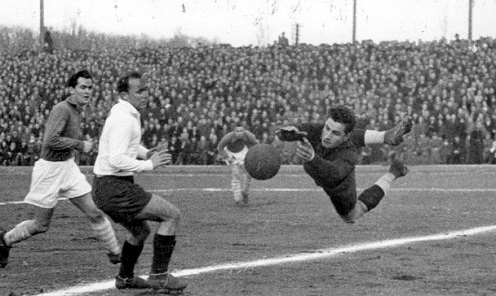
The legend of the former era when football was more than a game, the goalkeeper of Hajduk Split, Crvena zvezda and the Yugoslav national team, Vladimir Beara, died in Split at the age of 86, on the night between Sunday and Monday, August 10/11, after a series of strokes he suffered in the last year and a half Beara was born on August 26, 1928 in the village of Zelovo in Dalmatia, and the first club in his career was Hajduk Split.
In the memorial text on the occasion of Beoara's death on the website of Hajduk Split, it is said about that beginning: "He came to Hajduk in 1946, when after watching Hajduk's first team practice, Jozo Matošić approached him and said: 'Little one, come and stand on goal.' He stopped, many people shot at him, and he was "throwing himself in all directions". Coach Lemešić immediately invited him to come to the training of the junior team the next day.
He started defending for the Hajduk senior team in 1947, and already in 1950 he experienced his first great joy. Hajduk wins the first post-war Yugoslav championship title..."
Actor Drago Čuma once shared anecdotes from the life of Vladimir Beara, which the latter told him during the preparations for the monodrama "Beara catches a high ball". Vladimir Beoara, a Serb born in the village of Zelovo above Sinj, who came to Split to study electrical engineering, playing picigina, a Dalmatian game, throws ball after ball on Bačvice beach so elegantly that he was invited to the ballet. He didn't really like being a ballet dancer. But football experts also saw him, so he got an invitation from Hajduk and in seven days he became the first goalkeeper.
When asked by Draga Chuma how he learned such elegant jumps, Vladimir allegedly said: "As a child, I looked after goats and, like them, jumped from one stone to another." That's where my ballet and goalkeeper jumps come from."
He played in the Hajduk jersey from 1946 to 1955 and won three Yugoslav championship titles, and in 1955 he decided to move to Crvena zvezda Belgrade.
Police chief Milić Bugarčić and Slobodan Penezić Krcun allegedly hid him in Avala for the first seven days. The MUP of Split wrote to the MUP in Belgrade to hand over Vladimir Beara to them, because he allegedly planted a bomb with which he wanted to kill the President of Indonesia Sukarno and Tito... Hajduk's emissaries also allegedly came to Tito, who directed them to Kardelj, who allegedly said: "Well, by God, I guess it doesn't matter where Beara will play tennis, in Split or in Belgrade."
At Zvezda, Beara won four championship trophies and two cups.
He played for the Yugoslav national team in 59 games from 1950 to 1959.
In the jersey of Yugoslavia, he won a silver medal at the Olympic Games in Helsinki in 1952, and in the final against Hungary he saved a penalty from the legendary Ferenc Puskas.
Between the match against Austria on October 8, 1950, in which he made his debut, and Hungary nine years later, when he gave up his place between the posts to MIlutin Šoškić, Beara played for the Yugoslav national team in three World Cups, in 1950, 1954 and 1958. His defenses for the world selection in the match with England (4:4) played at Wembley in 1953 were also remembered. The nickname "Veliki Vladimir" was given to him by English journalists after an excellent game in a friendly match between England and Yugoslavia (2:2) at Wembley in 1950. The saves against England promoted Beara to become one of the best goalkeepers in the world. For this reason, in 1953, he received the exceptional honor of defending for the European team, against England (4:4). Three other great Yugoslav footballers played in that match - Zlatko Cajkovski, Bernard Vukas and Branko Zebec.
Beara was the last player of the famous Yugoslav generation of 1952, who played two memorable games against the former USSR at the Olympic Games in Finland. In the final of the Olympic tournament in Helsinki in 1952 against Hungary, Beara saved the famous Ferenc Puskas' shot from 11 meters.
This was preceded by a dramatic match against the USSR. It was the time of the Tito-Stalin conflict. At the center of the Russians was the famous player Bobrov, a hockey player in the winter, a football player in the summer. He was, says Beara, taller than Horvat, our tallest player, by a head.
After a corner, Bobrov jumped and scored 5:1, 5:2, 5:3, 5:4... and 5:5. "My godfather Lippi," said Beara to Dear Chumi, "you can imagine what a night we spent." They will say that we are traitors, that we let go." Fortunately, the second leg was played tomorrow, Rajko Mitić was in great shape and we won 3:1. The Russians go home, and we go to the final with the Hungarians, who at that time had perhaps the best team in the world of all time: Grošić, Buzarski, Lantoš, Božik, Lorant, Zaharijaš, Sandor, Kočis, Hidekuti, Puskas, Cibor.
For years, generations of fans have known by heart the famous lineup of that Yugoslav national team, which played only six games in the same lineup: Beara, Stanković, Crnković, Čajkovski, Horvat, Boškov, Ognjanov, Mitić, Vukas, Bobek, Zebec...
Russian goalkeeper Lev Yashin, winner of the Ballon d'Or in 1963, said of Beara that he is the best goalkeeper in the world. The equally famous Ricardo Zamora, the goalkeeper of the Spanish national team, made a similar assessment about Veliky Vladimir: "You, Beara, are the best goalkeeper in the world!"
From 1960 to 1963, Beara defended the goal of the German side Alemannia from Aachen and Viktoria from Cologne, where he also completed coaching school in 1967.
In 1967, he returned to his homeland and coached Rijeka for a year, then went to Germany again, where he became the coach of Fortuna from Cologne. In the 1970/7 season, with Hajduk, as an assistant to the head of the coaching staff, Slavko Luštica, he won the title, then he coached Osijek, then Troglav from Livno, then as the coach of the national team of Cameroon he won the African Cup, and then for a year he was the coach of Dinara from Knin, then he returns to Crvena zvezda, this time as a goalkeeper coach. As a coach, he came to the aid of NK Split, in order to end his coaching career as the coach of Bregalnica from Štip.
As a coach, he led German Freiburger, Fortuna Köln, Dutch Fortuna Sittard, and First Wien.