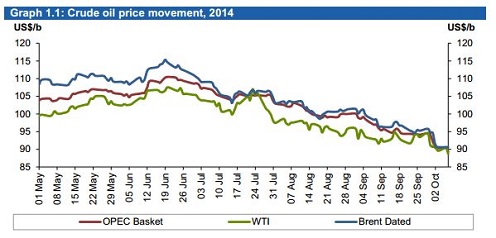
Global oil prices continued to fall on Thursday (October 23) following the release of US Energy Department statistics on crude inventories, which rose much more strongly than expected.
The 27-member organization of oil exporters OPEC (Organization of the Petroleum Exporting Countries), which exports a quarter of the world's oil, agreed on October 30 at a meeting in Vienna, according to some the most important in the last decade, to remain at the production of XNUMX million barrels per day. As the Wall Street Journal writes ( OPEC Leaves Production Target Unchanged) this implies a reduction in production by only about 300.000 barrels per day. If it is implemented, it is a very small reduction in the supply of oil, whose price fell again after the news from Vienna and reached a four-year "low record" of $75. The last time OPEC lowered the quota was in the fall of 2008 to 24,84 million barrels, when the price reached 147 dollars per barrel and has been falling ever since, and during this year the trend of cheaper oil was strengthened, which became one third less.
OPEC was under pressure from the poorer exporters to reduce production and prevent further cheapening of oil, which is most opposed by Qatar and Saudi Arabia, which, as the largest producers, essentially determine the policy of OPEC.
"Everything will be sorted out on the oil market." There is no need for OPEC to cut production, despite the large drop in oil prices threatening some cartel members," said Saudi Oil Minister Ali al-Naimi.
Russia, which is a member of the OPEC as an observer, did not participate in the summit in Vienna, because Moscow had previously concluded that the OPEC countries were divided and that nothing should be expected from the Vienna meeting - although Russian President Putin repeated several times that he would the low price of oil lead to a world crisis. According to some estimates, Russia's potential losses due to sanctions and the drop in oil prices could reach 140 billion dollars. So far, the Kremlin has not rebalanced its budget, which is largely financed by hydrocarbon exports, because the decrease in budget revenues due to the drop in oil prices has been compensated by the effects of the rising dollar exchange rate. (According to the agency RIAN On 27. the exchange rate of the dollar against the ruble on the Moscow Stock Exchange increased by 11 kopecks and reached 75 rubles. The euro jumped by 49,4 kopecks - to 62 rubles.)
The price of Brent oil on Wednesday, November 2, again fell below the psychological level of $ 70 per barrel: the value of January futures for the North Sea Brent mixture fell 1,15 percent — to $ 69,74 per barrel, and the January futures for light oil of the type WTI fell by 0,015% — to $66,87 per barrel, the Russian agency reported RIA Novosti
Updated on December 3rd
The futures price of American light sweet crude oil (WTI - light sweet crude oil) for December decreased by 2,57 percent - to 80,42 dollars per barrel. The price of December crude oil futures (north eea brent) fell by 1,95 percent - to 84,57 dollars per barrel.
The agreement on ensuring the uninterrupted supply of Russian gas in Ukraine until March 2015 was reached late in the evening of October 30 in Brussels by the Russian Minister of Energy Alexander Novak, the Minister of Energy of Ukraine Yuriy Prodan and the European Commissioner for Energy Gunter Oettinger, in the presence of the President of the European Commission Jose Manuel Barroso. the director of Gazprom, Alexey Miller, and the head of Ukrainian Naftogaz, Andrey Koboljeva.
A way was found for the Ukrainian "Naftogas" to pay the Russian "Gazprom" 3,1 billion dollars in gas debt by the end of the year, on the basis of which the disputed sum of the Ukrainian gas debt will be reduced, which will be decided by the Arbitration Court in Stockholm. The supplementary contract between the Russian and Ukrainian gas groups "Gazprom" and "Naftogas" was then signed by the directors of the two companies, Alexey Miller and Andriy Kobolev. The agreement refers to the settlement of Ukraine's overdue debts and the terms of payment for deliveries until March 2015.
The Russians estimated the total due debt at 5,3 billion dollars, but accepted that the disputed 2,2 billion be left to the arbitration court.
The key part of the compromise is that the price will be less than $385 per 1.000 cubic meters of gas, and will be valid for the duration of the transitional agreement.
Payment for new gas purchases will be made in advance, month by month.
Russian Minister of Energy Novak announced that Ukraine will also receive 1,45 billion dollars from international sources in the near future in order to prepay for November and December's 4 billion cubic meters of gas.
Ukraine will provide the funds to ensure payments to "Gazprom" from four sources: from the special fund of the IMF, from the own revenues of the Ukrainian "Naftogas", and also from the funds allocated to Ukraine by the EU.
European Commissioner for Energy Ettinger specified that Ukraine will pay $1,4 billion immediately using funds from the IMF and the European Commission, and that another $2014 billion will be paid by the end of 1,65. Ettinger said the deal was worth $4,6 billion ensures the energy security of Europe during the winter.
Until the end of March 2015, Ukraine can receive Russian gas at a price of $385 per thousand cubic meters or lower on the principle of advance payment, as Russia will give a discount of $100 per thousand cubic meters through the reduction of the export duty. After that, "Naftogas" and "Gazprom" will negotiate on further arrangements.
In June, "Gazprom" suspended deliveries to Ukraine due to the accumulated debt and demanded that future deliveries be paid in advance.
Source: RT TV
Updated on October 31
According to data from the US Department of Energy, commercial oil inventories for the week ending October 17 rose by 7,1 million barrels, or 1,9 percent, to 377,7 million barrels. Analysts had predicted an increase in US reserves of only 2,69 million barrels.
Distillate reserves increased by one million barrels, or 0,8 percent - to 125,7 million barrels. Gasoline stocks decreased by 1,3 million barrels, or 0,6 percent, to 204,4 million barrels.
"As long as OPEC does not cut production, I do not see any factors that could raise the price of oil," estimated Samsung Futures Inc analyst Hong Sung Ki (Hong Sung Ki), whose words are reported by the Bloomberg agency.
Since the beginning of 2014, Brent crude has fallen by almost 20 percent.
Analysts cite various causes.
Earlier it was announced that the Organization of the Petroleum Exporting Countries (OPEC) in September increased oil production by 402 thousand barrels per day compared to August, which was a record growth in three years. Libya increased production by 250 thousand barrels per day, Iraq by 135 thousand. In addition, Iraq, OPEC's second-largest oil producer after Saudi Arabia, is cutting the price of oil delivered to Asia and Europe in November. Earlier, Saudi Arabia announced it had cut prices for November oil delivery in Asia to a six-year low and increased output. Important causes include reduced demand for oil in Germany and China due to slowing economic growth rates.
Under the title Decision taken to boost Blue Stream's capacity to 19 billion cubic meters
Gazprom announces that in Moscow on October 1, an agreement was reached between Gazprom Director Alexey Miller, Taner Yildiz, Minister of Energy and Natural Resources of Turkey, that the capacity of the Blue Stream gas pipeline, which runs under the Black Sea from Beregovaya station to Durusu station near Samsun and beyond by train to Ankara) as quickly as possible from 16 to 19 billion cubic meters per year, in order to meet the increased needs of gas consumers in Turkey, which is supplied by the blue gas pipeline flow, and the Trans-Balkan gas pipeline.
After Germany, Turkey is the largest consumer of Russian gas - last year it bought 26,6 billion cubic meters of gas, and this year 30 billion. Turkey signed agreements on cooperation in the gas sector with the USSR in 1984.
The "oil basket" of the Organization of the Petroleum Exporting Countries OPEC (Organization of the Petroleum Exporting Countries OPEC) is cheaper by $5 a month for the third month in a row - it has fallen almost $12 or 11 percent from its value in June.
Some media report that the drop in oil prices was also influenced by the fact that the Islamic State ISIS, which has occupied large parts of Syria and Iraq and controls 11 oil fields in both countries, and sells oil through smuggling channels in the countries against which the government is fighting, in the Kurdish areas in the north of Iraq, in Turkey and Jordan - in tanks at a price of 25 to 60 dollars per barrel. Profits from oil exceed three million dollars a day, according to Louja al-Kateb, an expert at the Brookings Institute in Doha.
The 27-member Organization of the Petroleum Exporting Countries (OPEC) meets on November 30 to consider adjusting its output target of 2015 million barrels per day in the first half of XNUMX.
Macroeconomic indicators also suggest that the slowdown in global economic growth is reducing demand for oil, especially in the Atlantic basin and Asia - which, according to analysts, will continue to be key pressure points in the oil market. In addition to weak economic data from Europe and China, the slowdown in the performance of the oil market is also influenced by the strengthening of the US dollar, as well as the seasonal maintenance of refineries.
Oil production is rising in almost every region of the world, from the US to the Middle East and Russia, whose budget is potentially threatened by falling oil prices, but the impact of that threat is mitigated by a strong dollar against the ruble, as Russian oil producers sell oil in dollars and pay taxes in rubles. .
German radio Deutsche Welle, however, reminds that Russia finances its budget with at least 45 percent of income from energy exports. At the same time, oil prices are linked to gas prices. According to figures from Deutsche Bank, Russia needs an oil price of around $100 per barrel in order to have a balanced budget. Currently, the price of oil is around 85 dollars per barrel. And that has serious consequences, says analyst Stefan Meister from the German Society for Foreign Policy. Meister states that low oil prices are much more painful for Russia than Western sanctions.
Under the title The End Of An Era: Is The US Petrodollar Under Threat? on the website oliprice.com, which specializes in the oil market, questions whether the petrodollar is at risk, after China and Russia furiously signed energy deals worth $456 billion, and the Chinese and Russian central banks signed a deal worth $150 billion in which foresees yuan and ruble as means of account in the trade between the two countries, and in addition, China has contracted with Brazil a deal worth 29 billion dollars in Chinese yuan... It is estimated that the real the danger due to closer Russian-Chinese ties does not threaten China-US relations so much, but rather the US dollar, or the petrodollar, so called since US President Nixon stopped using gold as a guarantee for the dollar as a reserve world currency in the 1970s, but reserves oil. According to this assessment, the immediate danger is not such that the threat to the dollar would happen immediately, but still there are signs of alarm, given that other similar actions are expected around the world, including the possible reaction of Saudi Arabia, which is frustrated by the US foreign policy towards Iran. , and increased Chinese appetites for gold. These contracts do not mean the end of the dollar as the leading global reserve currency, but these actions indicate a weakening of the dollar, Olilprize writes, among other things, under the title Under the title The End Of An Era: Is The US Petrodollar Under Threat?, and that warning is conveyed by the American monthly business magazine Futures ( Futures magazine: The end of an era: the US petrodollar under threat) ...
In Russia, the current situation is reminiscent of the eighties. And then the price of oil dropped significantly. Nikolai Patrushev recently recalled this in an interview for the government newspaper "Rossiya Gazeta". Patrushev, who serves as secretary of Russia's National Security Council, said the United States caused the oil price crash three decades ago to bankrupt the Soviet Union.
Also in the report of the Russian Institute for Strategic Studies RISS, published in mid-September, it is stated that the current drop in the price of oil has to do with an agreement between the US and Saudi Arabia. Indeed, Saudi Arabia has so far shown no indication that it would like to stabilize prices by reducing oil exploitation. On the contrary, that country has even increased its exploitation. At the same time, Saudi Arabia opposed Venezuela's request to hold a special meeting of the Organization of the Petroleum Exporting Countries (OPEC), where the price would be discussed.
It is true that both the USA and Saudi Arabia are suffering from the low price of oil, but in the years when the price of oil was high, Saudi Arabia created reserves of about 450 billion dollars, which can now help that country to think and act in peace, it is stated in to DW analysis.
Most reports indicate that Saudi Arabia's target is Russia, however, one author of the German newspaper Zeit also mentions that the Saudis intend to limit American shale oil production by lowering the price of oil.
At the Europe-Asia summit in Milan on October 17, Putin said that the current oil price is artificial and that its further decline would lead to a global crisis. Under a title that suggests that with the decline of oil, Russia is weaker than the failed USSR Oil slump leaves Russia even weaker than the decaying Soviet Union The British Telegraph writes that the Saudis now do not have the capacity they had in the 80s when, with Reagan, they contributed to the collapse of the Soviet Union by lowering the price of oil, because they have their own problems - after the Arab Spring, they spent 130 billion dollars on the so-called welfare blitz, the Shiites in the eastern provinces are sitting on large oil reserves, and they are in favor of an agreement with other producers.
It is widely believed that the Saudis are bluffing to dictate the terms of the deal to the rest of OPEC in November.
The Telegraph, however, concludes that the Saudis can last two to three years with this kind of game - their foreign exchange reserves are 745 billion dollars and they can invest in new wells and "kill" some submarine wells in the Atlantic...
Whatever the Saudi motive, Russia is preparing for the worst-case scenario. Governor of the Russian Central Bank, Elvira Nabyulina, said that the Duma plans to work out a scenario in the event that oil falls below 60 dollars per barrel.
Union leaders in the US launched a mass strike on February 1 at nine refineries that together account for more than 10% of US oil refining capacity. The United Steelworkers union, which represents workers in 200 US refineries, terminals, oil pipelines and chemical plants, launched the first national strike since 1980 over the failure to reach an agreement on a national collective bargaining agreement with major oil companies.
Companies Shell, Marathon Petroleum and LyondellBasell, whose capacities were affected by the strike, activated backup plans. Company Royal Dutch Shell, the lead negotiator on behalf of the refiners, says he hopes negotiations with the unions will resume quickly.
Due to the strike, refineries reduced the demand for crude naphtha, so futures prices for March on the New York Stock Exchange fell, reports Bloomberg.
(Oil Declines as US Strike Seen Cutting Refinery Demand
2. 2.
US oil workers on largest national strike since 1980, BBC 2. 2. 2015. )
Moody's agency estimated that the Russian central bank spent about 60 billion dollars of foreign exchange reserves to ensure dollar liquidity, and Russian foreign exchange reserves fell to 396 billion dollars, writes the Telegraph.
Even American oil producers need a high oil price, because the exploitation of fossil fuels from oil shale or oil sands is only profitable at high prices. However, there is every chance that the USA and the Saudis have agreed to create problems for Russia in a short time with large oil production, and whether and to what extent they will succeed remains to be seen, concludes DW.
One of the theories is that the USA and the big oil producers are trying to put economic pressure on the two thorns in Washington's side - Russia and Venezuela - through hyperproduction. Despite certain concerns of domestic producers in Washington, at the same time, they look with satisfaction at the fact that all of this has increased the pressure on Venezuela. That country needs an oil market price of $162 per barrel for a balanced budget, according to DW's analysis.
The pressure may also be heading towards Iran. Kirsten Westphal of the Berlin-based Science and Policy Foundation says that Iran, which has lost more than half of its oil revenues since 2011 due to Western sanctions, needs an oil price of at least $125 per barrel...
While Brent oil hovers around $85 per barrel, Deutsche Bank has calculated that the break-even price for the Saudi budget is $99, for Russia and Oman $100, for Nigeria $126, for Bahrain $136, for Venezuela $162.
Voice of Russia
it is written that the USA and Saudi Arabia seem to have agreed to reduce the price of oil on purpose, in order to punish Russia, and that the Chinese media write that the drop in international prices of black gold is related to the geopolitical situation, and not to market factors.
The drop in oil prices has hit Russia, Iran and Venezuela hard. Therefore, it will not be easy for other countries, including European ones. And only American consumers are happy - their fuel costs have dropped significantly. According to the Western media, this is a fair price for an anti-American foreign policy.
That is why the sanctions directed against Russia and Iran are now supported by low oil prices. Since June, black gold has become cheaper by more than 25%. And since the beginning of the financial crisis in 2008, the economy has been recovering only in America. In other countries, including European ones, it is in decline. At the same time, the USA continues to assert itself on the international stage at the expense of others. This especially concerns governments that are inconvenient and disloyal to Washington. Russia and Iran are clearly the first on that list.
In part, Iran managed to restore exports thanks to concessions in the nuclear program, but the drop in oil prices leveled all gains for Tehran. Now the US is encouraging Iran to participate in the coalition in the fight against the Islamic State. According to experts, with the current oil prices, the Iranian authorities will have nowhere to go - they will obviously have to agree in order to save their economy. And Russia is expected to change its position on key international problems - such as the crisis in Syria and Ukraine. And in honor of that, the US can reduce the world price of oil up to 60, and even 50 dollars per barrel, writes the Chinese publication Zhenmin Zhibao, as reported by the Voice of Russia.
Sources: OIL SLIDES AS SAUDIS DIG IN FOR PRICE WAR, Reuters
Monthly Oil Market Report, OPEC, October 10, 2014.
Vladimir Putin Meets with Members of the Valdai International Discussion Club. Transcript of the Final Plenary Session
DW: The price of oil fell to bankrupt Russia
Voice of Russia: The US is artificially devaluing oil
Oil slump leaves Russia even weaker than the decaying Soviet Union British Telegraph
On January 5, Russian Prime Minister Dmitry Medvedev ordered the director of "Gazprom" Alexey Miller to carefully monitor the situation with the unauthorized withdrawal of Russian natural gas from the transit pipeline to Ukraine and, if necessary, to make quick decisions. At the meeting with the Prime Minister, the head of "Gazprom" announced that he does not rule out the possibility of unauthorized withdrawal of natural gas from the transit pipeline in Ukraine - due to the fact that Ukraine has not pumped the appropriate amount of gas into its underground storages. "We know that according to official data, there were 16,5 billion cubic meters of gas, which is not enough for a cold winter, and somewhere around 5-6 billion of the 16,5 is the so-called inactive gas, which in principle cannot be used "- said the head of "Gazprom".
Source: Kommersant: Medvedev ordered Gazprom to monitor the situation with the unsanctioned withdrawal of Russian gas from Ukraine
On the website of the Russian government under the title Meeting of Dmitry Medvedev with the chairman of the board of OAO Gazprom Alekseem Miller a transcript of that conversation was published:
Miller: At the end of December, Ukraine paid 1 billion 650 million dollars of its debt financial obligations (3,1 billion). These conditions have been met within the tripartite agreement between Ukraine, the European Commission and the Russian Federation ("Gazprom"), and, accordingly, the obligation for Ukraine to settle the debt in full has been met.
Medvedev: So the debt of 3,1 billion has been fully repaid?
Miller: Yes, but it is only part of the debt, because the amount of debt of Ukraine before the arbitration in Stockholm is 5,3 billion dollars. It is part of the debt that Ukraine is repaying, and it also paid an advance for gas deliveries in January in the amount of 150 million dollars. Given the fact that in December, Ukraine took significant quantities of gas from its underground storages, it also took those quantities that were prepaid for gas supply for December. Of the 1 billion cubic meters of gas for Ukraine in December, about 50 percent was consumed. Therefore, taking into account the advance for delivery in January of 150 million dollars, the Ukrainian quota for January is somewhere around 1 billion cubic meters. But in reality it is not so much for the simple reason that the weather is getting colder in Ukraine, and the volume of daily volumes in Ukraine now, in January, has doubled compared to December. Ukraine takes large quantities of gas from its underground storages. Because of this, there is still a risk that Ukraine will continue to cut off gas from the transit pipeline without authorization. First, that risk remained due to the fact that Ukraine did not initially pump the required volume of gas into its underground storage facilities. We know that the official data named for 16,5 billion cubic meters of gas. It is not enough for a cold winter. And somewhere around 5-6 billion of the 16,5 billion so-called the gas buffer is inactive. This gas...
Medvedev: ... which simply cannot be used.
Miller: They basically can't use. Given the fact that Ukraine actively took gas from its underground storage during autumn and early winter, given the fact that it continues to take gas in large quantities, it is risky during the coldest period (which is at the end of January - beginning of February). Therefore, the delivery of gas to Ukraine is now carried out in accordance with the applications sent to us by Ukraine, and we see that a situation may arise that may lead to unauthorized withdrawal of gas.
Updated on January 5, 2015.
See also: Gas stress test - Waiting for Godot
Western press after Putin's trip to Belgrade and Milan: The logic of "Waiting for Godot";
EU gas stress test: What will happen if Russian gas is cut off this winter?
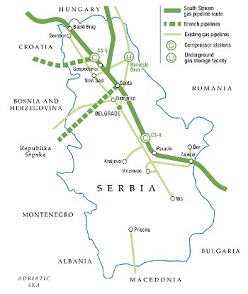
Regarding Serbia, Gazprom announced earlier (October 7) ( PHG "Banatskii Dvor" — an additional guarantee of the reliability of export supplies to Europe in the coming winter) that it has already filled 100 percent of the capacity of 450 million cubic meters of underground storage "Banatski Dvor", on the basis of which "Banatski Dvor" becomes an additional resource for providing the needs of Serbia with Russian gas, and also provides additional guarantees for the delivery of gas to Hungary, Bosnia and Herzegovina during the next winter. In this context, Gazprom announces that it expects to soon issue a permit for the construction of the main gas pipeline South Stream on the territory of Serbia, the construction of which is conditioned by the European Commission, demanding that it be adapted to the third energy package.
Under the title PSG "Banatski Dvor" — an additional guarantee of the safety of export deliveries to Europe during the coming winter on the website of Srbijagas, this news is basically confirmed with a reminder that in 2013 "Gazprom" delivered about 2 billion cubic meters of gas to Serbia, that "Banatski Dvor" has an active volume of 450 million cubic meters. became the first facility of the "South Stream" and will be used to ensure the safety of gas deliveries on the gas pipeline.
"South Stream" is a global infrastructure project for the construction of a gas pipeline with a capacity of 63 billion cubic meters along the bottom of the Black Sea to the countries of Southern and Central Europe in order to diversify natural gas export routes and exclude transit risks. In 2013, a long-term contract was signed for the delivery of Russian of gas to Serbia in the volume of up to 1,5 billion cubic meters of gas every year for 10 years. Gas is transported via the existing route, and in the future deliveries will be via the "South Stream" gas pipeline.
The website of TV N1 under the title Russia reduces gas supply to Serbia? The newspaper Danas reports that Russian President Vladimir Putin decided, after his visit to Serbia, to reduce the supply of gas to Serbia by 28 percent. TV N1 broadcasts the writing of the newspaper Danas that two days after the visit to Serbia, the Russian president decided to reduce the delivery of gas by a third of the total agreed quantities because he is dissatisfied with the outcome of the visit to Belgrade, because the Prime Minister of Serbia, Aleksandar Vučić, refused to sign the protocol regulating the return of the debt for Russian gas, in the amount of about 200 million dollars until March of next year, because he considers that Putin's request inappropriate and unfair, considering the fact that Russia, through the Oil Industry of Serbia, is profiting greatly from Serbia, which made the harmful contract possible on the sale of that company concluded between Russia and Serbia in 2008...
"We, together with our Russian partners, will be able to overcome any possible disagreements about the methods or deadlines for the payment of our debts and find the best possible solution in the interest of the citizens of Serbia," said the Serbian Prime Minister.
The Deputy Prime Minister of Serbia, Zorana Mihajlović, confirmed that gas deliveries from Russia to our country will be reduced and that the total debt that Serbia has for gas amounts to 1 million dollars.
"We have partnership relations with Russia, our total debt is 200 million dollars." We are ready to return 100 million soon, but we have to work as partners and talk every day," said Zorana Mihajlović.
The Minister of Energy, Aleksandar Antic, announced that during the next week, he will talk with Russian partners about the regulation of those debts, and that he will write a letter to the Russian Minister of Energy, Aleksandar Novak, in which he will ask him to normalize deliveries.
"The Government of Serbia will find a common language with Russian partners and define the dynamics of debt repayment in the next seven days," confirmed Antic.
He announces that by the end of the year "Srbijagas" will pay the first tranche of 100 million dollars of the debt to "Gazprom Eksport", from the loan that "Srbijagas" will raise, for which the government will give the necessary guarantee as part of the budget rebalancing for this year.
As he says, the rest of the debt payment will be negotiated with Russian partners, so it is expected that the agreement will be reached soon.
A source close to Gazprom told Tanjug that the quantities of gas that the company delivers to its partners remain within the agreed limits and within Gazprom's current export potential.
The quantities of gas that we now receive from Russia with domestic production and a small part with reserves from Banatski Dvor are currently sufficient for the needs of consumers in Serbia, said Minister of Energy Aleksandar Antic, who expects the problem to be resolved in seven days, when the Serbian delegation travels to Moscow.
"Competition for the Serbian Yulia Tymoshenko, convicted for the gas contract with the Russians"
The newspaper Danas also writes, referring to interlocutors who testify about the atmosphere at the meeting of the Serbian government, that Prime Minister Vučić informed the government about Putin's decision, that he is angry and disappointed because of Putin's request and decision to punish Serbia, that the Minister of Energy Antic is preparing to write a letter of protest to the Russian supplier...
In the text Russia reduces gas deliveries to Serbia The newspaper Danas reminds us that on August 11 of this year, the Ministry of Internal Affairs formed a working group to review the sale of the Oil Industry of Serbia to the Russian company Gazpromneft, that NIS was privatized in December 2008, as part of the package from the energy agreement with the Russian Federation, which was concluded in days earlier, during the government of Vojislav Koštunica, that the then Prime Ministers of the two countries, Mirko Cvetković and Dmitrij Medvedev, had agreed on the sale, that they had signed a guarantee that the work would be completed are presidents Boris Tadić and Vladimir Putin, and that the details of the transaction were determined in direct negotiations by the negotiating team appointed by the Government, whose member was Dušan Bajatović, director of Srbijagas, and whose head was Borisav Stefanović, the current vice-president of the DS.
The mention of Stefanović can be indicative, as a sign of the ruling party's usual policy of shifting the blame for all problems to the previous government, given that he, as head of the DS parliamentary group, exposed himself as a critic of the Vučić government before this connection with the oil contracts. For example, under the title Unconstitutional reduction of pensions, SNS to apply austerity measures on itself On its website, the DS reported Stefanović's announcement, as the head of the DS parliamentary group, that this party will raise the question before the constitutional court as to whether it is unconstitutional to reduce pensions, and that he also stated that the current government of Serbia does not know how to reduce the budget deficit of 2,5 billions of euros, and that in the last three and a half years SNS has employed over 50.000 of its people in the public sector, and also called on the governor of the NBS, Jorgovanka Tabaković, to explain the loss of 44 billion dinars National Bank of Serbia in 2013...
About gas and institutes...
There is not much to say about this topic in Russian sources. On the site Gazprom it is only mentioned that in the conversation between Aleksej Miller and Dušan Bajatović, the issues of ongoing deliveries of gas to Serbia and in the upcoming autumn-winter period were discussed...
The opposition (formerly Russian-American) newspaper Kommersant under the title Serbia again changes gas to factories writes that on the eve of Vladimir Putin's visit to Belgrade on October 16, the Serbian government again raised the issue of repaying the debt for Russian gas with petrochemical assets, that is, the proposal to transfer "Petrohemija" under the control of "NIS Gazprom Nefta". The newspaper quotes the Minister of Foreign Affairs Ivica Dacic after the conversation with the Russian Minister of Energy Aleksandar Novak, who said that during the conversation an agreement was reached to repay the debt through assets, especially through "Petrohemija", or in any way, but that in "Gazprom" refused to comment on it.
A Kommersant source close to Gazprom Neft (which owns 56,15 percent of Serbian oil and gas, i.e. NIS, and 29,87 percent belongs to Serbia), denies that the Russians are interested in Petrohemija. The newspaper quotes the head of NIS, Kirill Kravchenko, who reminded that this issue has been discussed many times, that NIS, which has a package of 12 percent of Petrohemija's shares (which is also his debtor, but does not say how much) does not want to become the main shareholder. Petrohemija", but to agree to look for a strategic partner for Petrohemija, which modernized can produce around 800.000 tons of polypropylene per year.
The paper also quotes Andrej Poliščuk from Raiffeisen Bank as saying that NIS does not want to be the majority shareholder of "Petrohimija" because of the state of affairs in the petrochemical company.
Kommersant writes that this is not the first time that the new Serbian government, which came to power in April, is trying to put pressure on Moscow, that in August, during the sudden deterioration in relations between Russia and the EU, in Belgrade, it again raised the issue of NIS privatization in 2008 , that a police working group was formed and that the pressure on Russia has continued to change the gas and transit price scheme. The newspaper reminds that according to the 2012 interstate agreement, the debt of "Srbijagas" in February and March 2013 was 30 million dollars, and in April and July 2014 it was 198,2 million dollars.
Agency RIA Novosti, referring to the Serbian Minister of Energy Antic, announced on November 10 that after a telephone conversation between Russian President Putin and Serbian Prime Minister Vučić, the Russian and Serbian sides had reached an agreement and that they would sign an agreement on the regulation of Serbia's gas debt by paying the first 100 million euros to be paid by the end of 2014, another 100 million — in 2015, and the rest, about 25 million euros — in 2016.
On the website of the President of Russia Putin The contract that the current government is trying to call into question may also refer to several sentences in which he makes an unusual request to the President of Serbia, Tomislav Nikolic: "Former President of Serbia Boris Tadić - your political opponent. We have worked with him no less (than with you) for many years as partners. The unusualness of my request is that I would like to thank him for our joint work through you and wish him all the best...
Updated on November 10
Russian Gazprom announced that it reached an agreement with the companies Eni, Wintershall and EDF on the purchase of a 50 percent stake in the joint venture company "South Stream Transport BV", created with the task of performing design and construction works and managing the submarine gas pipeline, thus becoming a XNUMX percent owner of that company.
(Source: "Gazprom" acquires 50% of the shares of South Stream Transport BV, Gazprom 29/12/2014 )
***
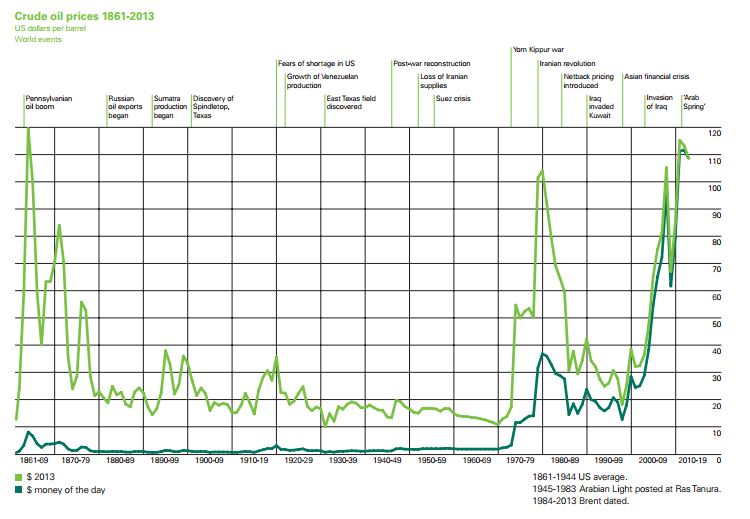
Dollars per barrel
|
|
| Dubai $/barrel*
| brent $/barrel**
| Nigerian forcados $/barrel
| West Texas Intermediate $/barrel*** |
| 1976
|
| 11,63
| 12,80
| 12,87
| 12,23 |
| 1977
|
| 12,38
| 13,92
| 14,21
| 14,22 |
| 1978
|
| 13,03
| 14,02
| 13,65
| 14,55 |
| 1979
|
| 29,75
| 31,61
| 29,25
| 25,08 |
| 1980
|
| 35,69
| 36,83
| 36,98
| 37,96 |
| 1981
|
| 34,32
| 35,93
| 36,18
| 36,08 |
| 1982
|
| 31,80
| 32,97
| 33,29
| 33,65 |
| 1983
|
| 28,78
| 29,55
| 29,54
| 30,30 |
| 1984
|
| 28,06
| 28,78
| 28,14
| 29,39 |
| 1985
|
| 27,53
| 27,56
| 27,75
| 27,98 |
| 1986
|
| 13,10
| 14,43
| 14,46
| 15,10 |
| 1987
|
| 16,95
| 18,44
| 18,39
| 19,18 |
| 1988
|
| 13,27
| 14,92
| 15,00
| 15,97 |
| 1989
|
| 15,62
| 18,23
| 18,30
| 19,68 |
| 1990
|
| 20,45
| 23,73
| 23,85
| 24,50 |
| 1991
|
| 16,63
| 20,00
| 20,11
| 21,54 |
| 1992
|
| 17,17
| 19,32
| 19,61
| 20,57 |
| 1993
|
| 14,93
| 16,97
| 17,41
| 18,45 |
| 1994
|
| 14,74
| 15,82
| 16,25
| 17,21 |
| 1995
|
| 16,10
| 17,02
| 17,26
| 18,42 |
| 1996
|
| 18,52
| 20,67
| 21,16
| 22,16 |
| 1997
|
| 18,23
| 19,09
| 19,33
| 20,61 |
| 1998
|
| 12,21
| 12,72
| 12,62
| 14,39 |
| 1999
|
| 17,25
| 17,97
| 18,00
| 19,31 |
| 2000
|
| 26,20
| 28,50
| 28,42
| 30,37 |
| 2001
|
| 22,81
| 24,44
| 24,23
| 25,93 |
| 2002
|
| 23,74
| 25,02
| 25,04
| 26,16 |
| 2003
|
| 26,78
| 28,83
| 28,66
| 31,07 |
| 2004
|
| 33,64
| 38,27
| 38,13
| 41,49 |
| 2005
|
| 49,35
| 54,52
| 55,69
| 56,59 |
| 2006
|
| 61,50
| 65,14
| 67,07
| 66,02 |
| 2007
|
| 68,19
| 72,39
| 74,48
| 72,20 |
| 2008
|
| 94,34
| 97,26
| 101,43
| 100,06 |
| 2009
|
| 61,39
| 61,67
| 63,35
| 61,92 |
| 2010
|
| 78,06
| 79,50
| 81,05
| 79,45 |
| 2011
|
| 106,18
| 111,26
| 113,65
| 95,04 |
| 2012
|
| 109,08
| 111,67
| 114,21
| 94,13 |
| 2013
|
| 105,47
| 108,66
| 111,95
| 97,99 |
( BP Statistical Review of World Energy June 2014
*1976-1985 Arabian Light, 1986-2013 Dubai dated. Source: Platts.
**1976-1983 Forties, 1984-2013 Brent dated.
***1976-1983 Posted WTI prices, 1984-2013 Spot WTI (Cushing) prices)