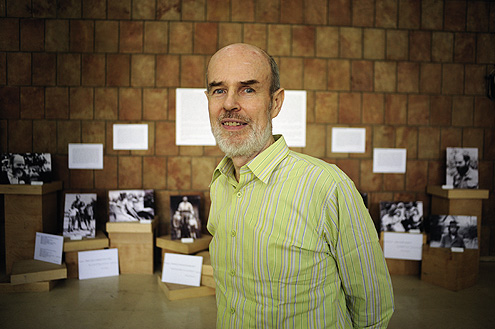
Interview - Timothy John Byford, Time | no. 1005 | April 8, 2010
TIME": Out of fifty working years, you devoted 44 to children. They say that it is more difficult to work for and with children than for adults. You would obviously disagree with such an opinion.
TIMOTHY JOHN BYFORD: I've also worked for adults and I'm not sure it's any easier. It's not for me. Children always tell you what they think, they are open and honest, which adults are not. And it's important for me to know what someone thinks and feels...
...The difficulty, it is believed, is to identify with the child...
It's not that difficult! I am still the same person I was when I was five years old, only now I have more knowledge and experience! And thank God I still have in me what I had then! I found many scenes in the series in my childhood. I was born at the beginning of World War II, when there was no money for toys and no television, so we had to invent our own entertainment, which is no problem on the farm. I had two sisters and a brother, we created our own television shows. We mostly played school, and since I was the oldest, of course, I was the school principal. In Neven there are many scenes from my childhood. Once, for example, I dug a hole, covered it with leaves and put a piece of beautiful ceramic on top - we collected those pieces in the garden, with the intention that my sister would fall into that hole. In the series, her characters Pura Moca and Jova dig a hole on the path that Pismonoša passes by, cover it with a branch and put an apple, because they know that he likes apples a lot, so they will reach for it and fall into the hole.
Your Marigold does not seem to belong to the seventies when it was recorded, it is more suitable for today's time, and it also reminds of the Monty Pythons...
Pytonovci started in England right at the time when I moved to Belgrade, I didn't watch them much. I don't think that the series was not for that time - after all, it immediately received five stars in "TV news". Of course, I'm glad that today's kids also like it, that it doesn't seem old-fashioned to them. The series was well paced. I follow the kids, I know what they like to watch on TV and I know they don't like slow things. I made a poletarac for preschoolers at the time when my children were that age, so I knew that they like cartoons and commercials the most because the pictures change there quickly. In Poletarac, there are over 300 cuts in half an hour, an average of 30 per minute, which means that each frame lasts two seconds on average.
What do you think of today's children's television programming?
I watch a little TV, I don't have time, but I have the impression that the current shows see children as if they were beings from another planet, beings that are dying. Too bad, that's certainly not true. It seems to me that today's authors make children's programs because they have to.
Why did you stop working at RTS?
I stopped at the time of Ante Marković, when the fees were never higher! That's when I realized that I only have one life and that it shouldn't be spent on one job. I wanted to try something else, so I went and started teaching English. I have changed women, countries, jobs, and I know that change is very pleasing to a man! Now I'm at the Children's Cultural Center and I'm doing well: I write and direct for children, and hang out with them. I wouldn't go back to television, it's terribly stressful there, and I don't like it at all...