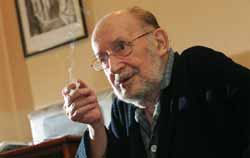
Mihajlo Mihajlov, the only real dissident in Yugoslavia - except perhaps Milovan Đilas - died in his apartment in Belgrade on Sunday, March 7th. Descendant of Russian emigrants settled in Pancevo, Miša Mihailov was a professor at the Faculty of Philosophy in Zadar in 1965, when - encouraged by Khrushchev's reforms and thinking they meant something - he embarked on a study trip around the then USSR. He returned and wrote a travelogue in two parts entitled "Moscow Summer" for the Belgrade-based "Delo". The first part came out, "The Work" was confiscated; the second part did not come out, and Misha Mihailov was arrested. Reading that travelogue today would make us smile: Misha was a gentle, prudent and noble man until the end of his life; good-natured, prone to childish pranks (he amused his guests with firecrackers and similar childish jokes). The then authorities, however, in their pathological concern not to resent Moscow, concluded that it was easiest to imprison Misha, and there was diplomatic and party pressure in that direction.
Misha Mihailov was in prison twice: the first time because of that travel document, and then because he was going through the records, so he was handsome. Then they released him and gave him a passport, so he went to America. They looked askance at him there, because they considered Tito a friend, he told us. In the 1990s, he returned to Belgrade after a lean dissident life in the USA. He lived in a nicely decorated, but still dark cellar on Obilićevo venc, received his friends, served them hellish hot vodka pertsovka and set up improvised explosive traps for them from harmless firecrackers.
Now, before the Last Informative Interview, everyone who knew him can testify: that he was the best, childishly good and harmless man; that he was telling the truth; that he never hated anyone; that he left behind a trail of honesty, truthfulness, humor and gentleness.
RSV
Mihajlo Mihajlov taught Russian literature at the University in Zadar, from where he went on a trip to the USSR on a kind of study trip. In 1965, after the first parts of the book Summer of Moscow in the Belgrade magazine Delo, after the intervention of the Russian ambassador Puzanov, Tito demanded his arrest in a speech to the district public prosecutors: "Do we, politicians, always have to show who broke the law?! Here, let's say, a certain Mihailo Mihailov slanders the fraternal USSR... This is a new form of Jilasism, have you done anything against it?!" He was arrested and already in 1966 he was sentenced to three and a half years in prison in Zadar, he was banned from speaking publicly for four years.
Here's what Mikhailov himself said about it later: "Before 'Moscow Summer' I didn't think about politics, I was absolutely outside that sphere." What a rebellion, I am not the Government-Revolution! I always have to underline that I am not a rebel, psychologically I am not that type. I was literally forced into politics when Tito attacked me and everything I did was my own defense. A few years before that incriminated travelogue text, I wrote and published texts about Soviet culture, which received the most positive reviews. This is probably why I was sent to Moscow, in the summer of 1964, in the cultural exchange of students from Zagreb University and Moscow State University. I returned from the trip in August, started writing the text in September and finished it in October, just when Khrushchev was replaced. The triumvirate of Brezhnev, Kosygin and Podgorny immediately began a kind of restalinization, after the period of Khrushchev's so-called thaw. The report began to appear in the January issue of the Belgrade magazine "Delo", and after the second continuation, in the February issue, the Soviet ambassador A. Puzanov delivered an official protest to Tito for slandering the USSR. There was nothing subversive in that "Moscow Summer" reportage, I think they were bothered by the fact that I supported Khrushchev's liberalization in my articles for several years. It hurt their eyes. In fact, a month before I left for the USSR, my essay on Solzhenitsyn was published in the Zagreb magazine "Forum" and no one in our country bothered.
The only thing I didn't write about in the Yugoslav press before that was the mention of the first Soviet concentration camp near Arkhangelsk in 1921. In the first ten pages of the second volume of the Gulag Archipelago, Solzhenitsyn looks back at my writing and says: Mikhailov was wrong! The camp near Arkhangelsk was formed in 1919, not 1921. It was the first concentration camp for the destruction of political opponents."
Mihajlo Mihajlov is the child of Russian immigrants, he was born in Pančevo in 1934 in a family of Russian emigrants, and he was educated in Belgrade, Sarajevo and Zagreb.
After serving his sentence, Mihajlov was sentenced to seven years in prison in Novi Sad for "enemy propaganda". After three years and two months, in 1977, he was released and from 1978 he lived in the West and taught at several universities, returning to Belgrade in 2001.
He published the books Russian Themes (1966), Planetary Consciousness (1967) and Unscientific Thoughts (1979), of which Summer of Moscow, capital studies The Return of the Inquisitor and Nietzsche and Russian Neo-Idealism have been translated into many languages.