Ivan Goran Kovačić, Dobriša Cesarić, Vjekoslav Kaleb in my little room in the attic
I REMEMBER when Ivan Goran Kovačić, Dobriša Cesarić and Vjekoslav Kaleb were sitting on the floor in my little room, under the sloping roof of the mansard, at Visoko 11 in Zagreb. (They had to sit on the floor, because I only had one chair.) They argued and convinced each other so much about the title of a song, that even then it became clear to me that the title is very important.
When I read the poems, I am first drawn to the title. Then I'm usually caught by a word or two, maybe even a sentence, and I'm drawn into the song. The beauty of the song slowly unfolds. Everything is somehow branching and greening by itself. It often happens that I just look at a song and don't hear or see it, and when I really notice that same song, after a long time, I wonder how it is possible that I passed by it for so long and was blind and deaf! It is possible, because a song is life.
The truth in the poem is words from ordinary, everyday life, from the earth, but somehow more beautifully complex, chosen, so it seems that they lift us a few centimeters above the ground, because not everyone can say the way a good poet says something. And for us, his song will be rich, easy and cheerful in our hearts. The actor adds his own dimension to the poet's words. When an actor pronounces a poem well, it's as if a spotlight illuminates the poet's words.
How to speak classical verse? There really isn't a recipe for it. I have listened to so many actors of different nations and each of them speak in their own way, each differently in their own language. So, there is no iron rule. It's all in the beauty and greatness of speaking the verses. It is a great gift of man that with a sense of rhythm and harmony, with consciously articulated speech, he can give a solemn form to a thought expressed in verse.
In every social period, in every period of individual life, the same verse is spoken differently. I've been saying the same verses for decades and I change the way I say it from year to year, from day to day, from place to place, certainly, always with my voice, my taste, my will, my ear and my hearing.
The symbols of the verse are very sensitive and if the actor is not careful enough, they escape as if they were not there, and that is not good, because then the words sound empty. Certainly, at the moment of his action, the actor is the master of the crowd, from which someone can always ask him: what do you mean, what does it mean, why do you do that... And it would not be good not to be able to answer. For me, speaking lyrics is always a holiday, an organized holiday.
Often, at various events, I listened to the stories of people who were in the war. Their true experiences, usually told, cause a deep impression on the listeners, so after such a story, every song on the subject of war, spoken in a somewhat elevated tone, turns out pale. I decided that when I find myself in such a situation, I will speak verses that are apparently the most ordinary, but also the most life-like, with the theme of everyday life. If possible, I speak as simply as possible. Or I get on the wheels and recite Aeschylus or Sophocles with all my might - I noticed that then the audience hears me as they heard the truth of that participant and eyewitness.
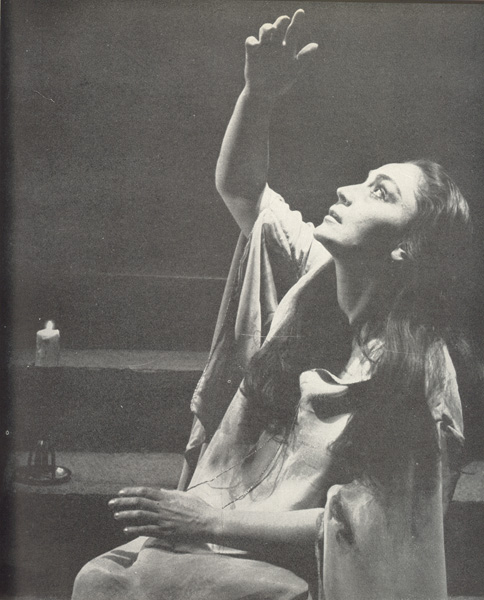
I remember when I was working on "Antigone" I struggled, because I thought one thing, and it seemed to me that I understood Tanhofer differently, so neither the voice nor the movement worked for me at all. Until the control rehearsal, at which Miloš Đurić said: "She loves her brothers and fears the gods." Suddenly I was talking, breathing, walking, and growing. It's strange how sometimes just one little thing helps an actor.
It is one thing to understand the sentence in the verse, and it is quite another to say the word and the sentence in such a way that the tone in which the verse is said can lift the veils that obscure the written thought. This is difficult to do, because the rhythm of breathing, the rhythm of handling the reservoir of air in the lungs and the rhythm of the blood flow of the actor need to be trained for days and nights for something that is beyond the moment, and in the moment.
Only actors follow that path of creation. Training is specific to each piece and experience doesn't help much. An actor must always do everything from the beginning for every poet. When I do a role, I get sick. Everything inside me is disturbed. One part of me has to start thinking differently, agreeing differently and connecting, really connecting, to something called the poetic rhythm of an idea and thought, and another part of me, again, weighs, measures, controls all of this.
One cannot talk about lines without knowing the character in the work and the personality of the actor who speaks them. That's why an actor is more complicated than a poet. If the poet doesn't like a word or a poem, he can throw it away if he wants, and an actor must not even cough when he coughs, even if he is "dead", because coughing would disrupt the rhythm of the other actors' verses. Several times due to wrong inhalation, my vocal cords dried up, so I had to shift all the weight of speaking to one vocal cord, of course, all covered in sweat from agony. It's lucky that the audience doesn't notice or hear everything.
Always before the play - both "civilian" (that's what I call prose) and "uniform" (that's what I call verse) - I go through the text out loud, at full steam. I go through the verse several times, and if there is a long gap between performances, I recite the entire text for several days. If, for example, I played "Iphigenia", which has 1.100 lines, 120 times, I actually played it three or four times more. Not to mention the rehearsals and the constant recitation of verses or the words themselves outside of rehearsals.
I know it is very difficult to describe how to play the piano. You need to practice your fingers, sit for years, hours and hours at the piano. And only then will the music come out from under your fingers. It's the same with acting.
Marija Crnobori, diary, News 2011
Andric, loneliness is a friend.
IVO Andrić was a reserved, witty man. Everything he would say was ordinary, but true, great. He belonged to a special kind of people, just like Krlež... What can we say about him? He said everything himself... I saw him often. He was a lonely man, not only in the ordinary sense of the word, but alone in an extraordinary sense. Regardless of the fact that he participated in social life, regardless of the fact that he had a wife - he was alone. Vera Stojić was with him all his life. And she, for example, was a part of Andrić's solitude. Extremely discreet, but a necessary collaborator for him - she was by his side for fifty years.
I remember, in March 1968, Milica Babić, his wife, died. Sadness was reflected on his face - it was a face on which sadness is especially visible. He was sick. His sinuses hurt and it bothered him for a long time. I ask him once how he is doing. "Huh, how? You see, I can't see well, I can't hear well, I can't sleep... and I just have to think. You know who I'm thinking about... So now, that's how I feel...". I had the feeling then, after Milica's death, that no one could help him. Of course, he didn't even ask for help.
I would often find him standing in his study by the standing desk, as friars do, with glasses in hand, and how, with his head close to the book, he was reading. Or how he stands by the window and looks at the park. Well, most often with a book...
He really didn't ask for much for himself. He was very considerate, attentive. I remember, when Veri Stojić would read something to him, he would say: "Be patient with me, just a little longer..." He always asked me about my son: "How is Sasha?" When I told him that he was going to Poland to study, he said : "That's very good..."
He always had the feeling that he was delaying death. And he was afraid that he didn't do anything, that he wouldn't have time to do everything he set out to do: "I never have time to do anything, and time passes..."
He persuaded me to prepare an evening of stories, because I had successful evenings of poetry. He loved Goethe very much, he watched "Iphigenia" twice.
"What is life, what is man?", he thought aloud on one occasion: "Here, for example, is Goethe. He was a wise man, one of the wisest men. And imagine if he accidentally fell as a child, hit his head and suddenly became helpless - then he would no longer be Goethe, wise Goethe..."
And when he became deathly ill, he had Goethe.
He loved music very much. Classic. We, Marko and I, received several good records. Milica and Ivo came. He enjoyed Beethoven's "Ninth Symphony"…
In the Yugoslav Drama Theater, we actors always gathered around him, expecting him to tell us something. And he would, smiling gently, with wide open black eyes, simply say: "You know, I don't understand the theater..." And it is not true that he did not understand the theater.
He very consciously obeyed certain customs. He knew, namely, that no custom fell from the sky, but was the result of an experience. He told how he had a friend in Madrid, a representative of Turkey. They hung out. They received an invitation to the reception and it was correctly indicated on the invitation - a collapsible cylinder is mandatory. Neither of them had such a cylinder. Ivo bought it, but Turčin didn't want to, he brought an ordinary cylinder. However, when they arrived at the reception, each of the invitees would fold the cylinder and put it under their arm. The Turk, he says, found himself in a predicament: he first put it next to the table, then on the window, and spent the whole evening struggling with the top hat. And Andrić says: "If he had listened to what was written on the invitation, he wouldn't have even known that he had a top hat..."
He came to the theater primarily to see the works of classical authors. He especially liked Pirandello.
Whenever he said something, it could have been a guide for you, some kind of clarification of the situation... And it was always said in ordinary words.
Milica's mother answered once: "Ivo Andrić is calling you, please come." I go and he says: "You know, I wanted to ask you - would you mind if 'Miss' speaks...". "Why would I mind," I wondered. "Well, you wanted it… It's primarily your right…"
He was postponing every decision... He was not doing anything. And when he didn't like something, his lips would swell from pain - especially when there was a crowd, when there was a lot of people around him, during celebrations, birthdays... He didn't like that. He liked to take a book, to enjoy his solitude...
I just can't believe I won't be hearing, "Come, Maria..."
THE OLD ARE NOT AFRAID
WHEN I was returning home from the market uphill, a woman came up behind me, took my borscht and walked in front of me. I don't react, I think: it's someone who knows me. Then she slowly stops, I catch up with her, and she's still carrying my bag. I mean - someone from the audience. Beautiful face, black hair, black eyes. I laugh, she laughs too. And carry on my borscht. I let go, it's easier for me to climb the street. I ask her what her profession is. "Engineer," he says.
I can tell by the melody that it's not my audience. "Where are you from?" "From Armenia!" What are you doing here?" "Business, now everything is business." And she says, "I have a mother far away over there." And she carries it hard." My throat tightened a little. I tell her that I am an actress and that I was with the theater in Russia. She liked that. On the way, she asked me if I was scared when she took my tseger. "I'm not afraid of anything, I'm old."
Then a tall man with a beard and a beard stopped us and begged for 5 dinars to pay for the train ticket. I had 20 in my pocket, I stopped by the supermarket, bought milk and gave him 5 dinars, because he was waiting in front of the shop. The Armenian woman was with me in the store. I gave her a name and phone number to call me. She said her name was Margarita. We parted in front of the store. She said she was going to the embassy.
Marija Crnobori, diary, News 2011