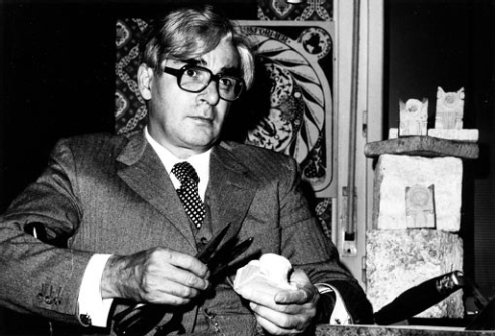
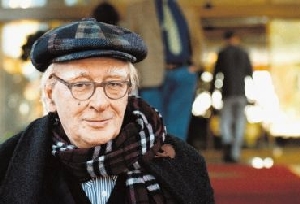
When Bogdan Bogdanović graduated, he went with his father, Milan Bogdanović, to buy a suit according to the customs of the time, and that's when they started the initiation conversation of adults. Bogdan asked his father what that republic would be like. Milan answered: "Judging by the monarchy, quite bad..." He told that autobiographical anecdote at that time with a certain self-irony characteristic of people of broad culture and a developed sense of realism aware of the flaws of their own environment that must not be kept silent.
I met him for the first time as a young professor at the Faculty of Architecture, as a young journalist of NIN in those years when he was the founder of the New School of Architecture at the Faculty of Architecture. It was, as one would say today, a kind of creative workshop. He encouraged students to imagine civilization, its culture, language, symbols and to design cities on that basis. In that school of thought, architecture and urbanism grew organically from the era in which they were created. In his Vain Mistria, which some say is a book about the architecture of secret societies, we were introduced to the mythical and symbolic aspects of architecture.
When many years later, in the circumstances of the war, I spoke with the satanized opponent of the war, professor Bogdan Bogdanović, in his apartment on Vračar, cramped, full of books and somewhat dark - today the address of that old building on the square that bears the name of the luxurious and disheveled Slobodan Marković is Liber Marconi - he also mentioned that school with a bitter memory of a kind of Red Faculty in accordance with the spirit of the time, which the liberals of that time seem to have supported, and those after them all they abolished that, in the end even that version of that school that resisted there in Mali Popović in the building of an old school...
Bogdan Bogdanović was an urban planner, philosopher, humanist, and the last memory of him is the memory of a city builder horrified by the actions of city destroyers and the ignorance of new ideologues. It was a sad 1992.
I can testify that he belonged to those few people in our midst who, a few years before, not only sensed the impending disaster, but also spoke impressively about it. At the time of the so-called events of the people and differentiation in 1987 and 1988, one of his open letters, which would later turn into the book Mrvouzica, Mental Traps of Stalinism, warned against shamanic rhetoric that heralds a dangerous pyromaniac plague. The symbolic image of the "Laza Lazarevic" psychiatric institution in flames remains in the memory from that text. The voice of Bogdan Bogdanović seems to have been the most impressive among the voices of the pacifists of that time. I can't see a better way to remember that man than by reprinting that bitter conversation from 1992 published in Vremen number 96. After that I never met him again. He went to Vienna in 1993 and, unfortunately, did not return to this environment.
"Time" interlocutor: Bogdan Bogdanović
INCENTIVES OF IGNITED IMAGINATION
Time no. 96 – August 24, 1992
Bogdan Bogdanović lives in a kind of personal isolation, losing his presence of mind in a quiet determination to persevere in the vivisection of Serbian nationalist corpses and in opposing the senseless war in the Yugoslav territories. In a dozen interviews in recent years, he spoke against the war, which was followed by disqualifications and outrageous satanization.
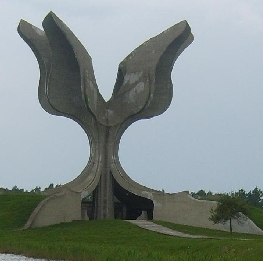
The entrance to the apartment of Professor Bogdan Bogdanović, the creator of the monument to the victims of Jasenovac, is covered with huge black graffiti that reaches from the ground floor to the first floor, which says that it is the "Ustasha apartment of Bogdan Bogdanović". Professor Bogdanović does not erase those graffitis, as if he does not want to interfere with Serbia rewarding in its own way the opponents of the war that ruined its reputation and its future, those who might be able to redeem its conscience.
"VREME": Hold on well, there, on Chuburi, professor...
BOGDAN BOGDANOVIĆ: I never wanted to emigrate. However, I could not give them that satisfaction. I planned, or rather negotiated with some people, to move to Sarajevo and to move the New School of Architecture from Mali Popović to an old house, from where I was kicked out. That was a year before the disaster. We thought that Bosnia would be neutral, that it would be demilitarized, that it might be under a protectorate. It will, perhaps, be under the Preotectorate, but it is no longer Bosnia, it is now a corpse...
You expressed your resistance to this nameless (ethnic) war by opposing the city destroyers...
Twenty years ago, I wrote that in the modern world, cities are becoming more important than the nations that emerged during the industrial revolution and which are still pressing the mind of every smart person today, and belonging to the city has always been more important, since there have been real cities and real citizens. from ethnic.
In the great cities of the world, beginning with Memphis and Babylon, even the "national" language was not a very clear category. In the same big city, within the framework of the same city culture, it was possible to speak various languages, provided that everyone understood the basic, quiet or noisy, but in any case non-mushy language of the city that they chose of their own free will.
Choosing a city is an ethical and aesthetic decision. If I could separate myself from Belgrade (because that was also a choice, today I feel more unhappy than happy), I would probably choose Bologna, because it has nice arcades, just like Vukovar had recently, in a small way.
Now Vukovar has been destroyed, the Croats promise that if they get it, they will leave that city in ruins. I haven't found the strength to go around that ruined city yet. I'm not talking about Mostar yet, because I haven't gotten to the point where I can imprint it on my mind. Sarajevo reminds me of a man lying down and trying in vain to get up. There is one terrible method in all this madness — demolishing the city is the simplest way to change the regional ethnic structure. It seems absolutely crazy to just demolish a city you want to take over. Nothing will ever take us out there again.
The respected writer of novels in which there are no cities or towns, talks with undisguised anger about those who would like to impose the attribute of city destroyers on us... He forgets the simple obligation to say who destroyed the unfortunate cities, the cities of novels, and why.
The last general explanation is that the people of Šumadin did not want to go to war, there were not enough infantry, and therefore heavy weapons were used around Vukovar.
That explanation is terrible. Then the question is why the people of Šumadin did not want to go to war and what other war did the people of Šumadin want. They didn't want to go to Slivnica yet. Twice that nation refused to go to war. And he was right. The scary thing is that we don't know if in the continuation of the story the people of Šumadin will hold back, or if they will go to Kosovo.
I look at the Bulgarians, they are drilled to avoid war; The Serbs, on the other hand, were drilled to rush into war. One of the important aspects of that war is that it is a war between brothers. How will these children save themselves from what they experienced? Much of our benevolence has mingled with moral indolence.
The most terrible thing to me is that I believed in the gentlemanliness of our warrior. How did it happen that they now enter that carnage like a wolf in Turin?
In "Mrtvouzice" you wrote that Serbia in the East, Serbia on the margins of civilization is actually tired of a civilization that it has not even touched...
I am afraid that something worse than anything is growing, a model of darkness is growing, a model of non-lay Serbia, clerical Serbia, darkness over darkness, is growing, I mean the attack of theocracy on the secularity of Serbian culture.
Now a competition has been announced for the arrangement of the underground railway station near the Wolf Monument. As soon as I saw the jury, it was clear to me what the competitors would offer: glasses, fiddles, reminiscences of the epic, Mother Jugović, maybe even these butchered Milić children. What is necrophilia?
Love with death.
One day, when that difficult moment comes, and it is coming, when we will talk about the Serbian national disaster, when we will ask ourselves who is responsible and how it happened that we became the last nation in Europe that is surrounded by so many enemies and so hated, then many great minds from the Academy will find themselves on the dock, if they experience it.
Ćosić says: "a big accident"...
Death was a high abstraction for me, but this is some elemental, how can I say, companionship with death. Nature and death, that's a formula that I myself took from the war. Then my dying in hospitals, for six months I languished in sepsis, in pus, in severe temperatures... but it was not companionship with death in this erotic, libido-like way.
That connoisseur of Serbian bitterness, that taster of the time of evil, seems to carry a mourner inside. I watched it in Pljevlja, he was tired and kind of bent over... I don't like to see my friend look so weak.
You and Cosic were friends?
Out of all of them, I still hung out with Dobrica the most. I was trying to teach him something, but it didn't work... We loved him, he came as a peasant, wore a sideburn, they called him "Gedža" and he stuck to his nickname. He started protesting only later. My father once said during lunch: "Children, they call him a geja!" People do not give nicknames by accident. We'll see what that means!”
How does he look to you now, as head of state?
For a moment, I thought that the respected head of my country, which is not yet mine, and which the children call "Gezhistan", had experienced a moral revival. After his first antediluvian troubles, I saw that he had no moral obstacles. He absolutely does not feel that he helped much to create something so ugly.
Afterwards, I was afraid that he would not be the war president.
When did your friendship "break"?
When I returned from America, we started the New School of Architecture. The new school of architecture was a kind of Red Faculty in accordance with the spirit of the time. Liberals, it seems, supported us. As a "red dean" I was not liked by my new academic society, a society of hierarchy.
You finally broke with the Academy in 1981?
I have painful memories from that company. I thought we could talk about serious things. I realized that there, especially in the art department, they don't touch on philosophy, architecture, the city, history, and register non-attendance at meetings.
I got rid of them easily, a friend told me that in an interview I described the atmosphere a bit like Swift. After that, I didn't belong there anymore, and they still considered me their corresponding member, they kept me so that it wouldn't happen that someone leaves the Academy. They even sent me some money, but I returned it regularly. I even wanted to ask for the help of the Human Rights Committee. I guess I could get out of the monastery, with a bit of luck I might be able to escape, if I were a woman, from a brothel in the Middle East, but I can't get out of the Academy, because nobody got out of it.
What, in fact, is the Academy?
Gone are the days of academies.
The Serbian academy was all obsessed with the attitude of being a working academy, like those in the Soviet Union from the time of Brezhnev, when it was the Ministry of Science. If it took the example of the French academy, to be a sweet circus and some satisfaction for the old men who can occasionally hang up those sabers, it would be much better...
Deroko once said to me: "What are these communists of yours doing?" I got along with those old academics, they admitted me to the academy, and I quarreled with my party comrades. They always politicized everything.
They wanted to be a big factor in society, and then very quickly it turned into a will for power. They had an elaborate story about their mission. That would have been fine if they had political ideas, but it all turned upside down. What is written in the Memorandum, I have heard a thousand times before that. They used to say that a nation only needs the Academy once. Well, now she was needed and this is what they did.
Some say that they even planned, and this is extremely likely to me, that they had some committees for demography and that they even calculated how many Serbs could die for the liberation of the western regions, without endangering the biological being of the Serbian people. I don't know if that figure has been reached, but I see, as far as the Serbs in Croatia are concerned, that they have succeeded in what Anta Pavelic failed to do.
Could it have been predicted that everything would end so tragically?
Krleza's astonishingly horrific picture of our world was accurate: that blood of his and that mud of his. He carried a feeling of cataclysm. I had a vague feeling that it wasn't going to be good, but that it was going to be so terrible, I couldn't imagine it. Before this calamity befell us, I wrote about city destroyers. When I announced the text for the city and against the city, and talked about possible city destroyers, Pilja Marković came out, my text annoyed him ten years ago. Today, it is published in the West as an extremely current text.
I had some prophetic intuition. For the monument in Čačak, I literally came across some animals that bite. I concluded that the beast was within us. When I was building the monument in Vukovar, I was drawing a city of decay. Worst of all, I'm afraid I can't even see how terrible it is.
What is a "medical history"?
It turns out that today's unbridled virus of nationalism was bred in vitro, back in communist times. This new nationalism seems to have absorbed all the limited arrogance of the Marxists, all the exclusivity and all the hypocrisy of the Bolshevik character type and combined it with the most morbid variety of pseudo-romanticism. In Serbia, and I believe in other parts of the former Yugoslav space, today's most bitter anti-cosmopolitans, religious converts, and even fanatics of racism, came from dogmatic communist ranks.
Within the framework of proletarian internationalism, the bomb of nationalism was carefully guarded against evil. In this regard, Yugoslavia was not an exception in the East. The republican centers, more precisely the republican central committees of the Communist League, had their secret nationalists and their public dissidents, that dangerous game, but always as a rule game under protection.
After all, the Memorandum was written exclusively by former communist academics. It amused me at first, I was watching those men between the Academy and the Central Committee and I thought that in that case it was also about a man. Later I saw that the thing was "self-initiated". I am inclined to believe that the writers of the Memorandum secretly hoped to hit the hidden thoughts of comrades from the then Central Committee of Serbia. However, things have gone too far, or rather, they have already gone downhill in a big way.
Milošević did not dare to accept the Memorandum publicly, but soon, with the diligence of a schoolboy, he began to implement it... So, who is more monstrous - Frankenstein or his creator?
Today we talk about how the final started?
Sunovrat began with the arrival of Milošević. Measuring spiritual guilt is more difficult, but also more important. Because the deviation of opinion, which led to one Milošević, can lead to a new Milošević through a generation or two.
It is safest, when examining the deeper causes, to start from the notorious fact that national paranoias, at least in the Balkans, are based above all on the stimuli of an inflamed imagination. Non-objective and ignorant handling of history encourages parahistory, building phantom images of former greatness and imposed failures leads to the search for historical injustices and world conspiracies.
Dobrica Ćosić's war novels have been preparing for years the state of spirits that will lead to the Memorandum and, consequently, to today's conquests, and I fear the bloodshed that accompanies them.
To round off this literary-political scherzo, I will remind you that the designers of the Bosnian horror are two or three poets of dubious value and one unfinished literary historian, while Karadžić himself is a psychiatrist by profession, a strategist by function, and a folklore poet in his spare time...

Bogdan Bogdanović has been a full professor at the Faculty of Architecture in Belgrade since 1973. His field of work is memorial architecture, urbanism, city history. The construction of memorial architecture, memorials erected in the second half of the twentieth century, to the victims of fascism in the Second World War, throughout the SFR Yugoslavia is significant. The most significant monuments of Bogdan Bogdanović are located in Belgrade, Prilep, Mostar Kruševac and Jasenovac ("Stone Flower"), where life is celebrated in stone at the sites of large execution sites. In the field of urban planning, his general urban plan of Cetinje, settlement plan near Morača monastery and settlement plan Pržna near Tivat are known.
Corresponding member of the Department of Fine and Musical Arts of SANU: from May 28, 1970 to February 24, 1978 (when he transferred to the Department of Social Sciences) and from April 25, 1980 (again in the home department). In a letter dated May 19, 1981, he submitted a request to be dismissed from SANA membership. President of the Association of Architects of Yugoslavia (1964-1968); President of the Cultural and Educational Association of Belgrade (1972-1976); president of the Cultural and Educational Association of the SR of Serbia (1976-1980) Mayor of Belgrade (1982-1986) He founded the Village School for the Philosophy of Architecture in Mali Popović, near Belgrade.
Since the mid-1990s, he lived in exile in Vienna.
Small town planning
A futile trowel
Urban mythologems
Urbs and Logos
Haunted builder
Book of chapters
Nooses, mental traps of Stalinism
Green box - dream book
Happiness in the city
City dictionary
Polis and megale polis
City and death
Three war books
In the German language
Die Stadt und der Tod, Wieser Verlag, Klagenfurt - Salzburg 1993,
Der verdammte Baumeister: Erinnerungen, Zsolnay Verlag, Vienne 1997/2002,
Die Stadt und die Zukunft, Wieser Verlag, Klagenfurt - Salzburg 1997,
Vom Glück in den Städten, Zsolnay Verlag, Vienne 2002,
Die grüne Schachtel: Buch der Träume, Zsolnay Verlag, Vienne 2007.