First quarter 2015.
The number of those who sought asylum in the EU in the first quarter of 2015 compared to the same quarter of the previous year increased by 86 percent, but remained stable compared to the last quarter of 2014. Overall, the number of people seeking asylum in the EU-28 in the first quarter of 2015 reached 184.800. That was 85.400 more than in the same period, i.e. the first quarter of 2014.
Where do they come from?

|
| Total (thousands)
| (% of population)
| Born in an EU member state (thousands)
| (% of population)
| Born in a non-EU country (thousands)
| (% of population) |
| Belgija
| 1 773,1
| 15,8
| 835,5
| 7,5
| 937,7
| 8,4 |
| Bulgaria
| 109,2
| 1,5
| 40,5
| 0,6
| 68,7
| 0,9 |
| Češka
| 396,2
| 3,8
| 155,1
| 1,5
| 241,1
| 2,3 |
| Danish company
| 569,6
| 10,1
| 191,6
| 3,4
| 378,0
| 6,7 |
| Germany
| 9 818,0
| 12,2
| 3 838,5
| 4,8
| 5 979,5
| 7,4 |
| Estonia
| 196,6
| 14,9
| 13,1
| 1,0
| 183,4
| 13,9 |
| Irska
| 741,3
| 16,1
| 471,5
| 10,2
| 269,8
| 5,9 |
| Greek
| 1 246,5
| 11,4
| 334,3
| 3,1
| 912,2
| 8,4 |
| Spain
| 5 958,3
| 12,8
| 2 027,5
| 4,4
| 3 930,8
| 8,5 |
| Francuska
| 7661,7
| 11,6
| 2 167,1
| 3,3
| 5 494,6
| 8,3 |
| Croatia
| 568,7
| 13,4
| 70,5
| 1,7
| 498,2
| 11,7 |
| Italy
| 5 737,2
| 9,4
| 1 815,4
| 3,0
| 3 921,8
| 6,5 |
| Cyprus
| 191,6
| 22,3
| 111,3
| 13,0
| 80,3
| 9,4 |
| Latvia
| 271,1
| 13,5
| 27,9
| 1,4
| 243,2
| 12,2 |
| Lithuania
| 137,4
| 4,7
| 17,6
| 0,6
| 1191
| 4,1 |
| Luksemburg
| 237,8
| 43,3
| 177,6
| 32,3
| 60,3
| 11,0 |
| Hungary
| 447,0
| 4,5
| 300,1
| 3,0
| 146,9
| 1,5 |
| Malta
| 40,2
| 9,4
| 18,9
| 4,4
| 21,2
| 5,0 |
| Netherlands
| 1 953,4
| 11,6
| 508,4
| 3,0
| 1 445,0
| 8,6 |
| Austrija
| 1 410,9
| 16,6
| 639,4
| 7,5
| 771,5
| 9,1 |
| Poljska
| 620,3
| 1,6
| 222,0
| 0,6
| 3983
| 1,0 |
| Portugal
| 859,1
| 8,2
| 221,6
| 2,1
| 637,5
| 6,1 |
| Rumunija
| 211,2
| 1,1
| 81,5
| 0,4
| 129,7
| 0,7 |
| Slovenija
| 235,3
| 11,4
| 68,8
| 3,3
| 166,5
| 8,1 |
| Slovakia
| 174,9
| 3,2
| 146,3
| 2,7
| 28,6
| 0,5 |
| Finnish
| 297,8
| 5,5
| 109,0
| 2,0
| 188,9
| 3,5 |
| Sweden
| 1 532,6
| 15,9
| 509,6
| 5,3
| 1 023,0
| 10,6 |
| Great Britain
| 8 035,6
| 12,5
| 2 806,3
| 4,4
| 5 229,3
| 8,1 |
| Iceland
| 37,1
| 11,4
| 24,3
| 7,4
| 12,9
| 3,9 |
| Liechtenstein
| 23,4
| 63,1
| 8,1
| 21,7
| 15,4
| 41,4 |
| Norveška
| 704,4
| 13,8
| 318,1
| 6,2
| 386,4
| 7,6 |
| Switzerland
| 2 183,2
| 26,8
| 1 321,9
| 16,2
| 861,3
| 10,6 |
(1) Source: (
Table 5: Foreign-born population by country of birth, 1 January 2014 (1) Source: Eurostat (migr_pop3ctb) )
Eurostat (online data code: migr_pop3ctb)
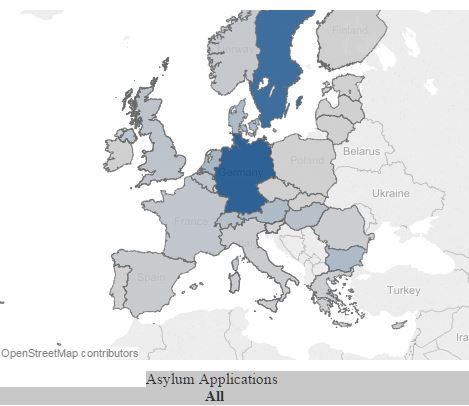
You can see a larger graphic in the PHOTO GALLERY
Citizens of 144 countries sought asylum in the EU in the first quarter of 2015. Most asylum seekers were from Kosovo (48.900).
Of the 48.900 asylum seekers originating from Kosovo in the first quarter of 2015, 90% of them were registered in two member states: Hungary (22.800) and Germany (21.100). Asylum seekers from Kosovo represented the largest group of asylum seekers in France and Luxembourg. Of the 29.100 Syrians seeking asylum protection for the first time in the EU during the first three months of 2015, almost half (13.800) applied in Germany. There were 46.400 more Kosovar asylum seekers than in the first quarter of 2014, and 12.500 more Syrians (29.100 in total), Afghans and Iraqis (5.500 and 4.900 more asylum applicants). About 12.900 Afghans sought asylum.
There were 19 times more asylum seekers from Kosovo in the first quarter of 2015 than in the same quarter of 2014, and in 2015 the number of Ukrainians (more than 5 times more), Iraqis (3 times more), Libyans (over 2 times more) and Albanians (almost 2 times more) also increased.
Main destination countries
The highest number of first asylum applicants in the first quarter of 2015 was recorded in Germany (73.100 applicants, or 40% of the total number of applicants in the EU), Hungary (32.800, or 18%), Italy (15.300, or 8%), France (14.800, or 8%) and Sweden (11.400, or 6%). 80% of all asylum seekers who sought protection in the EU-28 came to these five EU member states.
Germany (39.900 applicants more) continued to record an increasing number of asylum applicants, while Hungary (30.400 more) recorded a significant increase in the number of asylum seekers - more than 13 times more than in the same quarter of 2014. Austria (6.200 more or 3 times more asylum applicants) is the country with the third largest absolute increase in the number of asylum seekers in the EU in the first quarter of 2015.
( Eurostat, Asylum quarterly report Data extracted on 16th June 2015. )
2014.
Data for 2014 show an increase of almost 195 thousand asylum seekers in 28 EU countries compared to the previous year 2013, partly due to a significantly higher number of reported asylum seekers from Syria, Eritrea, Kosovo (UNHCR 1244/99), Afghanistan and Ukraine and to a lesser extent from Iraq, Serbia, Nigeria and Gambia.
The number of asylum seekers from Syria increased to 122 thousand in the EU-28 in 2014, which accounts for 20 percent of the total number of asylum seekers from non-EU countries. Afghans make up 7 percent of the total number, while asylum seekers from Kosovo (UNHCR 1244/99) and Eritrea make up 6 percent, and asylum seekers from Serbia (mainly Roma and Albanians from Bujanovac and Preševo) make up 5 percent.
Among the 30 main groups of asylum seekers in the EU-28 in 2014, by far the largest increase compared to 2013 was recorded for asylum seekers from Ukraine. There were also significant increases in relative terms in the number of registered asylum seekers from several African countries (Gambia, Eritrea, Senegal, Mali, Sudan and Nigeria), from two Middle Eastern countries (Syria and Iraq), from Afghanistan, as well as from the countries of the Western Balkans (Kosovo, Albania and Bosnia and Herzegovina).
The largest relative decrease in the number of asylum seekers was recorded for Russia, as the number of asylum seekers from the Russian Federation more than halved between 2013 and 2014.
In 2014, Syrians made up the largest number of asylum seekers in 11 of the 28 EU member states, including 41 applicants in Germany (where the largest number of registered asylum seekers among EU member states was recorded in 2014) and 31 Syrian asylum applicants in Sweden.
Around 27 Serbs and 13 Eritreans also applied for asylum in Germany, and 12 Eritreans in Sweden. Among other EU member states, Hungary (10 thousand inhabitants of Kosovo) and Italy (2014 thousand Nigerians) had more than 21 thousand asylum seekers in 10.
Almost four out of five (79 percent) asylum seekers in the EU-28 in 2014 are under the age of 35; those aged 18-34 made up slightly more than half (54 percent) of the total number of applicants, and minors under the age of 18 made up one quarter of asylum seekers (26 percent).
( Eurostat, Asylum statistics )
The number of asylum applications received in 2014 in the European Union (EU) increased by 25 percent compared to the same period in 2013. A quarter of asylum seekers are from Afghanistan, Eritrea or have Syrian origins. There have been many asylum applications from stateless people estimated at a total of 436.000 people across the European Union. Germany continues to be the recipient of the largest number of asylum applications, followed by France, Sweden, Italy and Great Britain.
In the first seven months of 2014, more than 87.000 people arrived in Italy by sea, mostly from Eritrea and the Syrian Arab Republic (Syria). In an effort to reduce the risks associated with such travel, in October 2013 the Italian government launched Operation Mare Nostrum, which has saved more than 100.000 people. Greece and Spain also recorded an increase in the number of arrivals.
( 2015 UNHCR subregional operations profile – Northern, Western, Central and Southern Europe )
Migration to the EU
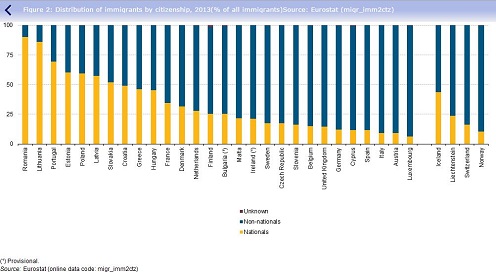
As of January 1, 2014, in Germany (7,0 million non-citizens) and Great Britain (5,0 million), Italy (4,9 million), Spain (4,7 million) and France (4,2 million). Non-citizens in these five member states live 76 percent of the total number of non-citizens, while those same five member states have a share of the EU's population of 63 percent.
A total of 3,4 million people immigrated to one of the EU-28 member states during 2013, while at least 2,8 million emigrants left one of the EU member states. These total figures do not represent migration flows to/from the EU as a whole, as they also include migration between different EU member states.
Among these 3,4 million immigrants in 2013, there were 1,4 million citizens of non-member countries, 1,2 million people with the citizenship of another EU member state and not the one they immigrated to.
Germany recorded the largest number of immigrants (692,7 thousand) in 2013, followed by Great Britain (United Kingdom) (526 thousand), France (332,6 thousand), Italy (307,5 thousand) and Spain (280.8 thousand). Spain recorded the largest number of emigrants in 2013 (532,3 thousand), followed by Great Britain (316,9 thousand), France (300,8 thousand euros), Poland (276,4 thousand) and Germany (259,3 thousand). In total, 16 EU member states reported higher immigration than emigration in 2013, but more people emigrated than moved in from Bulgaria, Ireland, Greece, Spain, Croatia, Cyprus, Poland, Portugal, Romania and the three Baltic EU member states.
In relation to the size of the resident population, Luxembourg recorded the highest immigration rate in 2013 (39 immigrants per 1000 persons), followed by Malta (20 immigrants per 1000 persons) and Cyprus (15 immigrants per 1000 persons).
The highest emigration rates in 2013 were reported in Cyprus (29 emigrants per 1000 persons) and Luxembourg (20 emigrants per 1000 persons).
About 33,5 million people born outside the EU-28 lived in an EU member state on January 1, 2014, while there were 17,9 million people who were born in a member state other than the one in which they reside.
( Migration and migrant population statistics, Eurostat, Data extracted in May 2015. )
"Naturalization rate"
The number of people acquiring the citizenship of an EU member state in 2013 was 984,8 thousand, which corresponds to an increase of 20% compared to 2012. In 2013, more people acquired the citizenship of one of the EU member states than in any other year in the period from 2002 to 2012.
In Spain, in 2013, 225.8 thousand (or 23% of the EU-28 total) people acquired citizenship; in Great Britain (207,5 thousand); in Germany (115,1 thousand), in Italy (100,7 thousand) and in France (97,3 thousand);
The largest increase in the number of those who received citizenship in 2013 compared to 2012 was recorded in Spain - 131.700, followed by Italy (35,3 thousand), Great Britain (13,6 thousand) and Greece (9,2 thousand). In contrast, the highest decline in absolute terms was recorded in Hungary (9,2 thousand fewer people received Hungarian citizenship than in 2012) and the Netherlands (5,0 thousand).
The most commonly used indicator is the "naturalization rate", defined as the ratio between the total number of approved citizenships and the number of "non-national" residents. Among the EU member states, Sweden had the highest naturalization rate in 2013 (7,6 citizenships per 100 "non-national inhabitants"), followed by Hungary and Portugal (with 6,5 and 5,9 per 100 non-national inhabitants).
( Migration and migrant population statistics, Eurostat, Data extracted in May 2015. )
Dramatic increase in the number of refugees in Greece
The number of refugees and migrants arriving in Greece is increasing drastically, and has now reached 160.000. The latest data collected by UNHCR in Greece show that the number of arrivals by sea from January 1 to August 14, 2015 was 158.456. In the same period, 1.716 refugees and migrants entered Greece via its land border with Turkey, bringing the total number of arrivals (by sea and land) to 160.172.
The pace of arrivals has been steadily increasing over the past few weeks. More refugees and emigrants arrived in Greece during the month of July (50.242) than during the whole of last year (43.500). From August 8 to 14, a total of 20.843 people arrived by sea in Greece, almost half of the refugees in all of 2014. The majority of tourists last week were Syrians (16.997 people or 82 percent of the total), Afghans (2.847 or 14 percent) and Iraqis (582 or 3 percent), confirming that the vast majority are likely to qualify for refugee status.
The latest figures from Greece show that the total number of refugees and migrants crossing the Mediterranean this year will be around 264.500, including 158.456 in Greece, around 104.000 in Italy, 1.953 in Spain and 94 in Malta.
(Source:
Numbers of refugee arrivals to Greece increase dramatically, UNHCR,
Briefing Notes, 18 August 2015.
UNHCR warns of a growing crisis in Greece and the Western Balkans due to the growing number of refugees fleeing the war
The number of refugees arriving on the Greek islands continues to grow. On average, 1000 people arrive per day. Since the beginning of the year, 77.100 people have arrived in Greece by sea (data from July 3). Close to 60% of those who arrived by sea are refugees from Syria, while others come from Afghanistan, Iraq, Eritrea and Somalia. Greece is now facing an unprecedented refugee crisis.
On Tuesday morning, a boat leaving Turkey with about 40 refugees sank between the Greek islands of Agathonisi and Farmakonisi. According to the statements of the Greek Coast Guard, Greek and Turkish rescue services at sea rescued 19 people. Eight were rescued by the Greek Coast Guard, 11 by the Turkish Coast Guard. The bodies of five drowned people were found, while around 16 people are still being searched for and are feared to have drowned.
The unstable economic situation in Greece, combined with the increasing number of arrivals, is putting great pressure on the small island communities, which lack the basic infrastructure and services to adequately respond to the growing humanitarian needs. The number of people arriving is now so great that, despite all efforts, the authorities and local communities are no longer able to cope on their own. An urgent response from Europe is needed before the situation worsens.
On the northern Aegean island of Lesbos, the number of arrivals far exceeds the capacity of the police-run identification center in Moria. Currently, more than 3.000 refugees are living in harsh conditions in the Kara Tepe makeshift accommodation, and 1.000 people are camping outside the facility in Moria. Adequate medical assistance, running water, sanitation services and shelter from high temperatures are lacking. The UNHCR has previously expressed concern for the health of the refugees, including pregnant women and children, who are forced to walk up to 60 km over the mountains to reach the island's main town, Mytilini. UNHCR welcomes the recent amendments to the law in Greece which will exempt those transporting irregular arrivals from prosecution under certain conditions and stands ready to help the authorities find a solution to the transportation problem.
UNHCR, through its executive partner METAction, made translators temporarily available to the police in order to speed up the registration process on the island of Lesvos, which continues to receive the largest number of refugees. On the island of Samos, food distribution was suspended this week due to late payments to suppliers and cash problems. The army temporarily stepped in to ensure continued food distribution. On some islands, including Samos, there is growing tension in accommodation facilities, and bottlenecks in the registration process have led to longer waiting times in increasingly worse conditions.
Despite the difficult situation in which many Greeks find themselves, they are mostly hospitable and generous to refugees. Communities organized by civil society organizations, including local NGOs and volunteers, small businesses and tourists oversee the collection and distribution of food, water, clothing and even basic health care. Once transferred to Athens, the refugees are faced with the same challenges, while Greece's accommodation capacity is drastically failing to meet the needs.
UNHCR has deployed additional staff in five locations in the Eastern Aegean region to provide advice and assistance to newcomers and care for unaccompanied children and persons with special needs. In the form of intervention assistance to meet humanitarian needs, UNHCR distributes, through its partner Agkalija and the municipality of Lesbos, drinking water and energy panels. Coordination with other humanitarian actors is now needed to ensure an adequate response to the needs of refugees in close cooperation with the Greek authorities.
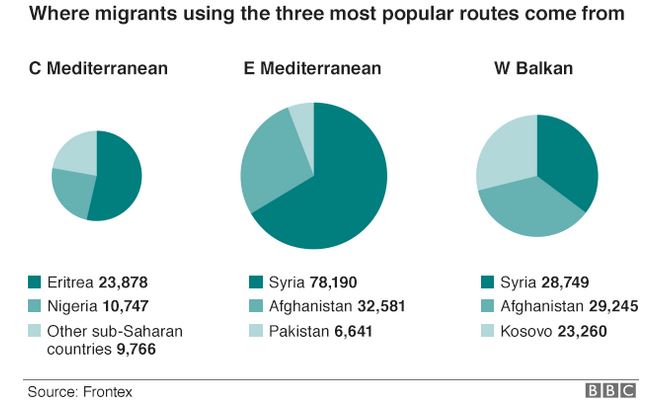
Most of the refugees arriving in Greece go further in an attempt to reach countries in Western and Northern Europe via the Western Balkans region. Countries in this region, such as the Former Yugoslav Republic of Macedonia (FYROM) and Serbia, are facing a dramatic increase in the number of refugees. In the first half of this year, around 45.000 people sought asylum in this region. This represents a nearly 900% increase in the number of submitted asylum applications compared to the same period in 2014. However, this is only part of the refugees entering these two countries, while the majority continue directly to Hungary and further north. It is estimated that half of the refugees who pass through the region remain unregistered by the competent authorities, and exposed to violence and abuse by smugglers and criminal groups. The number of people crossing daily from Greece to FYROM and Serbia increased from 200 to 1.000 during June. More than 90% of those traveling in this direction come from countries that produce refugees, primarily Syria, Afghanistan, Iraq, Eritrea and Somalia.
As in the case of Greece, the capacities of these countries to effectively respond to an emergency situation are severely overstretched. While the authorities are trying to ease the situation by establishing facilities to receive and process refugees, UNHCR is concerned by reports that border police are preventing refugees from entering. In some cases, refugees alleged that some police officers resorted to force and pushed them back into the hands of smugglers. Closing the borders is not the solution, nor are the Hungarian government's plans to erect a fence along the border with Serbia. Reports on the forced return of refugees from the borders of Serbia and FYROM and FYROM and Greece are worrisome, because such a practice exposes refugees to additional risks and contradicts the legal obligations of states. Refugees, including women and young children, often end up abandoned along borders, without protection or access to basic services such as food, water and sanitation.
This situation requires a common and far-reaching response based on the principles of humanity, access to protection and true solidarity and sharing of responsibilities, both within the EU and in countries outside the EU. Europe should behave in accordance with its tradition in this regard. UNHCR welcomes the renewed commitment of EU member states to resettle another 20.000 refugees in the EU. UNHCR hopes that the details of the resettlement within the EU of 40.000 people in need of protection will soon be finalized as a show of solidarity with those EU countries such as Greece that are facing an unprecedented number of refugees. These proposals – even if modest in relation to the needs – represent important first steps towards such a comprehensive approach. As needs grow, these measures need to be expanded. Greater efforts are urgently needed to increase safe and legal ways for people to reach protection in Europe, to improve reception conditions and asylum systems, to show solidarity with the countries where a large number of refugees come, to provide assistance to the countries in the immediate neighborhood of the European Union (primarily the Former Yugoslav Republic of Macedonia and Serbia) and to solve the basic reasons for forced displacement. In order to achieve these goals, UNHCR is ready to cooperate with EU member states and institutions, as well as with other partners.
(UNHCR in Serbia: UNHCR warns of a growing crisis in Greece and the Western Balkans due to the growing number of refugees fleeing the war
UNHCR in Serbia: The risk for the growing number of refugees and migrants passing through the Western Balkans is growing
UNHCR is concerned about the increasing risks faced by the growing number of refugees and migrants in the Western Balkans who use this route. Men, women and children often walk for days, and some of them are exposed to violence and abuse, or accidents along the railway tracks.
There has been a dramatic increase in refugees and migrants on the so-called 'Western Balkan route'. Some of them apply for asylum in the Balkans, while others continue on.
In the period between 2012 and 2014, the number of persons registering their intention to seek asylum in the Western Balkans increased from 5.000 to 20.000, which represents an increase of 400%. The numbers continue to grow in 2015, and more than 22.000 asylum applications were submitted in Serbia alone in the first five months. That is six times more than in the same period last year. Nearly 10.000 new asylum seekers were registered by the authorities in the month of May alone. The authorities and civil society in southern Serbia are currently doing everything in their power to provide basic humanitarian aid, to register and provide accommodation for around 200 asylum seekers who turn to them for help every day after they crossed over from FYR Macedonia. UNHCR estimates that at least an equal number of these persons who are potentially in need of international protection do not want to register but pass through the region irregularly, with the help of smugglers.
Most of those who travel along this route come from countries that "produce refugees" - Syria, Afghanistan, Iraq, Eritrea and Somalia. They mostly arrive via Greece, and bearing in mind the recent sharp increase in the number of people arriving in that country by sea, it is expected that the number of people going this way will continue to grow.
The situation is particularly difficult in the Former Yugoslav Republic of Macedonia, where refugees and migrants move along railway lines and mountain roads, walking for days exposed to the dangers of railway accidents, natural disasters, and abuses and threats by smugglers and criminal networks. A series of fatal accidents that have occurred in the past few months are a reminder of the dangers and threats faced by those traveling on these routes, including young children and women.
UNHCR has been advocating for the improvement of asylum systems in this region since the beginning of the 1990s. The existing capacities are not suitable for this kind of influx. We have close cooperation with the government of FYR Macedonia on amendments to the Law on Asylum and Temporary Protection, so that persons who are potentially in need of international protection are registered and gain access to legal procedures. The proposed changes, which have yet to be approved by the Parliament, need to be adopted and implemented as a matter of urgency.
The situation in Serbia is more positive, and asylum seekers are not detained. UNHCR is making efforts to increase support for the activities of state authorities and civil society related to the provision of basic assistance, services and access to procedures.
The situation remains critical and will require further support, including through joint efforts with the European Union, national governments and non-governmental organizations.
(UNHCR in Serbia: The risk for the growing number of refugees and migrants passing through the Western Balkans is growing
About 28 million recognized refugees live in the 1,5 member states of the European Union (plus Norway and Switzerland) - out of a total of about 16 million refugees in the world.
As estimated by the United Nations High Commissioner for Refugees (UNHCR), there are currently around 8,8 million refugees in the world.
In addition, 2 million people live in refugee-like situations and there are an additional 4,8 million Palestinian refugees. Together, it makes about 16 million people.
EU member states make a distinction between asylum seekers and refugees. An asylum seeker is a person who submits an application for refugee status.
The asylum seeker is not granted refugee status unless the member state decides to qualify him as such, according to a predetermined legal procedure.
Article 18 of the Charter of Fundamental Rights of the EU states: "The right to asylum must be guaranteed with due respect for the rules of the Geneva Convention of July 28, 1951 and the Protocol of January 31, 1967 relating to the status of refugees and in accordance with the Treaty on European Union and the Treaty on the Functioning of the European Union."
In public debates, the distinction between refugees and other people on the move is often blurred. It is important to remember, however, that refugees have a special legal status. Refugees are forced to leave their country because their lives are in danger. Migrants and other groups on the move often make a conscious decision for economic and other reasons. Refugees do not have that choice.
Refugees are forced to leave their homes and need international protection. This is the reason why one hundred and forty-seven countries around the world have signed the Geneva Convention and granted refugees a unique legal status.
(Refugees in the EU )
An estimated 9 million Syrians have fled their homes since the outbreak of civil war in March 2011, seeking refuge in neighboring countries or within Syria itself. According to the United Nations High Commissioner for Refugees (UNHCR), over 3 million have fled to neighboring Turkey, Lebanon, Jordan and Iraq. 6,5 million are internally displaced within Syria. Meanwhile, 150.000 Syrians have applied for asylum in the European Union, and member states have pledged to resettle another 33.000 Syrians. The vast majority of those refugees – 28.500 or 85 percent – go to Germany.
More than a million refugees fled Iraq across the border into Syria during the first decade of this century. However, now, as can also be seen in Lebanon, the roles have been reversed, Iraq is accepting refugees from Syria. Most of the Syrian refugees in Iraq reside in the Duhok province of Kurdistan.
In June 2014, the Islamic State of Iraq and the Levant took control of the Iraqi city of Mosul, triggering a second refugee crisis in the country.
(Source:
Refugees from Syria ;
Refugees from Syria in the EU, interactive map ;
There are currently almost 220,000 refugees registered with the UNHCR in Iraq, the vast majority in Iraqi Kurdistan.
)
|
| Refugee from
| Refugee in
| Internally displaced |
| Algeria
| 3.523
| 94.128
| 0 |
| Egypt
| 15.873
| 236.090
| 0 |
| Libya
| 4.194
| 27.964
| 363.067 |
| Mauritanija
| 34.114
| 75.635
| 0 |
| Morocco
| 1.532
| 1.216
| 0 |
| Tunis
| 1.486
| 901
| 0 |
| Western Sahara
| 116.482
| -
| 0 |
* December 2014
(
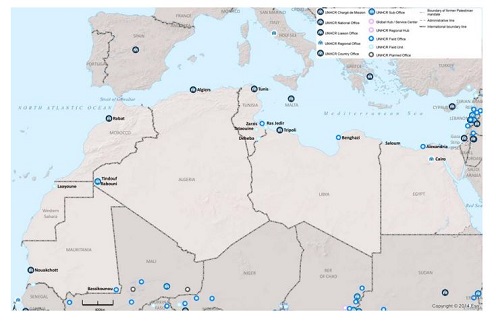
2015. UNHCR subregional operations profile – North Africa