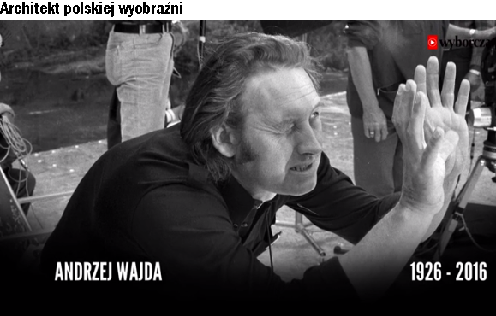
Film director Andrzej Wajda, co-founder of the Polish Film School, who made 50 films, including "Ashes and Diamonds", "Everything is for Sale", "Pan Tadeusz", "The Marble Man, winner of the Silver Palms for the film "Canal" (1957) in Cannes, FIPRESCI awards in Venice for "Ashes and Diamonds" (1959), awards at the San Sebastian festival for "The Wedding" (1973), FIPRESCI, Cannes for "Man of Marble" (1978) and Palme d'Or in Cannes for "Man of Iron" (1981).
His four films were nominated for Oscars: The Promised Land (1976), The Maid Wilko (1980), Iron Man (1982) and Katyn (2008). In 2000, Vajda received the Oscar for Lifetime Achievement, and along with Federico Fellini and Ingmar Bergman, he is one of the three laureates of the Lifetime Achievement Award of the European Film Academy.
A few weeks before his death, his last film "Afterimages" was nominated for an Oscar.
Andrzej Wajda was born on March 6, 1926, in Suwalka, Poland. His mother, Aniela Vajda, was a teacher in a Ukrainian school. His father Jakub Wajda, born around 1900, was a captain in the Polish infantry. In 1939, when Poland was invaded by Nazi Germany and divided between Germany and the Soviet Union, Wajda's father was one of thousands of captured Polish officers shot in 1940 by the Russian KGB in the Katyn Forest massacre.
Vajda's film Katyn (2007), which was nominated for the Academy Award for Best Foreign Language Film in 2008 and received many other awards and nominations, depicts the historic events in the Katyn Forest during World War II, in which Vajda's father was among the thousands Polish officers killed by Stalin's Soviet government. Vajda's film was well received by the last Soviet leader, Mikhail Gorbachev, who made the facts of the Katyn massacre public.
Young Wajda survived World War II with his mother and brother in occupied Poland. In 1942, Wajda joined the Polish resistance movement and served in the Craiova army until the war ended in 1945.
The film "Generation" (1955), with which he made his directorial debut in 1955, is about the generations of young people who came of age during the Nazi occupation of Poland. His award-winning films Canal (1957) and Ashes and Diamonds (1958) are part of a trilogy about life in Poland during World War II. Although he was under pressure from the Soviet domination and the then Polish authorities, Wajda positioned himself as an artist who was above the conflict, but he managed to show in his films the civil war between two ideologically conflicting artists. of the Polish anti-Nazi movement - members of the "People's Army" of the Polish Communists and the "Army of Kraiova".
In 1946, he moved to Kraków, where he attended the Academy of Fine Arts. He studied painting, especially impressionist and post-impressionist paintings, and he especially loved Paul Cézanne. Studied film direction in Lodz 1950-1954. at the Film School with directors Jerži Teplitac and Alexander Ford. Luis Bunuel was the director who inspired him the most at the beginning of his career.
His Oscar-nominated film The Promised Land (1975) is made up of multi-layered allegory and symbolism. The shooting of the workers in the final scenes is actually an exposé of the killing of workers in the Soviet Union in 1962, under Nikita Khrushchev and in Poland a few years later. The Marble Man (1977) was a deconstruction of the appearance of official propaganda. The film "Man of Iron" (1981) continued to expose the manipulation of the communist regime. In 1981, Vajda joined Lech Walesa's "Solidarity" trade union. He was a member of the "Solidarity" Council (1981-1989).
About Leh Valensi, he made the film "Man of Hope".
From 1989 to 1991, Wajda was elected senator of the Republic of Poland. From 1992 to 1994, he was a member of the Presidential Council for Culture. In 1994, he founded the Center of Japanese Art and Technology in Krakow, and was awarded the Order of the Rising Sun in Japan (1995). Wajda was the president of the Polish Film Association (1978-1983). He also received an honorary Golden Bear (2006) at the Berlin Film Festival.
He also directed at the "Savremenik" theater in Moscow.
Vajda was married four times: Gabriela Obremba (1949 – 1959), Zofija Zučovska (December 19, 1959 – March 14, 1967), Beata Tiškievič (May 13, 1967 – October 29, 1969), with whom he has a child; Kristinom Zakhvatovich (from January 1974 until his death on October 9, 2016) .
( Andrzej Wajda, BiographyIMDb
( Czy Wajda jest mędrcem, czy raczej genialnym intuicjonistą, krzego prowadzi czucie i wiara polskiej tradycyi? [MICHNIK] wyborcza.pl, 3.05.1994/15/38 XNUMX:XNUMX )