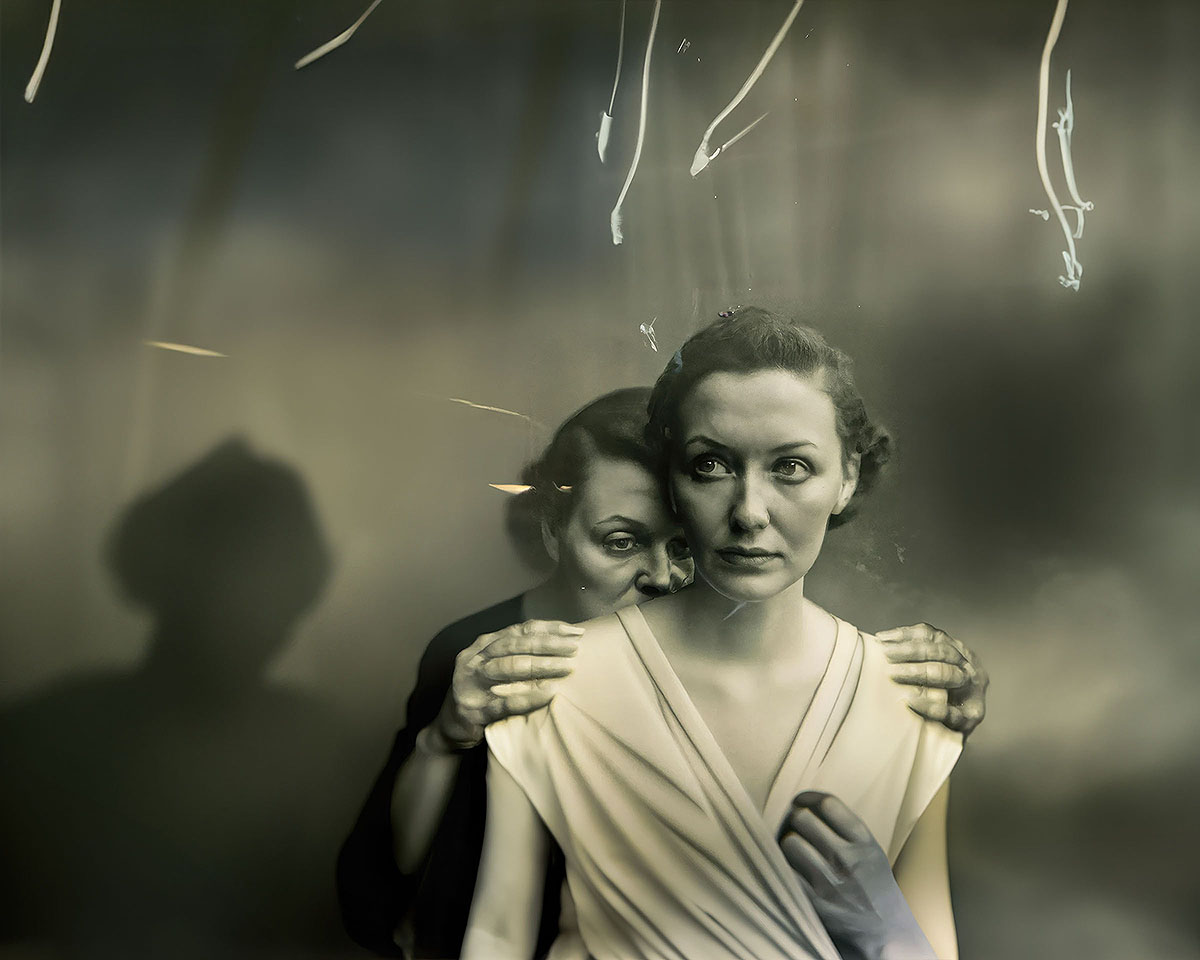
Is the image recorded exactly what you see or is the scene constructed by artificial intelligence, is the topic of this year's "Vizuelizator" festival, for which world-famous authors came to Belgrade
The influence of artificial intelligence on photography, which is a worldwide current topic, is the focus of this year's "Vizuelizator" photography festival (November 15 - December 7) in Belgrade, which asks the question "Do you believe your eyes?"
The festival begins with the opening of Magnum photographer Jonas Bendiksen's exhibition and the first international conference on the impact of artificial intelligence on photography. World authorities in the field of photography and media, coming from eight countries, will discuss: Jonas Bendiksen (Norway), Boris Eldgasen (Germany), Stefano de Luigi (Italy), Nuno Ricou Solgado (Portugal), Carine Van Gerwen (Belgium). and Zvezdan Mančić (Serbia).
Jonas Bendiksen is known to the general public for his controversial book The Book of Veles, which was created during the presidential campaign in the United States of America in 2016, and for which he disclosed a few months later that all the images published in it were generated by artificial intelligence.
photo: Jonas BeldiksenThe book of Veles
As he stated in a written interview for "Vreme", the project The book about Veles started when he "felt that we are not aware of the speed with which computer generated graphics are approaching us and that we are not ready for its arrival. Back then, in 2019, the technology for fully AI-generated images was not yet mature, but the computer-generated 3D models were extremely photorealistic. I started using those tools to see how difficult it was to use them, and to test if we were able to tell the difference. People have always manipulated photography, but we are entering an era where such manipulations can be automated and produced cheaply in huge quantities. And that has consequences for trust in society".
During the presidential elections in the United States of America in 2016, Veles was the center of disinformation, because it was from this city in North Macedonia that most websites with fake news sprang up. And that is not the only forgery from Veles. "The title of the project came from an allegedly ancient manuscript The book about Veles, claimed to have been discovered in 1919 and considered an important historical manuscript, was later found to be a complete forgery. I also play with the long tradition of forgery Books about Veles", he explained.
Bendiksen says he hopes his lecture and exhibit will encourage people to be cautious about all digital information. He notes that we must constantly assess the context of every text, photo and video we see online: Where did it come from? Who made it? Under what circumstances? What is the goal?
"Currently, it is still possible to distinguish a photo from a generated image - the latter are often too 'plastic', too clean, and have some strange details that are unrealistic. But there is no doubt that in the near future it will become very difficult, the viewer will need more information. One of the best ways to distinguish real from AI photography is to look at images taken just before or after the image you're interested in—like looking at old film-era contact sheets or a digital image light table. It tells the whole story and shows how the photographer moved through the scene. With AI it will be very difficult.”
However, there is no doubt that artificial intelligence plays an important role in everyday life and that we are already dependent on it, says Bendiksen.
"So, it's not a question of whether we will use that technology. We already use it. But we must be sure what is fact and what is fiction, and in that sense protect the media."
Boris Eldagsen also set a precedent on the topic of applying artificial intelligence to photography by refusing to accept the Sony World Photography Award because he entered the competition with an image generated by artificial intelligence. As he told Vremena, he did it to start a debate about the relationship between AI-generated images and photography. The "Visualizer" will present an exhibition of both photos.
"The advantages for me as an artist are that I am freed from material limitations. I can do what I imagine and in the process of work I use my experience and knowledge as tools with which I work. Now I'm in my early fifties, I've been making pictures for over 30 years and I can use that knowledge and I can experiment.”
In the story of AI photography, Eldagsen says that as an artist he sees only one problem, which is copyright, that needs to be solved, but as a citizen in a democratic society, he sees many others.
"Everything can be generated. You can generate false history, you can generate false facts and false photographic images of today's conflicts. So it's kind of made for totalitarian systems because AI is very amenable to disinformation, manipulation, destabilization and I'm very concerned about that. I think that democratic societies must be aware of this and must be prepared for it."
To tell the difference between a photograph and a generated image, Eldagsen said, “you should have some fact-checking. Google is trying to help by introducing a new feature in search called 'about this image', telling us where a certain image was first found, how it moved, so we can look at the sources and decide for ourselves whether to trust the source or not."
At the 12 exhibitions of the current "Visualizer", the audience will be presented with domestic and foreign authors, with both documentary photography and images generated with the help of artificial intelligence. The best photos created between the two festivals, and selected by the jury of the national competition Press Photo Serbia, this time will be like a kind of defiance of the illusion created by modern technologies.
What is happening in the country and the world, what is in the newspapers and how to pass the time?
Every Wednesday at noon In between arrives by email. It's a pretty solid newsletter, so sign up!
Like before Caro Claire Burke not only exposed the false image of a traditional woman in America, but also showed the level of women's rights in general - feminists claim. This novel is a direct attack on the traditional way of life - according to conservative Christian women
Forty years of a hairy creature who survived a nuclear disaster on Malmak, and everything he knows about America he learned from an advertising-paid program
In the underdeveloped south, where the saying Pyrrhic victory was born, where 813 men were killed because they did not want to convert to Islam, where the ancient Romans saw war elephants for the first time and many other unrepeatable things
Kristaps Porzingis retires from the court due to health problems. He was previously diagnosed with POTS, a syndrome that can cause exhaustion, dizziness and a rapid heart rate
At the moment when the institutions of the Republic are destroyed, when Vučić's octopus is still alive, when people are disgusted by the injustice and the stench left behind by the Essenes regime, we have, as Machiavelli said, only civic virtue as the fuel with which we can return to the beginning
The four independent members of REM are an example of perseverance and civic responsibility. Rodoljub Šabić even, upon leaving the premises of REM, after the sentencing of the Informer, experienced that the Essenes insulted him, hit him with their hands and feet. But that too will soon be over
Vučić pardoned the batterers and Dijana Hrkalović. The election winners should abolish the sultan's power that allows one man to run afoul of the entire judicial system
The archive of the weekly Vreme includes all our digital editions, since the very beginning of our work. All issues can be downloaded in PDF format, by purchasing the digital edition, or you can read all available texts from the selected issue.