About the events of the people, the carpet, Milo's kebabs for the euro, locked hotels and other current novelties on Montenegrin beaches once intended for exclusive tourism
"Doughnuts, corn, figs, doughnuts...", the strong voice of a local with a Mediterranean build has been echoing for more than a decade along the beach of the "Maestral" hotel in Pržno. This year, her daughter, who always helped her mother and carried the goods, is not with her: "She got married, she left, she doesn't want to work anymore!" says the woman as she pushes a cart loaded with fruit, freshly baked donuts and boiled corn.
The problem of labor shortage does not only bother the saleswoman from Pržno. There are not enough waiters, cooks, support staff in restaurants, security in bars all over the Montenegrin coast.
Hotel complexes and restaurants on Sveti Stefan and in Miločer will not have that trouble this summer, because they welcomed the summer season locked up, with chairs raised on the tables like after every fayront.
And the beaches? They say it was like that in Havana on January 1, 1959, when the dictator Batista fled to his friend Turjillo in the Dominican Republic in a plane with chests of gold. People crowded into casinos, hotels and luxurious beaches... Kraljičina, Kraljeva and Sveti Stefana beach, when I walked there last week, were full of people, "the people happened to them", as some would say. There is no trace or mention of the fact that world famous people like Leonardo DiCaprio, Sophia Loren, Bobby Fischer, Boris Spassky, Claudia Schiffer, Elizabeth Taylor, Kirk Douglas, Andrea Bocelli, Sylvester Stallone, Robert De Niro and others used to vacation here. the famous pool at the back of the island or at the hotel's private beach in front of it.
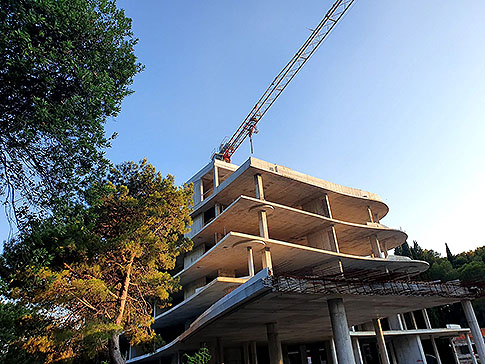
photo: Robert ChobanINAPPROPRIATE: "Queen's Beach" construction site in Miločerski Park
INDOOR FUN PARK
And yet, this is not Cuba in 1959, there was no revolution in Montenegro, even the president remained the same... Then what happened? Namely, after the tenant Adriatic Properties and the hotel operator Aman Resorts announced that they would not open the Sveti Stefan and Miločer hotels this season, access to the coast became free, the beaches remained unorganized, without furniture, and spa facilities, restaurants, and cafes were closed behind them. and other accompanying contents. We are talking about exclusive locations that for decades were reserved for hotel guests willing to pay thousands of euros for one night. Entry was also allowed to others, but with astronomical prices, so a set of sunbeds with a parasol cost up to 150 euros per day.
The tenants' decision to close the hotels was preceded by several protests by local residents at the beginning of the year, supported by the leaders of the Budva local government, when the fences on the approach to the hotels and beaches were removed. They opposed the construction of real estate within the new hotel "Kraljičina plaža" invested by Adriatic Properties, and they demanded unconditional access to the leased hotel beaches.
The President of Montenegro, Milo Đukanović, said recently that only an absolutely irresponsible government could make a representative part of the tourism offer Kraljičina Plaža a mockery, and that, as he said, Montenegro would lose an investor: "We believe that you have seen on social networks what it looks like the most representative part of the coast, Kraljičina Plaža. Selling beer and kebabs for one euro," said Đukanović. In the past week, a hit on social networks in Montenegro and the region was a photo of a man bringing a real rolled-up carpet to St. Stephen's beach.
And how did the story of tourism on Sveti Stefan begin? "In the fifties of the 20th century, the very political top of Yugoslavia came up with the idea to turn the fishing village of Sveti Stefan into a luxury city-hotel. This idea was first initiated by the then high-ranking federal official Edward Cardelj. His idea was wholeheartedly supported by Blažo Jovanović, then the first political figure of Montenegro, as well as the well-known painters of that time, Petar Lubarda and Milo Milunović," the book says. Budva, from myth to reality long-time Montenegrin tourism worker and expert Vlado Duletić. None of the actors of this story is alive anymore, not even the author of the book. And it seems that their dream has also died.
The impression is that the municipal and state authorities in Budva and Montenegro did not do well in many fields, especially when it comes to tourism. Namely, Budva was known on the one hand for mass tourism, and on the other hand there were hotels for the world's elite. The backbone of mass tourism that gave Budva numerous pejorative nicknames such as "Leskovac na Moru" were noisy open-air discotheques. Two years ago, namely, all six large open-air discotheques - "Trocadero", "Rafaelo", "Paris", "Ambiente", "Maltez" and "Miami", as well as 14 fast food outlets, were demolished. Whether someone liked them or not - but these discotheques were the main lure for tens of thousands of young people from the entire region who came to Budva to party. Right there was a big outdoor amusement park where I always had crazy fun with my daughters in "crash cars". Now that amusement park is gone too - someone came up with the crazy idea of shoving it into the hot, non-air-conditioned hall of the Adriatic Fair, where you can see the corona viruses flying in the air with the naked eye.
photo: Robert ChobanPADLOCK TO DALJE: Entrance to one of Miločer's restaurants
The second segment of Budva - elite tourism, concentrated on the mentioned hotels "Sveti Stefan" and "Miločer", Kraljeva and Kraljičina Beach, also experienced a downturn because the facilities are under padlocks, and the beaches instead of exclusive received the status of "wild".
COASTAL CONCRETING
When you swim about a hundred meters from the beach in Pržno and turn around, you see a gigantic concrete structure emerge from the otherwise studded streets of this once peaceful fishing village - the outlines of the future hotel "Kraljičina plaža", whose investor is also Adricatic Properties from the beginning of the story. This concreting of the coast, which we would not be able to see in Italy or Greece, is the main problem of tourism in Montenegro and in some places in Croatia. Part of the same concept that made Kopaonik and Zlatibor forests of concrete buildings instead of pine and spruce forests. The question that every reasonable person asks - who will come to summer or winter in such places - does not interest the investors and the corrupt officials who issue them permits. They will certainly use the money earned in this way to send their children to school in "normal" countries and buy real estate in London, Vienna or Trieste where the order is known.
By the way, this is not the first stumble of St. Stephen's in its 61-year hotel history. The first was in 1991 when, due to the war in Yugoslavia, it was left without the international tourist elite it was intended for. The second setback came a year later when Sveti Stefan was leased to Jezdimir Vasiljević, the owner of "Jugoskandik", who left many depositors in Serbia and Montenegro in the dark. After the collapse of the bank and the collapse of the owner of the Yezda empire, Sveti Stefan embarks on a gradual path of recovery. I was on it for the first time in 1997 and then, although it looked like a worn-out plush, it still had some glamor although there were no scenes from the Agent 007 movies in the casino, the roulette was mostly local mafia bosses and those who wanted to become one. In the restaurant "Pod maslinom" across the street from the island, Bogoljub Karić prepared a feast, who served his guests shark fillets that, as he confided, he had personally caught.
The last time ordinary mortals could sleep on St. Stefan was in the summer of 2006 when I spent a few days on the island with Sandra and my daughter India in my wife's belly. My favorite little pool at the back of St. Stephen's was covered in dried pine needles that no one was removing, but it still had its timeless charm. Next, in 2007, the hotel was leased to "Aman Resort" for 30 years, later the lease was extended to 42 years, the contract was taken over by Adriatic Properties, and Aman continued to run the hotel business. In 2013, the hotel was opened to its first guests, and a year later it hosted the glamorous wedding of Jelena and Novak Djokovic. I managed to negotiate exclusive photos from that wedding for the magazine "Hello!" and that issue of July 14, 2014 will be remembered as the Serbian weekly with the largest circulation sold in the 21st century.
We passed by the beach where, truth be told, we didn't see the kebab vendors from Djukanović's statement, although it is quite possible that some visitor brought them along with fresh tomatoes. Through the narrow isthmus that connects the island to the mainland, we reach the walls of Sveti Stefan, the former fishing village of Paštrović. A white stone plaque dedicated to NOB fighters and victims of fascist terror was installed on the occasion of the 10th anniversary of liberation at a time when locals still lived on the island. The letters are pale, they were erased by storms and unbelief, meteorological and historical, you can barely see what is written on the blackboard. To the left of the board is a wrought iron gate painted black through which you pass into the labyrinth of St. Stephen's streets. The gate is now closed, the lock wrapped in a thick chain patiently waiting for the Saint to finish his silence.
What is happening in the country and the world, what is in the newspapers and how to pass the time?
Every Wednesday at noon In between arrives by email. It's a pretty solid newsletter, so sign up!
Serbia is playing against Germany for points that could save it a place in the League of Nations. In front of almost empty stands, Paunović's team welcomes a selection that also has no room for error
The editors of "Vremena" received a request for denials to the article "Parents of Elementary School '20. Oktobar' tonight demand the resignation of the principal" published on October 29. We transmit it in its entirety and without changes
Like before Caro Claire Burke not only exposed the false image of a traditional woman in America, but also showed the level of women's rights in general - feminists claim. This novel is a direct attack on the traditional way of life - according to conservative Christian women
Forty years of a hairy creature who survived a nuclear disaster on Malmak, and everything he knows about America he learned from an advertising-paid program
In the underdeveloped south, where the saying Pyrrhic victory was born, where 813 men were killed because they did not want to convert to Islam, where the ancient Romans saw war elephants for the first time and many other unrepeatable things
At the moment when the institutions of the Republic are destroyed, when Vučić's octopus is still alive, when people are disgusted by the injustice and the stench left behind by the Essenes regime, we have, as Machiavelli said, only civic virtue as the fuel with which we can return to the beginning
The four independent members of REM are an example of perseverance and civic responsibility. Rodoljub Šabić even, upon leaving the premises of REM, after the sentencing of the Informer, experienced that the Essenes insulted him, hit him with their hands and feet. But that too will soon be over
Vučić pardoned the batterers and Dijana Hrkalović. The election winners should abolish the sultan's power that allows one man to run afoul of the entire judicial system
The archive of the weekly Vreme includes all our digital editions, since the very beginning of our work. All issues can be downloaded in PDF format, by purchasing the digital edition, or you can read all available texts from the selected issue.