Basketball
The end of the saga: Jabari Parker and Partizan terminated the contract
Jabari Parker and Partizan terminated the contract by mutual agreement, which ended the saga that marked his stay in the black and white jersey

"It is a scene that must be seen," stated the commentator who, due to the circumstances, instead of the match, commented on the fight, the throwing of oysters, the breaking and burning of inventory. "It must be seen to be a warning for everything that can happen to us later". Everything else is history
In recent Croatian national mythology, the event at the Maksimir stadium twenty years ago - the clash between Dinamo and Zvezda fans in the final championship match, and the general fight with the militia and riots until late at night on the streets of Zagreb - was declared the beginning of the Homeland War.
"It was certainly not the beginning of the war, but it was one of the events that was symbolically used for a new interpretation after the war had already started," says professor Žarko Puhovski for Croatian Radio and Television.
"We knew that we could not lose that war precisely because the citizens, and not the political elites, stood in defense of their own people," claims Antun Vrdoljak, director, at that time a member of Franjo Tuđman's closest team.
Twenty years later, the opinion is almost undivided that the whole event was staged, that the new government used it to take over (almost) all media companies in Croatia, first of all TV Zagreb, later HRT. It was the time when Ante Marković's reforms started to "hiccup", in the middle Adriatic, from Split to Zadar every now and then the house of some "recalcitrant" owner blew up, preparations for the disarmament of the Croatian and Slovenian Territorial Defense were completed...
In support of the thesis that the entire conflict was staged, the fact that the night before the game, stones were brought to the traditional Dynamo northern stand, but also to the southern one, which was intended for star players. "I think the whole case was politically staged. In that game, the disintegration of a system and a country practically began," says Darko Pancev, the center forward of the red and white team at the time.
OVERTURE: On the day of the match, a group of about 2500 Crvena zvezda fans arrived in Zagreb from Belgrade, led by Željko Ražnatović Arkan, at that time the just-enthroned "leader" of fans/hooligans, overnight from "Gypsies" renamed "Delije". Sporadic clashes started on the streets of Zagreb, and culminated in the stadium.
Street fights, overturning tables in front of cafes, breaking windows, smashing cars were just a prelude to a much fiercer conflict at the stadium, which viewers across the country could follow on live television. Before the main event at the stadium, two fan groups also clashed at Ban Jelačić Square, in which two Dynamo players were stabbed.
In the packed stadium, provocations continued from both sides: Zvezda's fans sang songs about Draža Mihailović, Dinamo's about Anta Pavelić, the former shouted "this is Serbia", the latter responded with "Serbs on the willows". And so on, and so on. Tensions that were rapidly growing on national and religious grounds throughout the country, the fierce polarization of Yugoslav society and the politicization of sports were more important than football.
WHO STARTED IT: The first rounds started in the half-empty eastern stand, where, surprisingly, there were fans of both teams. At the same time, Zvezda fans, who were located in the south stand of the stadium in Maksimir, broke through the fence and rushed to the east stand.
After several alternating "attacks" and "withdrawals" by both groups of fans, the chairs they used to throw at each other, hit and so on, were destroyed. All that time, the militiamen, about two hundred of them, just watched the conflict.
However, what followed was a stampede of the most ardent Dinamo fans, who broke into the field from the northern stand: the protective fence was torn down and the Bad Blue Boys started a march towards the south, and the militiamen, seeing that things had gotten out of control, started a confrontation with them. The commander of the militia platoon that supervised the playground, not the stands, was Vladimir Faber, director of the Croatian Police until last year.
"You just have to look at what happened in the southern stand, how the fans of Crvena zvezda horribly beat the fans of Dinamo, and how the militia of that time passively watched," says Antun Vrdoljak.
THE BOBAN CASE: Some players joined the fight: Dinamo captain Zvonimir Boban violently attacked a militiaman, Refik Ahmetović. Then there was a general scuffle and the final stoppage of the game.
"At this moment, a militiaman hit Zvonimir Boban, who could not stand it and fought back, it was obvious, Škrinja also got involved, later the players separated the belligerents, and as for that, there were no subsequent incidents," the commentator reported on the events. on the field. "Maybe there were some old accounts, we remember some games where Zvonimir Boban defended his teammates, someone ends it like that, but this battle is not over."
"Boban's attack on the policeman determined the path that Yugoslavia will soon take," said Zlatko Kranjčar, former football player of Dinamo and later coach of the Croatian national team. Due to the attack on the militiaman, the Football Association of Yugoslavia punished Boban with nine months of non-playing, and the "blue" coach Ivica Osim decided not to take him to the World Cup in Italy.
"The first thing, I protected our guys, the dignity of all of us who were in the stadium, but I also protected myself, because they started hitting me and normally I should have reacted... And that was bought over the years, Croatian pain. "I never wanted to assume the role of a hero, because I think that heroes are our warriors who bore the real burden of the war," says Zvonimir Boban today.
FIREFIGHTERS: The rampage at "Maksimir" was stopped with water hoses, although that was not easy either: two fire engines were brought to the field, which, according to the commentators, "just strolled" along the track, while Dinamo's fans pelted them with stones and uprooted poles they broke glass from the fence of the stadium.
Fire sirens also sounded, and music was played over the stadium loudspeaker. "Perhaps for some it seemed like a sedative for all that is happening, however, in those moments, the situation is much more serious," he was already a desperate commentator. Of course, someone in their frenzy remembered to set fire to the pole vault landing pad and landing pads.
Anyway, when the snots finally worked, Dinamo's fans began to retreat to the exits, while Zvezda's fans stayed at the stadium until late at night under the protection of the militia, when they were transported by bus to Dugi Selo and packed on a train to Belgrade.
"Here, he finally worked the snot out of a fire engine that had more problems and more self-rescues than it was efficient. And then again, in some matches, a part of the fans withdrew because the others were more powerful and stronger at the moment," the commentator finished his historic performance.
The riots at the stadium lasted a little less than an hour, and then they spread to the streets of Zagreb and lasted well into the night. Everything, however, was limited only to the fan campaign - despite expectations, the people of Zagreb did not take to the streets. "If they had gone out into the streets, it would have been hell", comments Antun Vrdoljak. "There would certainly be a military intervention and all the election results would be annulled and who knows what would happen next with Croatia."
The media was divided a day later: the Croats were against the Zvezda fans and the militia, while the "Serbian side" called out the Croats for nationalism and causing riots that would destroy Yugoslavia. They agreed on one thing: 193 were injured in the riots, of which 117 were policemen, 20 criminal and 60 misdemeanor charges were filed.
It is interesting that FSJ scheduled two control matches for going to the World Championship, against the Netherlands and Spain, in Zagreb, just two weeks after the "Maximir incident". Then, for the first time in history, the Yugoslav national anthem was whistled, and the home crowd cheered for the opponent.
In September of the same year, at the match between Hajduk and Partizan in Split, Hajduk's fans burned the SFRY flag in the center of the field, and drove the players of the Belgrade club into the dressing rooms.
EPILOGUE: Dinamo fans boycotted the celebration of the anniversary of the "historic, never played game Dinamo - Crvena zvezda", the final match of the Croatian Football League. The Dinamo fans' association, as the "Boys" are officially called, called on its members to boycott the celebration in protest of the events after the Dinamo-Hajduk match, which was played on May 1 at the "Maksimir", after which the police overstepped their authority with "violent and an aggressive reaction towards the fans who went home after the game".
"The Dinamo fans' association invites all its members and other fans of the Blues to on May 13 at 12:20 p.m., on the day when the XNUMXth anniversary of the conflict with the Red Star fans and the militia is marked as the beginning of the struggle for the independence of the Republic of Croatia, they came under the western tribune of the stadium in 'Maksimir' and lit a candle for all those who died in the Homeland War. On that occasion, representatives of the Dinamo Fans' Association will lay wreaths in honor of all fallen veterans and fans," the boycott call reads, among other things.
"It seems important to me that it has been shown that the conflicts between Bad Blue Boys and Torcida can have exactly the same proportions and exactly the same savagery as they had with the fans of Zvezda and Partizan, and this means that the nationalists who wanted in the behavior of the fans were quite mistaken , at the moment when they liked it, to see resistance against the Serbs", concludes Žarko Puhovski.
Whenever we went to Zagreb, we expected a fight. That's why I don't believe in the story that the war started on "Maximir", I think that then it just showed what the relations in society are like. When something like that is shown to you in mass form, it is clear to you what lies ahead and what is in people's souls
At that time there were three trains from Belgrade to Zagreb. One at 11.30 in the morning and two in the morning: at 6.40 for Munich and at 6.55 for Paris. I was on that train to Munich which was full of Zvezda fans. There were about 1800-1900 fans on that train alone. Even the freight cars and the letter cars were full of people. The first major incident happened in Vinkovci. Usually Dinamo and Hajduk fans would wait for us at the station and stone the train. However, that day they realized that a huge number of Zvezda fans were coming, so they waited for the train to leave for Slavonski Brod. As the train started, they pelted it with stones, but from the opposite side. I remember Krle pulled the handbrake. He was one of the older and braver fan leaders, he didn't stand out physically, but he was an authority figure. The train stopped and I remember that a large number of people belonging to the "Winers", "Zulus" and "Devils" rushed out. I saw several Croats on the ground, in a very difficult condition. All in all, it looked pretty creepy. Compared to something that was the usual harmless ritual that consisted of breaking two or three windows, cutting someone a little, this seemed much more serious. But that was already a conflict between Serbs and Croats, not Zvezda and Dinamo fans.
When we arrived in Zagreb, for the first time it happened that literally an army of policemen was waiting for us. They led us to the south stand. However, we, who were experienced, recognized some Dinamo fans who had the task of watching if one of us would stand out, and beat him up. I recognized Shaytan, Sarma and some others. I didn't see Kangaroo and Sandro who I knew as the leaders of the Bad Blue Boys. Then I found out that the other Zvezda fans also noticed it, so they intercepted them in front of a cafe and beat them up. Then other Dinamo fans came out of the cafe, shouting "hit the Chetnik". But all this was neither new nor unusual.
When they took us to the stadium, they didn't let us out, not even to eat. We occupied part of the southern stand, and in the other, smaller part, there were Dinamo fans. Zvezda's fans felt very strong and powerful for several reasons. First, Serbian nationalism was rising at that time, but they were there in large numbers. Because there were not only many people from Belgrade, although I don't think that there will ever be a repeat visit where a larger number of guys will go than then. A huge number of people came from Glina, Petrinja, Knin, from the whole of Krajina, because especially in that Dalmatian part, all the Serbs supported Zvezda. All this gave a sense of power to Zvezda's fans, as the growing Croatian chauvinism or nationalism, call it whatever you want, gave their fans a certain sense of freedom and power that they didn't have before. Sincere hatred was felt, from both sides the most gruesome songs about each other were heard.
Then the story started with Boban on the field... The conflict between Zvezda and Dinamo fans started exactly in that smaller part of the south stand where there were more Dinamo fans than Zvezda fans. I was on the lower part, but we all climbed up quickly. There was a minor skirmish in which Zvezda's fans pushed Dinamo's onto the grass. But Dinamo's fans from the "north" had already rushed onto the field, and from the "east" everything they could throw was flying towards us. Since in relation to us they stood on top, we from below could not know how to respond to them. That conflict lasted for a while, then there were no more chairs to shoot at each other. In the meantime, the police got into a confrontation with Dinamo's fans on the field.
In the end, the police packed us into a special train. They interrogated us all until they counted, I guess, every person on the train. But it really wasn't our fault. Almost none. For every other case, they could have said that Zvezda fans were responsible. For example, in Split when it was 2:2 in 1987, we, Zvezda fans, did more miracles than Hajduk.
However, everything that happened was not a surprise to any of us, and almost everyone I knew as people who were part of the "north" was at that game. We lived for that game. Whenever we went to Zagreb, we expected a fight. That's why I don't believe in the story that the war started on "Maximir", I think that then it just showed what the relations in society are like. When something like that is shown to you in mass form, it is clear to you what lies ahead and what is in people's souls. I don't even think that Boban was persuaded to hit the policeman. And if Boban hadn't done that, there would have been a fan fight. Fan conflicts have always happened, they were a normal thing, and football is always just an emanation of what is happening in society.

"It's me, when the fight broke out, moved to the west stand, I thought it would be better there, but I was wrong. I don't even know how big the fence was that we jumped over, nor how is it possible that we didn't get hurt. Some were running away, some were taking shelter, some fought, pure life saving. If there were no police, we wouldn't talk today"
Twenty years ago, Bishop Grigorije, bishop of Zahum and Herzegovina, served in the army in Zagreb. Like today, he loved football then and supported Red Star. He often went to matches, and to the one between Dinamo and Crvena zvezda that (didn't) take place on May 13 in Maksimir, he went in the uniform of the Yugoslav People's Army. He couldn't even imagine that anything bad would happen.
"I knew by heart who was playing in which positions and I couldn't wait to watch football between clubs that were playing at the level of the best European teams at the time," he says. Although he had spent months before that in the capital of Croatia, he had no unpleasant experiences. Only, the day before the game, when he entered the transport, holding a Belgrade newspaper in his hand, someone shouted something insulting at him, and that was the end of it.
"WEATHER": What happened when you came to the stadium, and in uniform?
HIS PRIESTHOOD, BISHOP GRIGORIJE: I went there as a Red Star fan. Before the beginning, you could see that the atmosphere was heavy, you could feel the discomfort, the hatred. There were several thousand of us in the south stand, in the cage. Dinamo fans started shouting, throwing anything and everything at us, that was bearable. And then that burglary started from the north stand, it was directly looking death in the eyes. At that moment, it was the same to be in a military uniform and in a Red Star jersey. Feeling that danger is something you can't forget. There are people standing in front of you who want to kill you, who are ready to kill you because you wear a certain jersey or uniform. Those were looks full of hatred, hatred was their only driver.
What were you thinking about at that moment?? And what did you do??
In such extreme situations, the brain works terribly fast. When the fight broke out, I moved to the west stand, I thought it would be better there, but I was wrong. I don't even know how big the fence was that we jumped over, or how it was possible that we didn't get hurt. Some were running, some were hiding, some were fighting, purely saving their lives. If it weren't for the police, we wouldn't be talking today. The willingness of the police to protect us was a sign that the state was still somehow functioning.
How do you explain that outburst of hatred? You say she could feel herself 13. maja, and if only for a day, two games before the game you could not have guessed that anything but good football would happen.
The masses in the stadiums show, on the one hand, the powerlessness of the elite to manage them, or, on the other hand, the interest of the elite, that is, it manages them as it sees fit. In Croatia, Tuđman had already won. From this perspective, I can say that it was an attack on the system, on the state, the beginning of the disintegration of Yugoslavia. Those who had the desire and will to prevent disintegration and conflict, even if it was a declarative desire, showed weakness and impotence.
There were also many who just succumbed to the euphoria, such as Boban. And I'm sure there were many who disapproved of it, but evil gained ground and prevailed.
How did you feel the next day??
I felt that difficulty, anxiety, somehow all of a sudden. I realized that someone was to blame, that someone allowed it to happen. Someone let the hatred take over. It might have been a good warning for reasonable people, but it was as if there were no reasonable people. You know, the police managed to prevent several hundred people from being killed then, but it seemed to be a prelude to all the deaths that would come later in the wars. Deaths that were not prevented.
After that it was very difficult to live in Zagreb, it was a very dear city to me, I knew every corner, I spent months there.
The breakup of Yugoslavia is, you say, started in the match. Even today, stadiums are places where violence takes place, where lives are lost. Where did the connection between violence and sports come from??
I have been going to stadiums since 1981, and then slowly the situation there started to change from normal to abnormal. Those horrible events at matches continue even today, which is a shame for all of us. It's terrible that there is so much hatred in sports, which actually has nothing to do with sports, but has to do with other passions that are allowed in stadiums, from the passion of spitting to killing.
I think that just as what happened in Maksimir was an indication that a country would fall apart, so when we can go to a game and watch football peacefully, as it is in other countries, it will be a sign that it has come together.
When you look back on that day now, what do you think first?
I think about what that day triggered. And I wonder how many people from that northern stand and how many of those who supported Zvezda are still alive today.

FOOTBALL PLAYERS WERE NOT AWARE OF THE EVENT: Stevan Dika Stojanović
Peers on the field and stands went to different sides. Football players in "white world" where most of them are, especially from Zvezda, had significant careers, and those who left the tribunes rushed to the front where they tried to resolve the dilemmas raised in the tribunes
List of players who did not play the game Dinamo - Crvena zvezda, May 13, 1990 in Zagreb, starting at 18.30:XNUMX p.m.
Dynamo: Ladić, Cupan, Preljević, Panadić, Lipovac, Prskalo, Škrinjar,
Mladenović, Šuker, Boban, Deverić, coach: Ivica Kuže
Red Star: Stojanović, Jurić, Marović, Kanatlarovski, Belodedic,
Najdoski, Prosinečki, Savićević, Pančev, Stojković, Šabanadžović, coach: Dragoslav Šekularac
The day was warm, clear, the field was "ideal for playing". The captain of the best generation in the history of FC Crvena zvezda and former goalkeeper Stevan Stojanović, who is currently active in his home club, does not think that the "Maksimir case" was some kind of decisive point after which nothing was the same. When he led his team out onto the grass of the stadium in Zagreb's "Maksimir" park a little before 6:00 p.m. and despite the electrified atmosphere in the stands, he did not think that the match would not even take place.
"We knew the atmosphere would be tense, but we were thinking about sports, not what was happening in the stands," Stojanović told Vreme.
Zvezda's footballers went to the side of the field in front of the northern stand of the stadium where Dinamo fans, who call themselves "Bad blue boys", were watching with great curiosity the chanting that had already started on the opposite side of the stadium. Zagreb television later reported that it all started when "Delije" fans from Belgrade started breaking advertisements on the south stand, and TV Belgrade reported that it all started when a group from Serbia was stoned from the east stand of the stadium. Both of them agreed in their reports that the organization failed, that is, that the police did not react on time and in the right way.
It quickly became clear that nothing would come of the game, and the story of sports was replaced by a police report of riots and broken ribs and heads.
"When the oysters started flying from the northern stand, I think I was the first to go to the dressing room, followed by the others. We never returned to the field," says the former Red Star captain.
The team stayed in the dressing room at the stadium for several hours and then was sent to Pleso Airport, from where they left for Belgrade, so they didn't even know what was happening on the grass.
"Dinamo players were with us, we were not aware of what was going on or if it had anything to do with other things," says Stojanović.
The game itself did not bring anything in terms of results. Zvezda was already the champion, and Dinamo was left to regret that it failed to crown one of the best seasons with the title. The Belgraders were led from the bench by Dragoslav Šekularac, who was brought in by the management a year and a half before as a savior after the worst half-season in history. In the 1989/90 season. Zvezda has rounded up the team that will become European and world champions next year with Ljupko Petrović on the bench. Šekularac was dismissed by mutual consent because he had a multi-game ban for an incident in a match against Cologne in the third round of the UEFA Cup in the fall of 1989. The team included two Croats, Jurić and Prosinečki, which is an important detail only from today's perspective, because the Zvezda team was "Yugoslavia in miniature".
"It was awkward because of Prosinecki and Jurić," said Šekularac to the Belgrade media these days, remembering those moments.
Although the main star in the team was Dragan Stojković (BBB also knew that, so they sang "To all of us Pixi, Pixi, k.... smoked"), Prosinečki was an upcoming star of world football, who came to Belgrade a few seasons earlier since Miroslav Blažević dismissed him from Dinamo as untalented. Today, he is the assistant to the first coach of the Croatian national football team, Slaven Bilić, and he repeated the game from Zvezda a few times later in his career. After the initial enthusiasm, he was not ready to speak more specifically to "Vreme" about this match.
On the other side was an excellent Dinamo team, led by Zvonimir Boban and Davor Šuker, then young men of twenty-one years of age, who later made great careers in Europe and with the Croatian national team reached third place in the world at the championship in the USA in 1994. However, only one move of the footballers was remembered that day: Boban's attack on the policeman who participated in the operation to return BBB to the north stand after they broke through the fence and headed south to deal with the "Delias".
The anthology recording earned Boban the title of Zagreb ban ("Zagreb ban, Zvone Boban"), but also absence from the World Championship in Italy in 1990, because he was suspended for six months. Today, the cafe owner, the owner of an elite restaurant in the center of Zagreb, was never willing to talk about that day for the Belgrade media. Even the current attempts of "Vremen" were left without his answer.
While the players were sitting in the dressing room and waiting to see if there would be a game after all, on the grass the police were chasing the BBB, trying to prevent a direct confrontation between the fan groups. The recordings that were broadcast later bring the statements of various "leaders" in which we saw that the idea was to come to Zagreb and fight with the Croats. The match was on the back burner. This relationship will last until today. Later, it was also said that the management of Zvezda tried to dissuade "Delia" from going to Zagreb, predicting what could happen, but they failed.
A group of over 2000 members of this group arrived by train and car in the capital of Croatia and had fun fighting for a day with everyone who got in their way. Later, some of the "leaders" admitted that Slobodan Milošević was cheered for the first time at that match, and songs about "General Draža" were already part of the routine singing. In addition, urban legend included putting BG plates on cars in Zagreb to provoke the BBB to destroy them, chanting "We have McDonald's, where are you" and singing the Chetnik standard From Poplar, and then to Ravna Gora in the center of Zagreb.
Apart from entering the unwritten history of hooliganism, these details show how far everything went from sports in those years in Yugoslavia and that all that was missing was a "shot at Ferdinand" for everything to start. The fight on Maksimir is somehow symbolically taken as the "beginning of the end of Yugoslavia", as the beginning of the civil war or Serbian aggression against other republics, whatever it was called.
Peers on the field and stands went to different sides. Football players in the "white world", where most of them, especially from Zvezda, had significant careers, and those who left the stands rushed to the front where they tried to resolve the dilemmas raised in the stands.
Twenty years later, the joyless jubilee is not something that anyone likes to remember and talk about. For those who were born on that day, the event has no great significance. It seems that it is more important that today from Zagreb they are sending to Belgrade translated documents of EU regulations into the Serbian redaction, that Croatia ("So beautiful and so close") is being advertised on billboards in Serbia, that thousands of young Croatian citizens are coming to Guča and Nova Now, young people from Serbia go to festivals in Croatia without knowing where on earth the stadium is in the "Maksimir" park. And near it is the main place to eat after the "night party", the "Kod Srbina" grill.
Perhaps, as part of any reconciliation, mutual "respect and apology", a gesture in the right direction would be to play this never-played game. Perhaps then the demons would return to the box from which they were then released.
Here, "Vreme" offers that idea for free.

That was the time when I was a journalist in the making and a student with only a thesis left. Not too bad for someone who is only twenty-three years old.
A friend's idea to watch the derby was crucial for us to meet on a strange field and with a VHS camera that he was brandishing as if it were a miracle from the "Star Trek" series. It smelled like a good match. He supported Dinamo, and I supported Zvezda. But we sat together with the intention that whoever won, we would go out for a drink afterwards.
As many would say, the fun never ends, but this stopped looking like any kind of fun at times when the "North", "South", part of the "East", and by God the "West" went crazy. I was smaller than a poppy seed and completely terrified, but he was telling me "who knows who you're rooting for".
Complete chaos reigned when Boban hit a militiaman and it was a trance among the audience.
Later we can watch various analyzes and recordings, but more important than all that is that the two of us left without euphoria and slowly disappeared in the form of a swallow's tail, and drank a drink without any interest in what happened next.
There was a strange but cheerful silence between us. We laughed at fools and madmen until he asked me - shall we go to war? I asked what? Not us, he said. These instead of us, he added.
That was shocking to me even though hatred was seeping everywhere and it wasn't so sweet to think about the future.
Today, after twenty years, I am here. He is not there.
It is difficult for me to say whether that match is the cause of this or whether it is the cause of a much bigger poisoning that lasted much longer. I only regret that I was there then.
After so many years, I met many fan leaders and now they don't seem to want to talk about all that, even though in the nineties they talked about it proudly. Other winds are blowing for them.
I was ashamed even then.
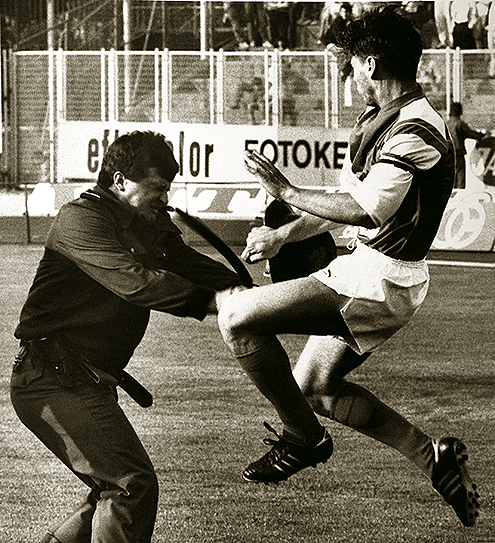 THE MOST FAMOUS HIT FROM THE STADIUM: Zvonimir Boban hits militiaman Refik Ahmetović

 HITTING ON AND OFF THE FIELD: 193 injured, 20 criminal and 60 misdemeanor charges
 UNSEEN SCENES UNTIL MAY 13, 1990: Showdown in the stands...
 ...and the demolition of the police tanker
Jabari Parker and Partizan terminated the contract by mutual agreement, which ended the saga that marked his stay in the black and white jersey

In the elections on May 5, 1935, the government and opposition lists were voted on. Before the elections, the government intimidated teachers and scholars with dismissals and arrests, called opposition candidates Ustasha allies and accused them of organizing the assassination of the king, prevented foreign journalists from reporting...

As if by pattern, the same thing that is happening now on Novoj.rs, happened on Television Novi Sad in October 1990.

Vesna Lalić, an excellent photographer, has passed away. She photographed all the most important social and political events in Serbia, as well as seemingly ordinary everyday moments.

It sounds incredible, but it's true - AI worms could soon spread through home devices

There is, literally, no difference between the one who claims it is day in the middle of the night, or the one who claims to be a giraffe, from the claims we read on billboards: that Vučić is working to unify Serbs and that Serbia is doing better and better day by day.

The pre-election arrests due to the alleged "overthrow of the state" testify to the regime's panic. The bad news for them is - they can't arrest the whole people who decided to defend themselves from progressive beatings and election theft

The ring that tightens around Ćaciland Student list is getting narrower. Because there are more and more spoiled people who see the false prophet for what he is: a street obscener who is fighting Serbia

The archive of the weekly Vreme includes all our digital editions, since the very beginning of our work. All issues can be downloaded in PDF format, by purchasing the digital edition, or you can read all available texts from the selected issue.
See all