What is today called the "Cyprus model" is actually a frozen conflict which, as things stand now, will be difficult to resolve so that both parties are satisfied. The Turks (that is, the Turkish army) have no intention of withdrawing from the island, and the "freedom for Famagusta" posters all over the southern part of the island clearly state what the Greeks think about it. This region is an eternal symbol of conflict and a signpost that should warn of which way to go
Fifteen kilometers from Ayia Napa, a popular resort mostly for young people looking for alcohol and a good time, is Devrinja, the city a refugee. A place, because one cannot speak of a city, not so much because of the number of inhabitants, which is certainly higher than in a large number of Serbian towns, but because of the very structure of Devrinja. Crazy streets, without a center, with a few local cafes. It becomes evident very quickly that tourists rarely go there; the scowling looks of the stooped locals playing backgammon, partly out of curiosity, but also in amazement give the impression that they don't understand what someone from the outside is doing there.
Devrinja is close to the border. For some - borders, administrative lines for others, and green lines for international actors. It is not difficult to guess who views the first two divisions. The Turkish population of Cyprus, which with the help of the Turkish army declared the Turkish Republic of Northern Cyprus in 1974 (which only Turkey recognized), sees it as a cemented border between the two countries, while the Cypriots (that is, the Greeks from the Republic of Cyprus) do not recognize the occupation, and nor its only neighbor, nor the rest of the international community.
CONFLICT AND CONSEQUENCES
The border was formed at the end of August 1974 and has not changed until today. When the Turkish army first landed in Cyprus, it occupied only about three percent of the territory. The resistance of the National Guard proved to be tougher than the Turks expected. However, it took them less than a month to consolidate and launch a new offensive that ended with the occupation of a third of the island. The help of the Greek motherland was absent to the extent that the Greek Cypriots expected, and the National Guard itself, supported by various units, could not match the already solidly equipped and trained Turkish army. But let's start in order.
The most important political figure in Cyprus after the declaration of independence from the British in 1960 was President Makarios III, otherwise the archbishop of the Orthodox Church of Cyprus. Although he himself was a supporter of the Hellenistic union (unification of Greece and Cyprus), he was not convincing enough for the Greek authorities, primarily due to the lack of nationalist charge that was raging in the military junta that was ruling in Athens at the time. On the other hand, Cypriot militant organizations, labeled as terrorist in some sources, especially EOKA B, enjoyed the sympathy of the Greek authorities. Everything culminated in an orchestrated military coup by the Cypriot National Guard and the overthrow of Makarios, who, with the help of the English, left the island at the last moment.
The support that Makarios enjoyed among the people is best evidenced by the two hundred thousand people who accompanied him to his eternal rest a few years later. He was buried on Mount Trodos, in the central part of the island, next to the Kikos Monastery. The new military government in Cyprus hastened preparations for unification, which the Turkish minority on the island did not like at all, and the first conflicts occurred. As it usually happens in conflicts based on ethnic and religious grounds, civilians suffered the most, which Turkey will use as a pretext for the invasion that began at the end of July.
The ethnic picture of Cyprus looked completely different then. The north was mostly inhabited by Greeks, just like Famagusta (important for the rest of the story). The Turkish population lived in enclaves, mostly in the middle of the island, but also in the south, including the old cores of some port towns.
PRIPJAT ON THE MEDITERRANEAN
photo: ap photoDIVIDING LINES: Everyday life in Cyprus
Devrinja belongs to the Famagusta region. Turks call it differently - Gazimagusa. In the northeast of Devrinja, there is one house that does not look different from the others, but it is located along the "green line" itself, although, according to Google maps, it is also on no man's land. The first thing that is noticed are the hand written signs that photography and recording are expressly prohibited for security reasons. Namely, at a distance of several hundred meters, there are Turkish military positions. In between is a clearing, low vegetation, completely scorched by the sun and dried. It looks as if it had burned, but it didn't: only the fire of war was raging there. Next to the house there is a clumsily constructed observation tower, which is also a small museum. The thing is this: when the Turkish army occupied 34 percent of the territory of Cyprus in the second military operation, one of the residents of Famagusta escaped right here, leaving everything he had. He somehow built a house (and an observation tower), and now he offers foreigners to observe the occupied part of Famagusta, his hometown, with binoculars. For a few euros you can look through binoculars, drink local Cypriot coffee (which is not much different from what we call Turkish) and eat a sandwich.
The view, on the one hand, is really impressive. On the other hand, it is disturbing, because it is a living testimony of human stupidity and the then Cypriot military government, supported by Greek nationalists from the military junta, which thoroughly massacred the Turkish population of the island, as well as the Turkish state, which occupied foreign territory against all rules of international law.
What is today called the "Cyprus model" is actually a frozen conflict that, as things stand today, will be difficult to resolve so that both parties are satisfied. The Turks (that is, the Turkish army) have no intention of withdrawing from the island, and the "freedom for Famagusta" posters all over the southern part of the island clearly state what the Greeks think about it. This region is just an eternal symbol of the conflict and a signpost that should warn which way to go.
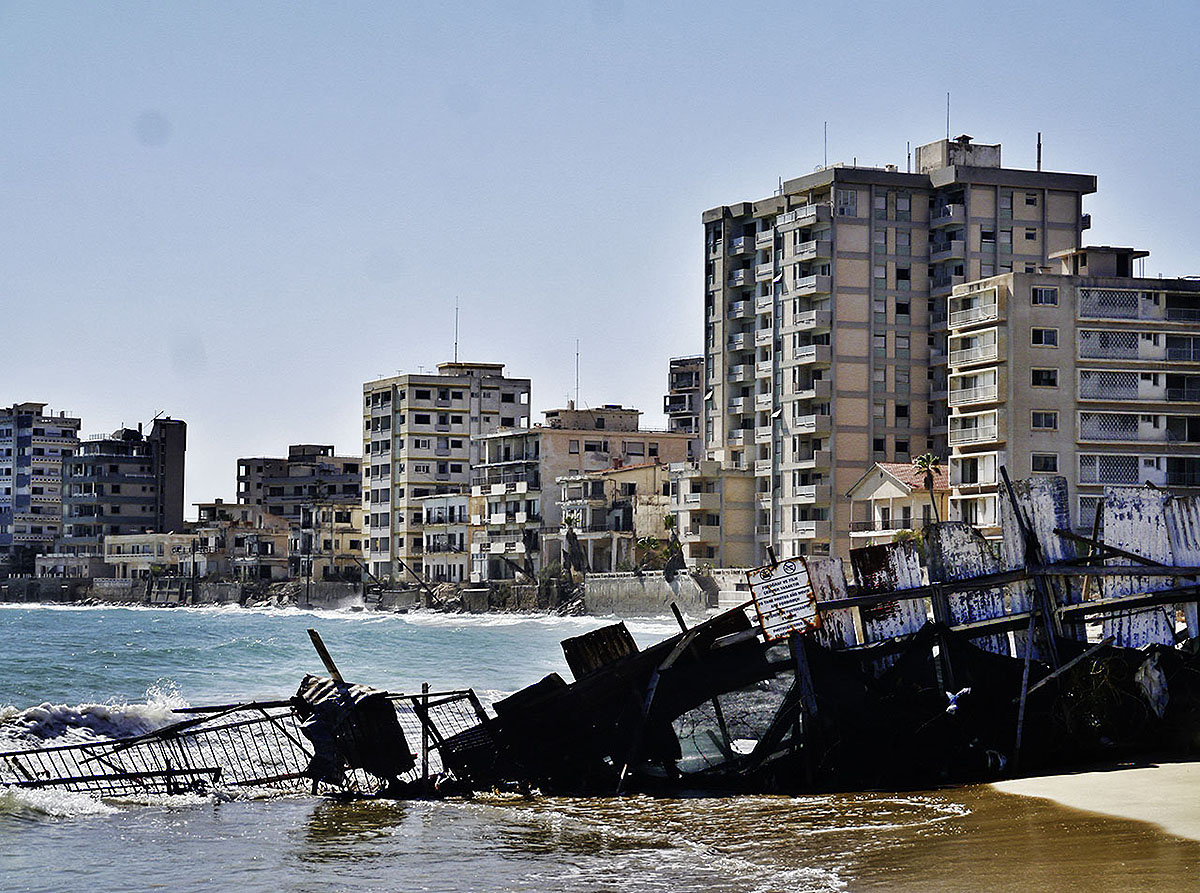
However, what attracts the most attention is Varosha, in Turkish Maroş. Old Famagusta has been repopulated, but the former famous resort of Varosha looks like Chernobyl's Pripyat. Abandoned buildings, cars in the same place where they were left in 1974, once crowded beaches are now overgrown with weeds. A ghost town, the gloomy fate of a historical epicenter. Famagusta, by the way, traces its roots back to the Middle Ages. It used to be the richest region of Cyprus, primarily thanks to the fact that for centuries it was an indispensable port on the Mediterranean trade routes. The city was founded more than two hundred years before Christ, when a descendant of one of the generals of Alexander the Great built a small port right there. It is concentrated around the medieval fortress, built in the 15th century, which significantly set it apart from Larnaca and Limassol, which have practically no historical value. In history, it was under the control of the Venetians, it was the last bastion of defense against the Ottoman invaders, then it was occupied by the Turks, and later, when the "sick man from the Bosphorus" had already fallen ill, the British flag flew over Famagusta.
TOWN, WAR RECONSTRUCTION
As the Turkish minority in Cyprus was distributed throughout the island, and the Turkish army conquered what it could, i.e. where the defense was weakest, the relocation of the population was inevitable. The Greeks left the north of the island, while the Turks from the south and from the enclaves that remained in the southern part emigrated to the north. Today's ethnic division into North and South is actually quite simplified – the result of drawing lines on a military rather than a demographic map.
The Turkish army, which is still deployed around the Green Line, did not open Varosha to visitors until 2020. Of course, with long-term mediation and persuasion of United Nations negotiators. Now there are adventurous tourists on the beaches, lovers of abandoned urban areas who bathe with a view of barbed wire and collapsed residential buildings. Although it is close to Ayia Napa, Varosha can only be visited from the Turkish side. It is necessary to pass the checkpoint, cross no man's land, enter the center of Famagusta, and then head to Devrinja from there. Basically, a day trip. When you consider that temperatures in Cyprus exceed 40 degrees Celsius during the summer, a car is the best (practically the only) option. The trouble is that most car rental agencies strictly forbid customers to leave the Republic of Cyprus.
A good part of this quarter can be walked through the deserted streets, while some parts are still closed, fenced with wire and accessible only by Turkish guards who occasionally patrol near the separation line. Beach chairs and umbrellas can be found on the beaches today, but you can't escape from the abandonment of the city. Greek Cypriots who lived there are not allowed to return. And they have nowhere to return to.
Varosha's very existence, or rather non-existence, for the last half century requires a visit. It is a reconstruction of the war in the open, it bears witness to two times - what it was like in peace and what it was like in war. Although the conflict as such has ended, freezing he doesn't allow Varosha's wounds to heal, he is too close to both sides. Therefore, her misfortune remains a beacon for the few who still dream that the unification of Greeks and Turks in Cyprus can happen again.
What is happening in the country and the world, what is in the newspapers and how to pass the time?
Every Wednesday at noon In between arrives by email. It's a pretty solid newsletter, so sign up!
Like before Caro Claire Burke not only exposed the false image of a traditional woman in America, but also showed the level of women's rights in general - feminists claim. This novel is a direct attack on the traditional way of life - according to conservative Christian women
Forty years of a hairy creature who survived a nuclear disaster on Malmak, and everything he knows about America he learned from an advertising-paid program
In the underdeveloped south, where the saying Pyrrhic victory was born, where 813 men were killed because they did not want to convert to Islam, where the ancient Romans saw war elephants for the first time and many other unrepeatable things
Kristaps Porzingis retires from the court due to health problems. He was previously diagnosed with POTS, a syndrome that can cause exhaustion, dizziness and a rapid heart rate
At the moment when the institutions of the Republic are destroyed, when Vučić's octopus is still alive, when people are disgusted by the injustice and the stench left behind by the Essenes regime, we have, as Machiavelli said, only civic virtue as the fuel with which we can return to the beginning
The four independent members of REM are an example of perseverance and civic responsibility. Rodoljub Šabić even, upon leaving the premises of REM, after the sentencing of the Informer, experienced that the Essenes insulted him, hit him with their hands and feet. But that too will soon be over
Vučić pardoned the batterers and Dijana Hrkalović. The election winners should abolish the sultan's power that allows one man to run afoul of the entire judicial system
The archive of the weekly Vreme includes all our digital editions, since the very beginning of our work. All issues can be downloaded in PDF format, by purchasing the digital edition, or you can read all available texts from the selected issue.