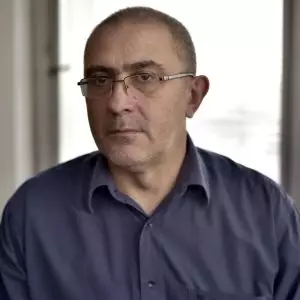
Melancholy of the machine je book philosophical reflections about us and artificial intelligence. Its author is Dr. Divna Vuksanović, a professor at the Faculty of Dramatic Arts, an expert in philosophical and media research on artificial intelligence, and the author of numerous literary works.

......
Exploring the boundaries between human and artificial, from identity in the era of late capitalism to the ethics of autonomous systems, digital totalitarianism, modern wars, art and aesthetics, Divna Vuksanović tried to shed light on the transformation of the relationship between man and technology. At its center is the dialectical relationship between technology and freedom, rational and emotional, algorithm and memory.
"WEATHER" Which is why machines are melancholic, as the title of your book says?
DIVNA VUKSANOVIĆ: The title should not be taken as an assertion that machines are literally melancholic. On the contrary, the point is to move and change the place between man and machine in the modern technical environment. Melancholy here primarily refers to the human experience of loss - the relationship to the object, to oneself and to the meaning of existence, which is a classic observation, meant both in a psychoanalytical and in a philosophical interpretive key.
In the modern technological context, a paradoxical process occurs: people behave more and more as if they are part of automated Systems VI, while machines are increasingly "humanized". Therefore, artificial intelligence is not some kind of neutral technical infrastructure, but it becomes a place where the exchange between human and technical entities intensifies. Melancholy can therefore be understood as an aesthetic and aesthetic category, i.e. as the way in which the loss of meaning, object and stable identity appears in contemporary cultural forms. It is not a label for a mere psychological state; it is a way of articulating an epoch-making transformation of the relationship between man, the world and technology.
Is there room for panic?? Is the problem in "humanizing" machine or in the resulting possibility that people, relying on them, stop developing their own personal, scientific, creative and mental capacities?
The issue of (media) panic regarding artificial intelligence is often misplaced because it starts from the assumption that the problem lies in the "intelligence" of machines. The essential question is, in fact, how the cognitive framework and social relations change through AI, since artificial intelligence does not act only as a technological tool, but also as the basic infrastructure of today's interpretation of reality. At the same time, the risk does not lie in the fact that machines will "take over" human activities, but in the gradual transformation of the way in which decisions and knowledge are formed. This can already be seen in the everyday use of algorithmic recommendations - from the selection of clothes, movies and music on streaming platforms, to navigation and optimization of flight routes - whereby individual choices increasingly rely on pre-structured models and not on immediate understanding of the situation.
In the book you make a distinction between reason, which has a role in analyzing and handling data (which we share with artificial intelligence), and mind, who asks questions about himself, the world and the relationship between the two (which is characteristic only of humans). How to show that relationship more clearly, or how long the machine can, and where "he can't come"?
I understand the difference between reason and mind as differentiating the operational and reflective dimensions of thinking. Reason, according to my understanding, implies the ability to process, analyze and connect data, and in this sense there is a partial comparability between human thinking and the operation of the VI system. Mind, however, means the ability to ask questions about meaning, about one's own assumptions and the limits of one's own knowledge. It is a reflective level of thinking that is not only technical, but also existential, cultural and historical in nature. Therefore, the boundary between man and machine is not in the "speed" or "accuracy" of the performed operations, but in the ability of self-reflection, as well as in the capacity for ethical and aesthetic judgment and creativity.
Do you think we have gone deep into transhumanism?, without us even noticing it?
Transhumanism is a process that does not need to be clearly ideologically articulated in order to be operational. In this sense, the elements of transhumanist logic - the merging of the technical and the biological, the extension of human cognitive abilities through technology - are already present in everyday technological and social relations. Therefore, the real question is not whether we have "entered" the era of transhumanism, but to what extent we are already living it.
With the help of artificial intelligence, everyone can become an artist today. Will the artists be drowned out by the cacophony of creators VI?
Today, with the help of artificial intelligence, almost anyone can generate "artistic" content, which changes the very structure of the field of art. The production of VI is, in fact, often manifested through the forms of the so-called "high" kitsch, which, after all, is not alien to a large part of contemporary production within the so-called creative industries. But I think that soon there will be a clearer separation between creative industries and art in the narrower, authentic sense of the word. The first will largely be able to be automated and replaced by generative production systems, while the second sphere will remain tied to authors acting independently or in collaboration with technology. Accordingly, I would not talk about the "disappearance" of artists, but about the restructuring of the field of art: part of the production will be made up of industrial and algorithmic logic, while the other part will be concentrated around the authentic creative act, which can be human or hybrid, but will certainly remain tied to a specific type of authorship and experience.
As a member of the Board of Directors of the Aesthetic Society of Serbia, you are trying to contribute to the development of culture and the gathering of contemporary artists. How to oppose scams and reality shows in our public space?
I don't see the shund phenomenon as a simple opposition of "high" and "low" culture, but as a question of the way in which what becomes visible in public space is determined. In modern media formats, including reality shows, there is a shift in the boundary between private (personal) and public, whereby private life is transformed into a spectacle. However, the role of cultural institutions is not in the moral prohibition of such phenomena, but in an attempt to preserve and affirm spaces for reflection and critical thinking in contemporary culture. The problem, then, is not the shund as such, but the disappearance of the space in which one can think at all.
Real journalism costs money, and we will not be bought by tycoons and corporations. Support us with a one-time or monthly donation. The time for it is now!