Their names cause fear. It is not necessary to know the structure of the atomic nucleus or to understand the force of the chain reaction, it is enough for someone in the room to say one of those terrifying words - Hiroshima, Chernobyl, Fukushima - the evil spirits of nuclear physics will immediately emerge from the dark corners. The dramatic history of the nuclear era is described in the book Alchemy of the Bomb Slobodan Bubnjević through twenty such terrible toponyms, diverse locations on the planet where the use of atomic energy left permanent scars and grew into symbols of modern times. The weekly "Vreme" brings excerpts from chapter 13, dedicated to the creation and development of the Vinca nuclear institute
The RA reactor will operate in a trial mode for three years, and after the overhaul in 1963, it will start working continuously from 15 to 18 days a month, achieving 30.000 MWh of operation during each month. The number of employees at the reactor during this period was 120. However, as time passed, and the idea of building a bomb was suppressed, the number will decrease significantly.
48- Alchemy Frontpage...
In the most influential work on the role and importance of nuclear research in Vinci, Tito's Nuclear Legacy, a historical review published in the middle of the second decade of the 21st century, states that Yugoslavia built Vinča with the aim of developing Yugoslav nuclear weapons, and that it is a "mystery" why Tito gave it up during the sixties. But just as the project was never officially launched as a project to build a Yugoslav bomb, Vinča never officially changed that unspoken purpose either. It continued to serve the development of science, although with the arrival of the sixties, the original passion of the ruling structures apparently disappeared.
However, for a country constantly balancing between two blocs, Vinca is already a good bet. That's why Vinča is slowly gaining another, concrete purpose in diplomatic affairs - the very existence of an experimental reactor in Yugoslavia manages to demonstrate its prestige to foreign guests, and Yugoslav leaders plan to organize shows about the high level of development of domestic nuclear physics.
That's why Vinca literally becomes part of state protocol in this era. Delegations that come to visit Yugoslavia are routinely taken to Vinča, where Tito and his associates show them the achievements of Yugoslav science, which is a guarantee of the power of a country that lives alone between blocs. Year after year, Vincha is visited by influential leaders from all over the world - Soviet leader Nikita Khrushchev, with whom Mikoyan and Bulganin come to the institute on the banks of the Danube, then the Secretary General of the United Nations, Dag Hammarskjöld, and then the Secretary General of NATO, Paul Henri Spack . The visit of the Emperor of Ethiopia, Haile Salasius, was organized with special care in Vinci.
INSTITUTE IN VINCI…laboratories…
Vincha is also visited by the controversial Egyptian leader Gamal Abdel Nasser, then numerous leaders from Greece and Turkey, as well as Indonesian leader Ahmed Sukarno, Indian leaders Indira Gandhi and Nehru, Afghan king Mohamad Zahir, Cambodian king Sihanouk, as well as dozens of other leaders from all over the world. . All these guests of Tito, lavishly welcomed, in Vinci can see live the forces that caused Hiroshima. Some are infected by this magic hidden in the nuclear core that Yugoslav physicists tell them about. Others can't help but wonder what else is out there that hasn't been shown to them. That's why they leave convinced that Yugoslavia can easily be both East and West, and maybe even make an atomic bomb, if it wanted to. With such a successful performance, Yugoslavia does not need the bomb itself.
At the same time, the focus of the institution shifts to new goals. Over time, nuclear physics becomes only one of the fields of research, intensive development of other fields of physics also begins, and as the decades pass, the whole of physics increasingly gives space in Vinci to other sciences, which can be seen in the new structure of the institute. In an abundant analysis of the history of the development of this institution, one of the directors, Zdenko Dizdar, thus divides the history of Vinča into two eras: the phase of the nuclear concept from 1948 to 1968 and the phase of the mixed concept from 1968 to 1998.
NON-ALIGNED MOVEMENT
The development of Vinča was decisively influenced by the establishment of the Non-Aligned Movement and the peaceful, anti-bloc orientation of SFR Yugoslavia in the 1960s. Members of the Non-Aligned Movement, poor former colonies and, logically, non-nuclear countries, actively advocated stopping nuclear proliferation. Since Yugoslavia played a leading role in the movement, it was expected that it would not develop its own nuclear weapons project (although, with an enviable military industry and a huge military budget, it liked the status of a country that could build a bomb).
After the bomb was quietly abandoned in the 1970s, which has since been only a show, in XNUMX Yugoslavia officially acceded and signed the NPT agreement, declaring itself as a country that opposes and will not develop a nuclear bomb. In the meantime, the reactor, outwardly resembling a yellow metal cylinder as tall as a two-story house, contributes not only to diplomatic needs but also to the great development of Serbian physics.
HIGH RADIOACTIVITY ZONE…and the hallways,…
However, its role regained its military importance a decade later, when - as stated in Tito's Nuclear Legacy - In 1974, Yugoslavia suddenly "renewed its interest" in building a bomb and was active in this field until 1984. That's when India detonates its nuclear device, and since this country is Yugoslavia's rival in the non-aligned movement, the Yugoslav leadership, despite the NPT, launches a very specific military nuclear program. Now he relies not only on Vinča, but also on numerous institutes that have since been established in Serbia, Croatia and Slovenia. However, the reactor is the center of the operation, so in 1976, instead of low-enriched uranium, new fuel segments with 80 percent enriched uranium dioxide were purchased from the factory in Novosibirsk, so that the reactor would completely switch to highly enriched fuel in 1980.
But compared to similar federal operations, such as the production of the Yugoslav jet plane or the construction of the prestigious Yugoslav M84 tank, the nuclear program is poorly organized. His role in relations with other countries is undoubted, but the question is whether at any moment he represented anything more than "throwing dust". Military nuclear programs A and B, as they were called, were used by researchers in the meantime to get funding from them for their various researches, while the construction of the bomb did not get anywhere until the mid-XNUMXs. The programs were then shut down.
BOMBING
56-07…entrance to the RA reactor
Over the years, and especially after the termination of SKNE, Vinča is occasionally required to do something concrete, including more intensive participation in peacetime programs and energy development. Along with the work of other Yugoslav institutes, a plan is being made to build more nuclear power plants. However, as we will see, after Chernobyl, that plan is also abandoned, a local moratorium is introduced in Serbia and Yugoslavia, and the construction of further nuclear capacities is prohibited.
The reactor operated until August 1984, when it was stopped for reconstruction and fuel replacement. However, it was never launched due to, as they say in "Vinca", "numerous technical, administrative and political reasons", and that is how it will meet the end of Yugoslavia, when the institute becomes the property of Serbia, which inherited its old glory, but also certain unpleasant mortgages . Spent fuel, which can be very dangerous, is temporarily stored in the reactor building itself. Although a good part of the system has been dismantled, the reactor and the stored uranium have become a convenient toy for thinking about whether an atomic bomb can be made on the Danube, which is an old illusion from Vinča, but now it is not used by the authorities in Belgrade, but by its enemies.
In the finale of the disintegration of Yugoslavia that marked the nineties of the 20th century, Serbia, together with Montenegro, due to the conflict in Kosovo and the controversial decisions of the then leader Slobodan Milosevic, entered the war with the NATO pact, not only as the only non-nuclear country that engaged in it, but also the only one without nuclear allies or at least the support of a nuclear power. Under these circumstances, in the spring of 1999, while NATO was carrying out massive and devastating bombing campaigns throughout Serbia, Vinča became a political topic again.
The Western press raises the issue of Tito's nuclear institute. Several newspapers in the USA publish articles claiming that the regime in Serbia at the time had enough fuel to make two atomic bombs. The information, although part of the war propaganda, is actually correct - the stored enriched fuel of the RA reactor could indeed be used for military purposes, but when the great Yugoslav state failed to do so two decades earlier, it is difficult to imagine that, even if it had tried, the crisis and war-torn Serbia has only ever succeeded in this. However, the nuclear stake, which the Yugoslav communists skilfully used in negotiations with the great powers, became a dangerous burden for Serbia, and even one of the additional excuses to continue being bombed.
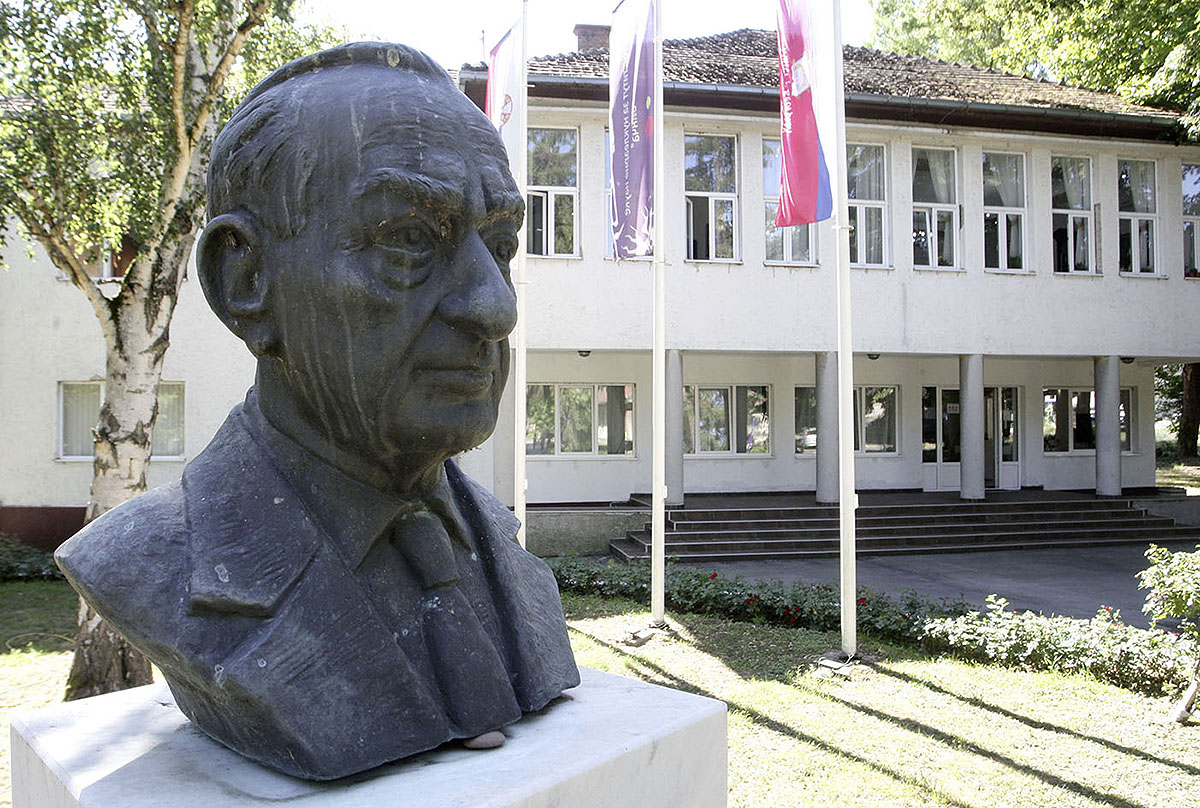
photo: milovan milenkovićOLD GLORY AND PRESENT STATE: "Vinča" Institute
That's why, in the post-war epilogue, after the change of government and democratic elections, Serbia, by all accounts a non-nuclear country, decided to systematically clear out the remnants of the Yugoslav nuclear program. After the war, researchers from Vinci were actively involved in cleaning up the sites where NATO had dropped bombs with depleted uranium. However, despite the success of this venture, Vinča in Serbia has an incomparably lower status than the one it had in the federation - in the following years, the institute was divided into two units, a research part and a utility company for nuclear waste. Foreign officials and local leaders no longer visit him - a visit by a minister or state secretary is now an extremely rare event. Talented students bypass it, and more distinguished professors and researchers have long since transferred to universities and the Institute of Physics in Belgrade, where top science is developed.
Meanwhile, in order to remove any doubt about the non-nuclear policy, the reactor fuel was removed from Vinca and returned to its country of origin. In July 2002, the Serbian government, namely, made the final decision on the permanent cessation of operation of the RA reactor and on decommissioning, as the dismantling of such a nuclear machine is professionally called. Then Prime Minister Zoran Đinđić organized the transport of unspent uranium to the country of origin, Russia. Transport to the warehouse in the Russian city of Ulyanovsk was organized at night, and footage of this operation was broadcast on television as soon as the fuel left Serbia. The action was realized with financial assistance from the USA of about 700.000 dollars and with the cooperation of the Russian Federation. With the removal of the reactor fuel, in the last act of Tito's nuclear show, the Yugoslav illusion about the bomb also left Vinča.
What is happening in the country and the world, what is in the newspapers and how to pass the time?
Every Wednesday at noon In between arrives by email. It's a pretty solid newsletter, so sign up!
Like before Caro Claire Burke not only exposed the false image of a traditional woman in America, but also showed the level of women's rights in general - feminists claim. This novel is a direct attack on the traditional way of life - according to conservative Christian women
Forty years of a hairy creature who survived a nuclear disaster on Malmak, and everything he knows about America he learned from an advertising-paid program
In the underdeveloped south, where the saying Pyrrhic victory was born, where 813 men were killed because they did not want to convert to Islam, where the ancient Romans saw war elephants for the first time and many other unrepeatable things
Kristaps Porzingis retires from the court due to health problems. He was previously diagnosed with POTS, a syndrome that can cause exhaustion, dizziness and a rapid heart rate
At the moment when the institutions of the Republic are destroyed, when Vučić's octopus is still alive, when people are disgusted by the injustice and the stench left behind by the Essenes regime, we have, as Machiavelli said, only civic virtue as the fuel with which we can return to the beginning
The four independent members of REM are an example of perseverance and civic responsibility. Rodoljub Šabić even, upon leaving the premises of REM, after the sentencing of the Informer, experienced that the Essenes insulted him, hit him with their hands and feet. But that too will soon be over
Vučić pardoned the batterers and Dijana Hrkalović. The election winners should abolish the sultan's power that allows one man to run afoul of the entire judicial system
The archive of the weekly Vreme includes all our digital editions, since the very beginning of our work. All issues can be downloaded in PDF format, by purchasing the digital edition, or you can read all available texts from the selected issue.
Their names cause fear. It is not necessary to know the structure of the atomic nucleus or to understand the force of the chain reaction, it is enough for someone in the room to say one of those terrifying words - Hiroshima, Chernobyl, Fukushima - the evil spirits of nuclear physics will immediately emerge from the dark corners. The dramatic history of the nuclear era is described in the book Alchemy of the Bomb Slobodan Bubnjević through twenty such terrible toponyms, diverse locations on the planet where the use of atomic energy left permanent scars and grew into symbols of modern times. The weekly "Vreme" brings excerpts from chapter 13, dedicated to the origin and development of the Vinca nuclear institute, in four installments.