Nagasaki, a city in western Japan, was razed to the ground on August 9, 1945, when the US dropped a plutonium-239 isotope bomb weighing about five tons, nicknamed "The Fat Man." For decades, the dropping of the atomic bomb on Nagasaki was considered the event that ended World War II. Is it really so?
Death is often cruel and brutal. But she can also be cynical. In a Japanese seaside town Nagasaki, on August 9, 1945, tens of thousands of people lost their lives. Some vaporized or burned within seconds, some were pierced by shards of glass, while others were buried by parts of buildings. Many were exposed to radiation and died slowly - sometimes after decades of suffering.
That second atomic bomb, which was dropped three days later dropping the bomb on Hiroshima, was not actually intended for Nagasaki – much less to explode right over a church, he writes Deutsche Welle (DW).
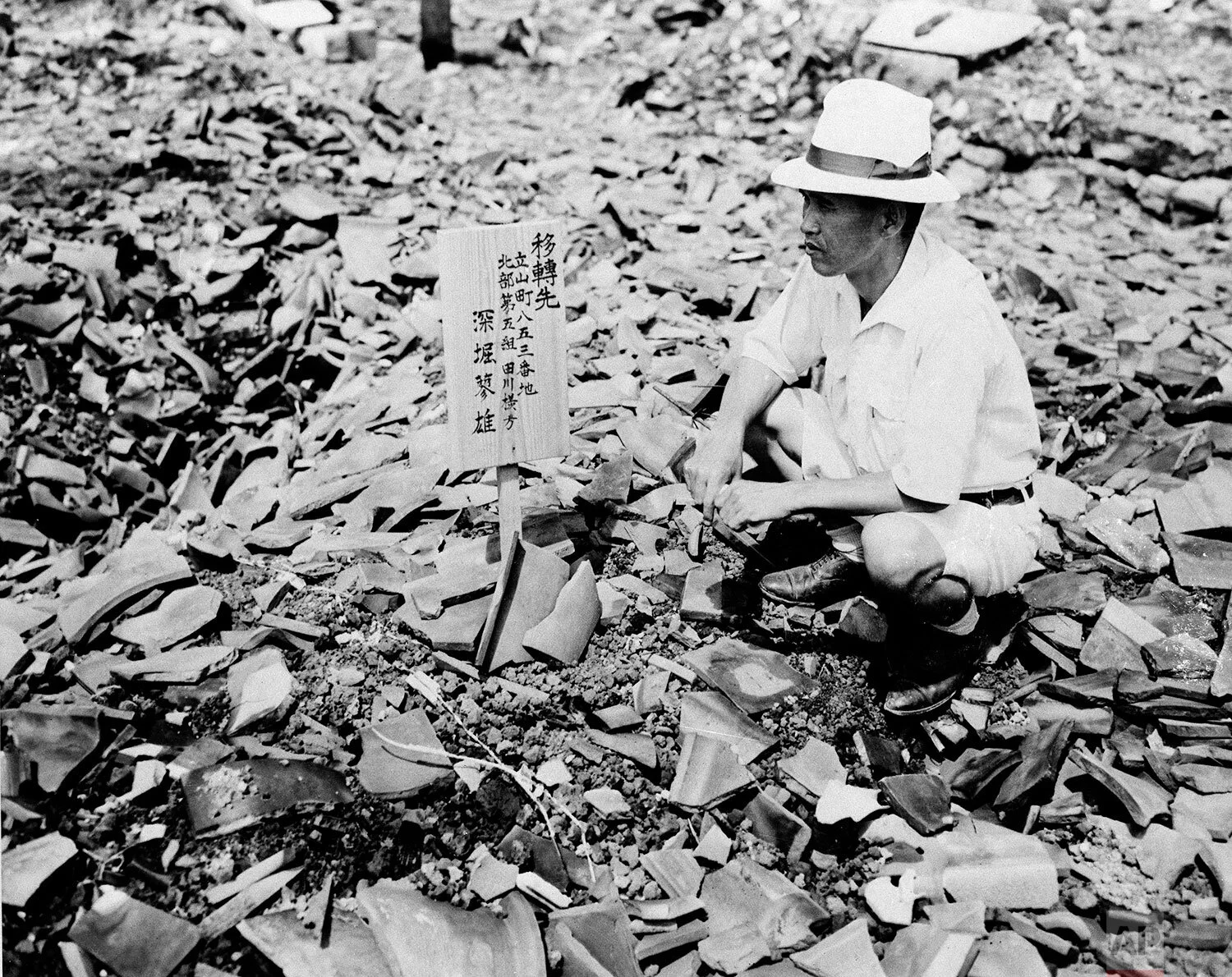
Photo: AP PhotoRemains of the Catholic church in the demolished city
The good weather was a killer for Nagasaki
The U.S. military initially targeted the city of Kokuru, the center of Japan's military industry, but it was covered in thick clouds that day. The crew of the American bomber tried three times to attack, before finally dropping the bomb. With the tank almost empty, they flew to the nearest American base.
"All we wanted was to get rid of the thing," said William Barney (1923 - 2016), one of the crew, when he was already over ninety years old.
That "thing" claimed the lives of 70.000 people who were unlucky enough to have a clear day on August 9.
Barney is one of the many witnesses, soldiers and historians interviewed by award-winning reporter Klaus Scherer for his book Nagasaki – The Myth of the Crucial Bomb (2015).
The most poignant are the parts where the survivors talk about the day that changed their lives forever. Chieko Ryu tearfully describes how she recognized her mother's body, reduced to ashes, only by the nearly melted tortoiseshell hairpin.
"I touched her foot," she said. "But it crumbled immediately, like dry sand."
Chieko Ryu, who is in the iconic photograph taken the day after the atomic bombing of Nagasaki in 1945, passed away on August 15, 2020 at the age of 90.
Like Chieko, the other witnesses experienced the moments after the explosion as an apocalyptic nightmare. Many, as Sakue Shimohira testifies, could not bear it - and committed suicide.
Photo: AP PhotoA third of the city was destroyed by an atomic bomb
Deconstructing the myth of the decisive bomb
Giving a voice to surviving victims, restoring their dignity is one of the key themes in Scherer's brilliant book.
But even more important is the deconstruction of a myth: that both atomic bombs were necessary to end World War II. Klaus Scherer, who as a correspondent lived for years in Japan and the USA, disputes that claim - and shows that it actually got its "power of definition" only a year after the end of the war.
In the American archives, he discovered two "United News" weekly newsreels - one from 1945 on the end of the war, and the other from 1946 on the occasion of the anniversary - which unequivocally confirm this.
A report from 1945 states that Japan was already demoralized and militarily defeated before the destruction of Hiroshima and Nagasaki. Conventional bombs have already leveled 66 cities. Completely destroyed cities, shipwrecks, industrial ruins are shown.
"At the end of that report," writes Scherer, "the authors allow themselves the startling sentence: 'Scenes like these leave no doubt that Japan was completely defeated even before the atomic bomb.'"
What changed in 1946 compared to 1945?
A year later, the tone of the coverage has completely changed. Images of "Japanese soldiers marching in formation, long lines of polished cannons, as well as fighter planes and amphibious vehicles ready for action" are shown.
The film chronicle states that the first atomic bomb "just left the Japanese speechless." The turning point, it is claimed, came only with the bomb dropped on Nagasaki. "That was the final blow. That's when they capitulated," the report said.
"Within a year, the real or imposed perception of the end of the war was completely turned upside down," Scherer concludes. "The atomic bomb as a wonder weapon – technically impressive, strategically necessary and morally justifiable. That's how the world was to see it in the future."
What is clearly seen from the comparison of the two chronicles is increasingly becoming the dominant opinion in historiography: neither the bomb on Hiroshima nor the one on Nagasaki was necessary to end the war.
The real turning point was the declaration of war on Japan on August 8 by the previously neutral Soviet Union.
Why?
But the question arises: why were both bombs dropped anyway? And why was their effect, both from the American and Japanese sides, declared decisive for the end of the war?
Scherer offers more answers. The use of atomic bombs in war has given scientists far deeper insights into their effects than desert tests.
And since the bombs were of different construction - the first was made of uranium, the second made of plutonium - it was "necessary" to try both. So, an experiment on humans.
In addition, American President Harry S. Truman, faced with increasing war fatigue in the United States, wanted to avoid a bloody and prolonged invasion of Japan by ground troops at all costs - but also to avenge the defeat in Pearl Harbor.
The use of the bomb was also a demonstration of power towards the Soviet Union – just as the anti-fascist coalition was beginning to disintegrate and the beginning of the Cold War was looming.
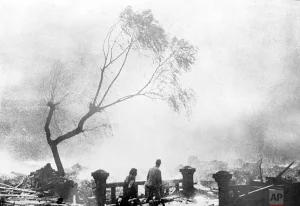
Photo: AP PhotoThe survivors leave as a fire rages in the background
Favorable interpretation – for the perpetrators
But why did Japan accept this interpretation? Scherer quotes American researcher Ward Wilson, who in his book ("Five Myths About Nuclear Weapons", 2013) offers a surprisingly simple answer: it was convenient - at least for the perpetrators.
The myth of the miracle weapon allowed the Japanese to avoid the painful analysis of their own wartime past.
If we put ourselves in the position of Emperor Hirohito or some other high-ranking Japanese politician or general who led the country through a disastrous war, the point becomes clear. "The economy is in ruins. Eighty percent of the cities have been bombed and burned. The people are starving. What should they do? Should they admit that they made a series of grave mistakes? Or should they attribute the defeat to (...) a scientific breakthrough by the enemy, which no one could count on?"
"We are the victims of two perpetrators"
The victims of the bombs see it quite clearly: "We are the victims of two perpetrators," they say. And Sakue Shimohira turned her survival into a political message: "I had to choose between the courage to die and the courage to continue living," she said.
"So it has become my mission to demand one promise from the world: that we will forever remain the last victims of the atomic bomb."
Big summer discount on "Vreme"! Just click here, choose a subscription and support the editorial staff in their independent work.
What is happening in the country and the world, what is in the newspapers and how to pass the time?
Every Wednesday at noon In between arrives by email. It's a pretty solid newsletter, so sign up!
Like before Caro Claire Burke not only exposed the false image of a traditional woman in America, but also showed the level of women's rights in general - feminists claim. This novel is a direct attack on the traditional way of life - according to conservative Christian women
Forty years of a hairy creature who survived a nuclear disaster on Malmak, and everything he knows about America he learned from an advertising-paid program
In the underdeveloped south, where the saying Pyrrhic victory was born, where 813 men were killed because they did not want to convert to Islam, where the ancient Romans saw war elephants for the first time and many other unrepeatable things
Kristaps Porzingis retires from the court due to health problems. He was previously diagnosed with POTS, a syndrome that can cause exhaustion, dizziness and a rapid heart rate
At the moment when the institutions of the Republic are destroyed, when Vučić's octopus is still alive, when people are disgusted by the injustice and the stench left behind by the Essenes regime, we have, as Machiavelli said, only civic virtue as the fuel with which we can return to the beginning
The four independent members of REM are an example of perseverance and civic responsibility. Rodoljub Šabić even, upon leaving the premises of REM, after the sentencing of the Informer, experienced that the Essenes insulted him, hit him with their hands and feet. But that too will soon be over
Vučić pardoned the batterers and Dijana Hrkalović. The election winners should abolish the sultan's power that allows one man to run afoul of the entire judicial system
The archive of the weekly Vreme includes all our digital editions, since the very beginning of our work. All issues can be downloaded in PDF format, by purchasing the digital edition, or you can read all available texts from the selected issue.