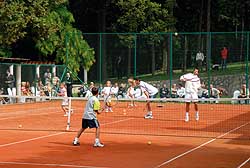
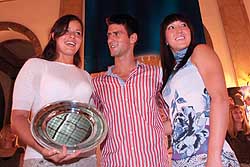
AND THEY STARTED LIKE THIS: Janko Tipsarević and Novak Djoković (Magnified)
Speaking about the state of Serbian tennis in the 1990s, when he and other players known today were starting out, Janko Tipsarević told Reuters: "People should be aware that we achieved everything from nothing - from mud." At that time, there was no big tennis academy, nor a strong tennis federation."
At that time, the head of the tennis association was Radoman Božović, because of which the then coach of our national team, Radmilo Armenulić, resigned. Remembering that era, Armenulić tells Vreme: "He was a man from politics, not sports. Leaving the Alliance, I said that I would return when he left."
Jelena Genčić, our most respected tennis coach - she coached Monika Seleš, Iva Majola, Tatjana Ječmenica, Goran Ivanišević, Sabrina Goleš and Novak Đoković - believes that "there was never enough money for the development of tennis, no matter how many willing people there were", but adds that the biggest problem is the lack of vision for the future of our tennis. "As a coach, I make detailed daily, weekly, monthly and annual work plans for five years in advance for all the children I coach. I think that such plans should exist for all tennis players," says Jelena Genčić.
FAMILY JOB: Due to the lack of conditions for training, most of our today's successful tennis players were forced to go to tennis schools abroad during the nineties. In the absence of sponsors, parents sold apartments and took on debt so that their children could play this sport. Janko Tipsarević said that the only people he and the other tennis players can thank are their families.
Even today, conditions are not much better. Radmilo Armenulić explains that parents are still the main sponsors because clubs and associations do not have funds. About how much money is needed to become a successful tennis player, Jelena Genčić says: "Total annual expenses for tennis players under the age of 13 are from 50.000 to 100.000 dollars, while for those of professional rank they reach up to 200.000 dollars per year."
After this year's Roland Garros, many children will want their parents to enroll them in a tennis school. About what awaits them, Danilo Ristic, professor of physical culture and coach of the tennis school of the old DIF, says: "The English calculated that it is necessary for a tennis beginner to take at least one lesson a day for two years." However, in my experience, for some it is enough, for others too little. In order for someone to master the basic ten elements of tennis, he needs between thirty and fifty hours."
It is also important which school the child enrolls in and what kind of coach he works with. Danilo Ristic explains: "A child can start playing tennis at the age of four or five, but it cannot be real tennis but a 'tennis playground' where tennis is learned through play." There, the achieved results are not evaluated numerically. Otherwise, if the child immediately focuses on competitive play, tennis can destroy the psyche, because the child focuses only on winning, which creates frustration. The coach must not shout or curse the student, which, unfortunately, often happens. Such coaches only hold children back and they leave tennis because of it."
Tennis is considered an individual sport, but how much is it really a result of teamwork? "Maybe I'm wrong, but I believe that everything takes place in the triangle formed by the player, the coach and the parents." Cooperation with parents is essential. Sometimes the father wants the child to devote himself to tennis and the mother to school, so there can be a conflict between them that affects the children as well. Then the coach has to mediate and solve it together with them," says Jelena Genčić. In her opinion, the problem is that our trainers do not want to improve. "I went to see how Nick Bollettieri and other world coaches work, brought foreign literature and realized that many of my colleagues are not interested in it because they think they know everything." I consider this job a hobby, I don't charge for training because I like working with children, but training is necessary."
All the interlocutors of "Vremen" agreed that out of a thousand of those who start playing tennis more seriously, one or two become top players. "Five to six hours of training a day is a big sacrifice. "Tennis is a mining job," says Jelena Genčić.
TRADITION I CURRENT THE SITUATION: Our top tennis players are "young, beautiful, successful and rich" as the Minister of Youth and Sports Snežana Samardžić-Marković said, but apart from such praise there is a lot that the state could do for the development of tennis.
According to Radmil Armenulić, today Belgrade is the only major city in Europe that does not have a quality tennis tournament. "It's a shame that the Gemax tournament, which promised to become significant, was cancelled. In order to organize a good tournament, a prize fund of about 125.000 dollars is needed, but also an adequate schedule considering that the tennis calendar is condensed."
It used to be different, because international tournaments were played in Belgrade before the Second World War. For the first time, tennis was played in Serbia at the turn of the nineteenth and twentieth centuries, and at that time, like everywhere else in the world, it was viewed as a pastime, not as a sport. The players played it in their everyday clothes, so the women played it in floor-length dresses, with hats and in midriffs, and during the game they would lift their skirts with the hand that was not holding the racket to move around the court more easily. The men took off their jackets, but kept their ties, and if they wanted to roll up their shirt sleeves, they had to ask permission from their teammates. The game was much slower than today, and this is evidenced by the fact that a shortened ball (drop shot) was considered an unfair game.
According to the available data, tennis was institutionally played in Palić in 1893 as part of the "Achilles" Sports Society, and in Belgrade a tennis section was established at the First Serbian Bicycle Society. After the First World War, the Šumadija Tennis Club was founded in Belgrade in 1919, whose courts were located in Kalemgedan on the site of today's Partizan volleyball courts, the BOB Tennis Club, which had courts on the site of today's Zvezda tennis courts, and the Belgrade Tennis Club, whose courts were located on the site of the Tašmajdan swimming pool. At that time, international tournaments were played in Belgrade in spring and autumn. There was also a tennis court at the National Bank near the Mint in Topčider. The Novi Sad Tennis Club was founded in Novi Sad in 1922, and the Vršac Tennis Club was founded in Vršac in 1924, which built four tennis courts.
The first tennis player of ours who appeared at the Olympic Games was Djoka Dunđerski, who played at the Olympic Games in Paris in 1924. Our national team first appeared in the Davis Cup in 1927 in a match against India. The first victory in the Davis Cup was achieved in 1930 in a match played in Belgrade; Sweden was defeated 5:0. In 1939, Yugoslavia was the champion of the European zone of the Davis Cup and was declared the third tennis nation in the world, and the players appeared on the world rankings. This success represented the greatest success of our entire sport at that time.
After the Second World War, tennis was given the status of a rich man's sport and those who played it had problems because of it. "I was going to the tennis court when a young squire intercepted me and, saying that I was a bourgeois, stole my racket and broke it." I soon moved to Belgrade, but I no longer played tennis. In the 1990s, I was visiting my hometown and learned that a new tennis court had been built. There I saw a man who brought his granddaughter to tennis lessons. I realized that it was the same player who once broke my racket. He noticed me looking at him and recognized me. I approached him and said: 'Game, set, match for me,'" the interlocutor, who wished to remain anonymous, told "Vreme".
However, after the Second World War, tennis clubs such as Partizan, Crvena zvezda, Vojvodina and many others were founded, which contributed to the development of modern Serbian tennis.
There is not even a tennis stadium in Belgrade today. "I really hope that they will build a tennis center and make it much easier for the young generations, so that they don't have to leave the country to train," said Jelena Janković in an interview with Reuters.
Goran Kreclović, city secretary for sports and youth, says that this problem will be solved: "The national tennis center will be built in Novi Beograd block five, next to the Palace of Sports." "Currently, the conceptual project for the construction of the center is being worked on and the funds for the construction have been secured," says Kreclović.
The tennis federation has modest resources and cannot do as much as the tennis federations of other countries can, as, for example, the French Tennis Federation can, which is considered the best in the world and it is to its credit that the French always have at least ten tennis players among the top fifty in the world rankings.
Radmilo Armenulić says that the budget of our Olympic Committee for the preparation of candidates for the Olympic Games in Beijing in 2008 amounts to two million euros. That sum is divided among all participants, while the Austrian Olympic Committee has 40 million euros at its disposal. That is why the Olympic Committee has gathered sponsors who will help the preparations of our national team members with their funds.
SUCCESS I COMMENT: The state could use diplomacy to make it easier for our tennis players to get visas. Ana Ivanovic tells "Vreme" that she still has to go to get visas in person, although now she gets them for a longer period of time.
When Ana Ivanović and Jelena Janković met in the semifinals of Roland Garros, one of the news items in the RTS central daily was that the organizers of the tournament asked the Embassy for our flag and anthem. If they had won, the Serbian national anthem would have been heard in Paris. However, according to the current law, they would not receive a sports pension based on this, because the Grand Slam tournaments are not valued as European or world championships.
The success of Serbian tennis players at Roland Garros was the topic of the world media. Foreign journalists were the ones who stated that this year's French Open Championship could be called Roland Garosic. The editors of the WTA website (World Association of Professional Tennis Players) published a series of joint photos of Ana Ivanovic and Jelena Janković in front of the Eiffel Tower, opting for a photo of them holding the Serbian flag on the front page of the website, with the comment that they might be in the final and thus achieve "the first Serbian Grand Slam final".
Like the world media, the Croatian media also reported on the "success of Serbian tennis players", which caused controversy among readers on the "Večernji" and "Jutarnji list" websites. One visitor wrote that "sometimes the sun shines under the dog's tail", and others "let those Serbian girls shine a little light". He was followed by the answer that "it is ugly to comment on someone's success - it speaks about the person who is commenting". The polemic that took place among the visitors of the websites of these two Zagreb dailies was perhaps best summed up by the following comment: "And if one of ours was in the semi-finals, I highly doubt that there would be comments like this." The girls are playing very well, that's why they reached the semi-finals, so don't be silly."
The Podgorica dailies did not follow the global trend of reporting on Serbian success. "Pobjeda" brought the news about the entry of Janković and Ivanović into the semi-finals by mentioning only their names, but not the country they are from, while "Vijesti" announced that they are from Serbia, but the article about it was still placed under the title "Furious Belgraders".
The world has noticed the talent of tennis players coming from Serbia, and we have received calls from those who say that there is a special Serbian talent for tennis and that we are, in fact, a tennis nation. When asked by "Vremen" if this is true and how we got such a successful generation of tennis players, the answers of Jelena Genčić and Radmil Armenulić were: "A coincidence of happy circumstances" and "It happened".
The earliest version of tennis, in which the ball was hit against the wall, comes from French monasteries, from which it spread during the 12th and 13th centuries. Players discovered that they had more control over the ball using only their hands, so the use of leather gloves was associated with the beginnings of tennis. The first racket was a wooden pole, and the next step was the transition from wooden to leather balls filled with bran.
During the 16th, 17th and 18th centuries, the game became an elegant sport of kings and nobles, known as "jeu de paumme" - "play of the palm". The players started the match saying "tennis" - "to play". That "royal tennis" was played indoors.
Tennis is becoming popular in Europe, especially in England. King Henry VIII built the court at Hampton Court which is still in use today. At the end of the 18th century, around the time of the French Revolution and Napoleon, tennis lost its popularity, but it regained its popularity already in the 19th century. That's when the first organized clubs were born, and enthusiasts turned it into an outdoor sport. All England Croquet Club wanted to attract a large number of visitors, decided in 1875 to offer tennis as an additional attraction. The new game was a great success, so much so that the club changed its name to All England Croquet and Lawn Tennis Club. In the same year, the first tennis tournament was organized. Thus was born the first Grand Slam, known as Wimbledon.
The first tournament was played in 1875, and among the names of the first winners is William Renshaw, who won the title eight times between 1881 and 1889, a record that is still unbroken.
The tournament was broadcast on the radio for the first time in 1927. In those years, the posh sport was dominated by Fred Perry, Don Budge and Henri Lacoste, and Wimbledon is experiencing perhaps its greatest boom. Among tennis players, long pants were popular as a jersey, while female tennis players wore long skirts and socks - until in 1933, the American Bunny Austin shocked the audience by going out on the court - in shorts.
During the Second World War (1939–1945), the tournament was not held, but at the first post-war tournament, in 1946, the players were last seen wearing long pants. Australian tennis players Rod Laver and Roy Emerson dominated in 1960, when the first television broadcast was organized (the first in color was broadcast in 1967; for a better image on TV screens, yellow balls were introduced in 1986). Björn Borg, Jimmy Connors and John McEnroe dominated Wimbledon in the 1977s; among tennis players Sue Barker, Chris Evert and Martina Navratilova. The last British tennis player to win was Virginia Wade in XNUMX.
Another trademark, Wimbledon rain, you can always watch - from the stands or on the screen.
Tennis is played on a flat rectangular surface 23,77 meters long and 8,23 meters wide (singles), or 10,97 meters wide (doubles and mixed). The net is 1,07 meters high at the posts and 914 millimeters in the center of the court.
The speed and bounce of the ball depends on the type of surface, but it also affects the quality of the game. Hard courts can be concrete, asphalt, wood or covered with artificial grass. The Grand Slam tournaments are played on different courts: the US Open and the Australian Open on hard courts, the French Open on clay courts, and Wimbledon is played on grass.
It is played in two or three sets won; each makes several games, and one game makes several points. Scoring used to correspond to the division of an hour into quarters, four times of 15 points each. Due to the simplicity and attractiveness of the pronunciation of the third point in French, "quarante" (40) was taken instead of "quarante-cinq" (45). French also influenced the pronunciation of zero in scoring. Namely, the English read zero as "love" precisely because of the French "l'œuf", which means "egg". And the term for a tie, "deuce", comes from the French "à deux le jeu" or "both have the same point (game)".
After the success at Roland Garros, Ana Ivanovic, Jelena Jankovic and Novak Djokovic were welcomed in front of the city hall. In individual sports, only Aleksandra Ivošev, the gold medalist at the 1996 Olympic Games, experienced this honor before them.
Already now, the tradition of public reception of athletes begins on June 3, 1995, with a spontaneous gathering at Belgrade Airport. The occasion was the victory of the basketball team in the final of the European Championship. Columns of cars decorated with flags, with loud sirens, headed for the airport. A hasty decision was made that, due to the large number of people gathered, the basketball players would greet the people and celebrate the title with them on the plateau in front of the federal assembly. There was no special organization. It is not known whether the first sports victory after the sanctions, 41 points (with nine three-pointers) by Aleksandar Đorđević, Danilović's dunk over Sabonis, or the departure of the Croatian basketball players from the podium before the singing of the Yugoslav national anthem, had more influence on the mass outpouring of enthusiasm.
In the following years, basketball players, water polo players, and volleyball players were welcomed. World and European gold, Olympic medals of all colors were celebrated. More than 300.000 people gathered, sang, played the national anthem, kissed the flag, and played rock and roll. The scenario became recognizable: watching the broadcast on the city streets and in cafes, then the line of cars towards the city center and, the next day, the reception of the athletes at the Airport and in front of the federal assembly. Dejan Cukić "subscribed" to the basketball players, Voja Nedeljković and Inspector Blaža to the others... And so on. Later, the celebration moved to Pioneer Park and the plateau in front of the Belgrade Assembly.
There, the winner of the Eurovision Song Contest, Marija Šerifović, appeared on the balcony, last before the tennis player.