Vladimir Pistalo, writer and professor of history, was appointed acting director of the National Library of Serbia last month. It is not excluded that the list of changes that will take place by the end of his mandate will also include the establishment of the exact date of establishment of this institution, so the Day of the National Library of Serbia, after less than 20 years, will not be celebrated on the wrong date in the future.
How did that, to put it politely, mistake come about in the first place?
Decades ago, there were two pieces of information about the founding of the National Library of Serbia. The first claims that the National Library of Serbia arose from the public library of the bookbinder and bookseller Grigori Vozarović in 1832 in Belgrade, and the second, that it has its roots in Typography and that it was founded at the Ministry of Education in 1838 in Kragujevac.
Grigorije Vozarović was the first bookbinder, bookseller and publisher in the Principality of Serbia. It started in 1927 in a dilapidated building on the corner of today's Kralja Petar Prvo and Knez Sime Marković streets. When he moved to the place where the "King Peter the First Liberator" Primary School is located today, on February 27, 1832, he founded a public library. He invited prominent individuals and representatives of the clergy to the opening, including Jevrem Obrenović, the brother of the ruling Prince Miloš and a great book collector, and Jevrem came. Later, precisely because of this, researchers believed that the state was also involved in the opening of Vozarović's library. However, there is no written source that would indicate that, that is, that Vozarović's library was founded by the ruler's decision.
In the "Chronicle of Matica Srpska" of the time, the term "Nova Biblioteka serbska" is used for the newly founded Vozarović library, not "national library", which would be appropriate for something founded by a ruler. Vozarević's library was a commendable initiative of an individual, not the state.
At the beginning of the fall of 1833, Vozarović's public library began to shut down, possibly because that September he moved to Kragujevac in order to deal with the binding of the first Serbian constitution - Sretenjski. According to some researchers, Vozarović moved his library to Kragujevac on that occasion, but there is no evidence for this claim.
Milovac Spasić wrote in 1844 in the "Glasnik of the Serbian Learned Society" that the National Library has no connection with Vozarović's public library, denying stories about it, so that future researchers would not be confused. An additional confirmation was left by Dimitrije Davidović, the creator of the first Serbian constitution, only three months after Vozarović founded the bookbindery. In a letter to Miloš Veliky, he announced that on that day "he will undertake an inspection of the typography, and after its inspection I will arrange our library (sic!) according to the order I have seen in European libraries".
The library that Davidović mentions is the one established in Typography, which, as was said at the beginning of the text, is the root of the National Library of Serbia.
Typography was founded in 1831 in Belgrade. During the previous year, Prince Miloš sent emissaries to St. Petersburg in order to get support for him from the Russian court, but also to buy presses, dies and other equipment necessary for the establishment of a printing house, as well as books for the establishment of a library. At the end of that year, the emissaries brought Prince Miloš thirty boxes of books and printing material. The titles and number of books are not known, but it is known that they were damaged during the journey, and that they were handed over to Vozarović for drying and possibly rebinding. After that, the books for the Typography library were stored in Princess Ljubica's Residence. In 1835, the State Council ordered the Ministry of Education to establish a public library. Three years after that, the Minister of Education, Stefan Stefanović Tenka, addressed Prince Miloš with a request that it was necessary to acquire a library for the future Lyceum in Kragujevac, and therefore to transfer the book fund that was located at the Typography from Belgrade to Kragujevac, in order to create a library of the Ministry of Education. On the same day, July 12, 1838, Prince Miloš the Great responded positively to the request of the Minister of Education and the books from the Typography Library were transferred to the Ministry of Education. Thus, the conditions for the establishment of a library at the Ministry of Education with headquarters in Kragujevac, the future National Library of Serbia, were provided. There are written documents about all this.
Therefore, it would be logical, and based on historical science, to conclude that the National Library of Serbia was founded on July 12, 1838. However, in 2002, the National Library of Serbia decided that its day would be February 28. Why?

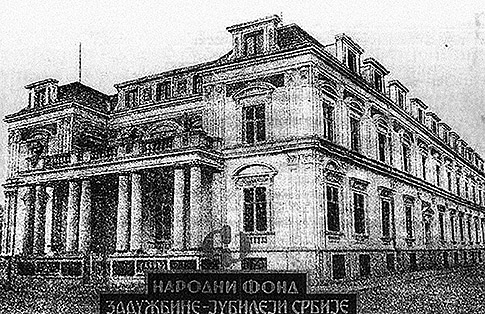
ONE OF THE MOST BEAUTIFUL IN THE CITY: The bombed-out building of the National Library of Serbia on Kosančićevo Venac
After the Second World War, the Day of the National Library of Serbia was April 6 to commemorate its complete destruction during the bombing of Belgrade in 1941. In the wish not to mark the date of the death but the date of creation of the Library, the manager of this institution at the time (in 2002) Sreten Ugričić proposed to change it. It turned out that the founding date was unknown, and a team was formed with the task of investigating it. The team included three female philologists employed at the Library. They had a short deadline to come up with an answer, they came across the story about Vozarović, they announced that the requested date was February 28, and the NBS management decided that in the future February 28 would be celebrated, in memory of the day when in 1832 in Belgrade he held his public the library was founded by the bookbinder and printer Grigorije Vozarović.
In addition to the essential mistake of ignoring historical sources that unequivocally indicated that the National Library of Serbia originated from the library of the Ministry of Education, there was also another, let's call it, ridiculous mistake. Namely, Vozarević's library was founded on the feast day of St. Onesimus, February 15 according to the then valid Julian calendar. In the 19th century, the difference in the date conversion from the Julian to the Gregorian calendar was 12, not 13 days as in the last century, which means that the NBS calculated incorrectly - the correct date would be February 27, not 28.
This miscalculation and wrong date was first pointed out by historian Dejan Ristić in the scientific paper "The National Library of Serbia was not founded in 1832 in Belgrade" which was published in 2016 in the "Glasnik" of the NBS (sic!), and then, in the same year, in a monograph The house of incombustible words, National Library of Serbia
1838-1941. (second amended edition published last March, publisher Byzantium), but it did not affect the change in the date of marking the day of this institution. Then Dejan Ristić sent the then director of the National Library of Serbia, Laslo Blašković, and the Board of Directors a proposal to change the date to July 12, 1838, he also attached all the archival documents that speak in support of this, but it turned out that all that material ended up in the director's drawer. Why was this change not implemented by Dejan Ristić himself while in 2012/13. was the administrator of the NBS? He replies that at that time he was dealing with the financial and infrastructural problems encountered in that institution, and that doing science was not his priority, but also that he would very possibly have managed to correct the wrong date if he had not been transferred to the position of State Secretary for culture.
Well, it's Vladimir Pištal's turn.