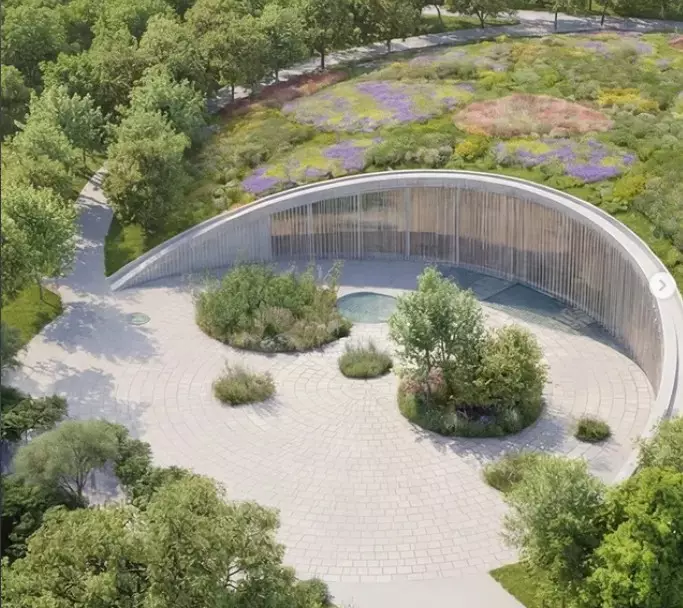
The Secretariat for Urbanism and Construction Affairs of the City of Belgrade issued a permit for the execution of preparatory works as part of the preparation for the construction of the future aquarium at Usce, and the document was published in the Central Record of Unified Procedures (CEOP).
Preparatory permit works refers to the activities that precede the start of the main construction works and include the preparation of the ground, the organization of the construction site, the protection and transplanting of existing seedlings, as well as other auxiliary works provided for by law and planning documentation.
An appeal can be filed against the decision on issuing a permit for preparatory works within eight days from the day of its publication.
"The idea of Belgrade getting a modern space dedicated to education"
The author of the project, academician Branislav Mitrović, points out for "Vreme" that all preparatory activities take place transparently, stressing that the goal of the project is to create a unique educational and cultural entity in the area of Ušće.
"The aquarium is not conceived as an isolated facility, but as part of a wider educational zone that will include the construction of the Natural History Museum in the next phase. The idea is for Belgrade to get a modern space dedicated to education, science, ecology and the popularization of natural sciences," Mitrović said.
He emphasized that both buildings together will occupy less than one percent of the total area of Park Ušće, while preserving the dominant part of green areas and public space.
"I believe that Belgrade can get facilities that are the standard of large European cities, while at the same time preserving the character and openness of the Ušće area," Mitrović said, adding that this approach builds on the urban concept of New Belgrade created in the post-war period.
"Urban planners led by Nikola Dobrović planned New Belgrade as a modern city in which large green areas, public spaces and facilities of general importance complement each other. According to this vision, the area of Ušće was conceived as a large green urban oasis enriched with cultural, educational and public facilities, which connects the natural values of the confluence of the Sava and Danube rivers with representative institutions of importance for the entire city," said Mitrović.
However, the public is still divided when it comes to the construction of a city aquarium in the Ušće area, especially due to doubts regarding the future content of the facility and the question of whether it is only an aquarium or the concept also includes a dolphinarium.
Director of the Public Aquarium and Tropicarium Branislav Jakovljević points out that Belgrade does not need a dolphinarium.
"I am against the idea of building a dolphinarium. On the other hand, I believe that Belgrade, as a scientific and educational center of the region, does need a modern city aquarium. However, important questions remain open regarding the content, function and overall concept of such a space," Jakovljević told "Vreme".
He points out that the public must know what kind of aquarium it will be, what contents will exist and how that space will contribute to the education of the youngest.
"No dolphinarium is out of the question"
Director of the Center for Local Self-Government, Nikola Jovanović, assessed that the problem is wider than the project itself and that citizens today have a seriously damaged trust in institutions.
"Unfortunately, this project was not accompanied by full transparency and citizen consultation from the very beginning. Citizens prefer the idea of an open park, in which the contents are superficial, without a lot of digging and concrete. No dolphinarium is out of the question. If the investor is ready to change the project, to go in the direction of scientific and educational contents, which will promote Belgrade and the Danube's cultural and ecological system, then we should talk about it," said Jovanović.
The Turkish company Ronesans Holding was hired as the main contractor for the project, while the American company ICM is responsible for the development and planning of the contents of the future aquarium.
In the area of Ušća, at the place where the construction of the aquarium is planned, a protective barrier was installed back in February in order to start investigative work. Some activists state that according to the available planning documents, the removal of 28 mature trees is foreseen for the construction of the aquarium, while the investor claims that the trees will not be cut down but transplanted, "with the planting of 105 new, tall trees that will be irrigated".
Real journalism costs money, and we will not be bought by tycoons and corporations. Support us with a one-time or monthly donation. The time for it is now!