At a time when digital screens offer almost every imaginable visual experience to users whose attention span is getting shorter and shorter, exhibition Bojana Stevanića's Sungazers (Sun Watchers) in Belgrade's "Parobrod" offered to meet with artistic creations which require presence, silence and time. Forty paintings and drawings in combined techniques, created in the last two years, already at first glance reveal an author who knows both brush and pixel equally well. Although he is an academic painter by training, the term "multimedia artist" describes Stevanić's work and creative routine much more precisely.
His expression is not limited to the traditional canvas, but he finds an authentic visual language and everyday creative rhythm at the triple border of digital formats, animation and design. It is the experience from the digital sphere that brings a specific dynamism and modern sensibility to his "classic" works, showing how traditional painting techniques and modern media can permeate and complement each other. To that extent, the Sungazers exhibition is, at the same time, a convincing "return to painting" of this artist.
In an interview for "Vreme", Bojan Stevanić reveals the motives and ideas behind the new cycle of paintings and drawings, describing them as a "search for light and meaning". The very name of the exhibition is ambiguous. The sun is not only mentioned here as a source of light, heat and life - but at the center of the setting is the metaphor of "sun watchers": individuals who, despite the challenges of modern life and internal conflicts, stubbornly search for balance and hope. The visual language is built on "opposites of light and dark, visible and hidden", with the need to examine "how modern man finds his way between the natural and technological world", explains the author.

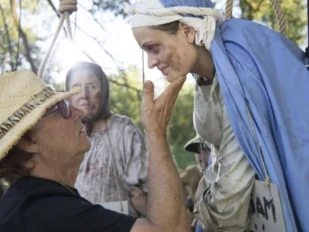
Firefly collectors, combined technique on paper
In this context, Stevanić looks back on the role of traditional art in screened everyday life, emphasizing that "the immediate materiality of the image becomes a value in the time of dominance of digital formats". According to him, painting requires time - both in the creation process and in observation. "That's why the very act of manual work, error, uncertainty and long-term process becomes a value in itself. On the other hand, digital media allow images to be seen all over the world, but at the same time increase the desire for a direct encounter with the original", concludes our interlocutor.
An interesting segment of the exhibition was the parallel between Stevanić's drawings and paintings: both drawings and paintings alike offer a space for contemplation and an authentic aesthetic experience. Although some drawings served as the initial idea and elaboration of the theme that was later transferred to the canvas, they did not function as mere sketches. Seemingly "paired", these works are actually separate, independent works of art.
Speaking about the creation process, Stevanić says that he was inclined to experiment: on some canvases, he consciously copied already completed parts, while on others he erased what had been painted. The attention of the signatory of these lines was particularly drawn to the segment of the exhibition imbued with dominant blue tones that form the visual backbone of works such as "Endless", "Dawn in Jaipur", "Scroll Collectors", among others... Speaking about challenges and opportunities for young authors, Stevanić states that the future brings more opportunities than ever before. However, it also brings new challenges, such as high competition and the pressure of visibility, due to which the artist feels that he has to constantly produce content. However, he sees advantages in the global accessibility of the audience and the combination of classic practices with new technologies.
"In that combination, some of the most interesting artistic expressions of the contemporary era are created", the author points out, concluding that the future will not be reduced to a choice between "old" and "new", but to "the ability of artists to find their own voice and meaningfully use all the tools available to them.
Real journalism costs money, and we will not be bought by tycoons and corporations. Support us with a one-time or monthly donation. The time for it is now!