Today, Bitef seems to be a self-sufficient refreshment for the local scene; we can only hope that achievements such as Brussels#4, Pupilia, Ex-position or Macbeth begin to influence her
BEST PERFORMANCES: Macbeth...
The two-week theater holiday popularly known as Bitef ended last week, after eleven shows in the main program, and with great ups and downs. The drama part of the festival opened with a Hungarian play I am tired.. The effective scenography (an anxious little room, which opens up into a narrow corridor, wedged under a sharp perspective) at the start suggests a standard, (secondary) school interpretation of Kafka - a grinding machine, claustrophobia, absurdity... We soon see that it really is so - a free adaptation the novel does not offer a new reading of the same, genre play brought a lot of imaginative solutions, which are reflected mostly in the details. The setting of the young director Victor Bod does not bring anything epochal, but it is very entertaining - there are also songs and choreography (performed nonchalantly but with a smile) and inevitable sparkles everywhere. A charade of freaks parades across the stage: mute Franz, a hungover judge, a smiling bully... all lost between circus and cartoon, but still able to scare, aggressive and violent. However, a bunch of individual stunts get out of control at one point, and a Martian-like figure appears out of nowhere, closing the show. The chaotic changes of space and the accumulation of absurd situations caused the main thread of the play to be lost, but in all the confusion, the acting ensemble does its best. Physically prepared and energetic, they are the main reason that, despite significant problems, the show is I am tired. a pleasant theatrical experience.
This was followed by the first hit of the 41st Bitef - Brussels
...Ex-position
4 Romeo Castellucci. The play is easiest to describe as a series of effects tableau, which can be folded into some loose narrative flow. Sound and light form the atmosphere, and more than that - they suggestively announce a certain event, raise tension, open up space for anxiety and manipulate the reception of the images given to us, clean, cold, reduced, visually brought to perfection. Every movement is strictly determined, and the performers themselves are in this case flesh and blood puppets. Brussels
4 is undoubtedly a solid form, stable and calculated - the stage signs are minimal, but extremely strong, signifiers without the clearly marked and invite us to numerous downloads. The viewer himself produces many more meanings than the play really has, but the problem is that they are mostly reduced to general places that compensate for a strong visual impression: the universality of human destiny, life from the cradle to the grave and its mysteries, the repression of state apparatuses... The play also gives political comments of the same general type: a black woman appears in front of us washing the floor on which police violence will be carried out, the victim of violence is stuffed in a bag and a microphone is placed in front of her. However, the real little gem is the poetic, almost cinematic ending that completely contrasts with the coldness broadcast up to that point. The old man lies down in bed and lightly and literally disappears in it, a transparent black curtain is lowered and a check-out cue without clear words is projected over it – an effective and touching silent departure from the stage.
MEMORIESIMISSIONS: Another performance of an associative character, which initially deals with the phenomenon of memory, but with a form that allows for the most diverse interpretations, is Handlewithgreatwhich Dalije Aćin (who was already written about in "Vremen" no. 849). In this minimal and reduced setting, where the play of light maintains and gives some of its own rhythm against the slow motion, each of these movements is precise, so that even the movement of the little finger seems incredibly important. Watching Handlewithgreatwhich is first of all an intimate, at times hypnotic experience, and the play itself is one of the more well-rounded works presented at this year's Bitef.
...Brussels#4
Janez Janša (until a few months ago Emil Hrvatin) also dealt with memory, although in a completely different way, in the production of Maske from Ljubljana. Original PupiliaPopeWardPaPupils, performed in 1969, is considered a key and influential event of the local theatrical avant-garde, and the new Pupilia in the first place is the reconstruction of that performance. During the reconstruction, Janša relied on various documents from different media (video, photo material, quotes from Slavoj Žižek to Ljubiša Ristić...), and it is very noticeable from the documentary material that was presented to us through the video beam that the verbatim repetition was not carried out. In fact, the setup seems to be based more on text documents than the original video footage. This one Pupilia is therefore a new work, which could be characterized as a historical-theoretical work on an original performance. The reconstruction serves to establish the historical continuity of the theatrical avant-garde, a form of institutionalization of the theatrical non-mainstream in the area of the former Yugoslavia (which includes conceptual dance, performance art, and various other types of performing arts that the magazine "Maska" and Janša as editor have been promoting for many years deal with). Perhaps the aesthetics of the 1960s are no longer attractive today, but such a thoughtful process of combining theory and practice certainly deserves attention.
In the second week of Bitef, three failures followed one after the other. To Palermo Eme Dante talks about petty bourgeoisie, poverty, freedom from social restraints... There are recognizable moments of family life in a small environment: violence after which one prays for forgiveness, patriarchy, a grandmother whose stories everyone knows by heart, but these motifs are treated superficially, shallowly and illustratively . For example "liberation" means that the actors will be splashed with water and stripped naked. In addition, we have not only a pathetic choice of music, but also cheap sentimentality - the sudden death of the grandmother and the mute wail of the gaping-mouthed family. To Palermo it also leaves the impression of amateur negligence, so it remains unclear why this play was selected by Bitef.
The next day, Ville Walo and Kale Hakkarainen, whose show is for us Discussions presented as circusnew, they showed off some juggling skills and visual tricks with a few projectors – and that's it. Petty bravado is not enough when the play is not about anything, let alone some general place about unrequited love. Discussions are a boring, irrelevant and nicely packaged setup, thankfully in just an hour.
It was a much-anticipated performance Betweenpsaiwolf. Andrej Moguchi used the prose of Sasha Sokolov to create a stage play in which a romanticized half-world moves - there are unbelted men and a vulnerable ballerina. the rifle reads the text in Serbian. Moguchi repeats all the stereotypes about Russia and the "Russian soul", with exaggerated and not at all spontaneous poetics and empty metaphors. For almost two hours, pathetic stage pictures parade in front of us, with a great tendency towards spectacularity, which, however, turns into ordinary kitsch (for example, a woman in an elegant dress drags a transparent PVC film behind her to wrap the TV in order not to get the desired light effect in front of the spotlights). , and there are also some extremely tasteless solutions. Let's mention just one thing: while all the scenes of hangings, fights, etc. depicted without much stylization, the rape of a girl is choreographed and poeticized to infinity. When we add to that the combination of conventional direction, playing on the audience, selling sentimentality and failed irony, the extremely negative impression is complete.
And just when these three performances started to throw you into depression, and to strengthen the belief that this is the weakest Bitef in the last few years, Boris Bakal and the troupe Shadow Throwers took the matter out, and of course, Düsseldorf Macbeth.
MEMORIES, PHOTOSIZLO: As soon as you as a visitor step into the lobby of the former department store "Kluz", where Boris Bakal as the master of ceremonies sits in front of a black curtain and welcomes guests, you become an active participant in the performance Exposition. From the moment you enter the play, you don't know whether you will spend an hour, two or more; you are additionally worried about the serial number that is chosen at the beginning and determines what awaits you behind the curtain. The whole situation of the "waiting room" is played out - and it is performed by Bakal as much as by all the few present in the room at that moment. Bakal demonstrates to us the skill of telling a story, skilfully adding and subtracting details, and each of his colorful stories could be embodied in one of the performances that follow.
Once you finally pass through the black curtain, a journey of sorts begins from the room designated by the number you chose. The "host" blindfolds you and leads you through the space, touches, whispers in your ear, sings... The abolition of the visual aspect displaces the usual perception of the performance and emphasizes touch, sound and smell, freeing up space for intimacy and inner imagination. The stories range from a childhood journey, through a humorous version of the Immaculate Conception, to a disturbing and cruel one about a prisoner of war; they are fun, sometimes scary, emotional and at times moving to tears. Beneath that basic and extremely impressive experience lies another layer - an examination of the perception of space and the city. First you are guided through the basements and corridors of a forgotten department store, then you go out into the street and come back again to the dusty Cluj. A parallel is drawn between the forgotten space/forgotten (tactile) feeling, and the abolition of the visual establishes a new relationship of the body in the space/city. The key word is sensuality: the sounds of trams or heels, whispers or street roars, grass in the park or the seat of a car become part of the bodily, organic experience.
It is also interesting that one of the stories always changes depending on the area in which it is played. In fact, the pivot of the story - the main character's life story - remains the same, while the contexts change, which above all politicizes the gaming space. In this case, the "Cluse" building, with its political and ideological implications, plays a significant role in the local perception of the play, especially when we have at work an orgiastic revisionism of history from the Second World War onwards. This reminder of Franjo Clouse and the old Yugoslavia is not mere nostalgia, as one might think, but above all calls for a re-examination of what we live today.
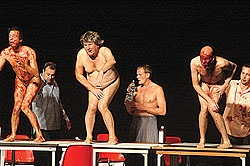
Macbeth was pompously welcomed as "the best German play of the last season", and it is performed by seven men who pour fake blood on themselves, chop up the liver, stab with plastic knives... Jürgen Gosch's setting satirizes everything that is within reach - blood, masculinity, the body, violence, brutality - , parodies, and gives it back to us, stripped and demystified, and thus twisted even more terrifyingly. The scene is dominated by an abundance of fake bodily fluids and secretions; naked, imperfect male bodies run across the stage - flesh and blood, physicality, and through it, violence itself, are trivialized and trivialized. The final, almost pornographic scene of the fight between Macbeth and Macduff confirms this: the two bodies wrestle, stab frantically and are covered in fake blood while the actor who until recently was Lady Macbeth plays a light song in the style of Old English ballads. What we get is plain and simple slika blood and slaughter, and that is precisely what disturbs. Even the space, despite the chaos, scattered tables, spilled bottles, torn sacks of flour, is completely designed in red, white and black - a pure artistic composition. Macbeth it takes a long time and requires too much concentration, the madness of Lady Macbeth is almost skipped (the actor who plays her just takes off his clothes and plays the text), but there are also ingenious solutions - the three witches or the approach of Birnam Forest. Such and some other simple and clean solutions, behind which there is nothing but the image itself, expose not only the banality of violence today but also - in accordance with Hannah Arendt's old thesis - the banality of evil itself.
After watching all the performances, it is clear that the democratic slogan of the 41st Bitef "It's a theater too" serves more as a disguise for the lack of a clear concept and a justification for the varied program. This would not be such a problem if Bitef was a revue of truly top-notch achievements, which bring significant shifts in theater practice or artistically strong hit plays. The festival had at least three major failures, which leaves a bitter taste. Also, the selected plays also problematize the subtitle of Bitef - "new theater tendencies" is an expression that could not possibly be applied to the majority of this year's program. Today, Bitef seems to be a self-sufficient refreshment for the local scene; we can only hope that they will suddenly and miraculously achieve such things Brussels
4, Pupilia, Exposition or Macbeth begin to exert a strong influence on her.
What is happening in the country and the world, what is in the newspapers and how to pass the time?
Every Wednesday at noon In between arrives by email. It's a pretty solid newsletter, so sign up!
The 61st October Salon, which begins in Belgrade on November 7, will feature the works of 27 artists. From the program announced in the announcement, it is possible to guess what it is about
Being the first to choose the dates, the Belgrade Jazz Festival (BJF) inadvertently "planted" its 42nd edition before the parliamentary elections themselves. In the shadow of the coming social changes, he remained without the usual publicity and accompanying programs because his main patrons are the institution headed by A. Šapić and N. Selaković. After all, maybe even better - would you like to see them before the concert for which you bought a ticket? The city assembly has been an auxiliary building of Ćaciland for too long anyway. On the other hand, there are never stronger reasons for "it's good that it was held at all", at least it was not postponed and there is no non-jazz alternative. Plus, Šapić didn't have time to build a roundabout for them
There is no official confirmation that Miroslav Lekić has resigned from the position of President of the Board of Directors of the Film Center of Serbia, as he announced, but other leaders whose resignations are being requested are not even announcing this.
The City Secretariat for Culture refused to co-finance the 30th Festival of Choreographic Miniatures, and the Ministry of Culture gave them money to pay for the hall. That's why they celebrate the jubilee for only two days and without foreign competitors
The four independent members of REM are an example of perseverance and civic responsibility. Rodoljub Šabić even, upon leaving the premises of REM, after the sentencing of the Informer, experienced that the Essenes insulted him, hit him with their hands and feet. But that too will soon be over
Vučić pardoned the batterers and Dijana Hrkalović. The election winners should abolish the sultan's power that allows one man to run afoul of the entire judicial system
Davor Matura's ALTA empire is the transplanted heart of the corrupt regime of Aleksandar Vučić, who was defeated in the October 25 elections. From ALTA Bank, roads lead directly to the top of the progressive government.
The archive of the weekly Vreme includes all our digital editions, since the very beginning of our work. All issues can be downloaded in PDF format, by purchasing the digital edition, or you can read all available texts from the selected issue.